How to Model Binary Variables with Logit & Probit
TL;DR
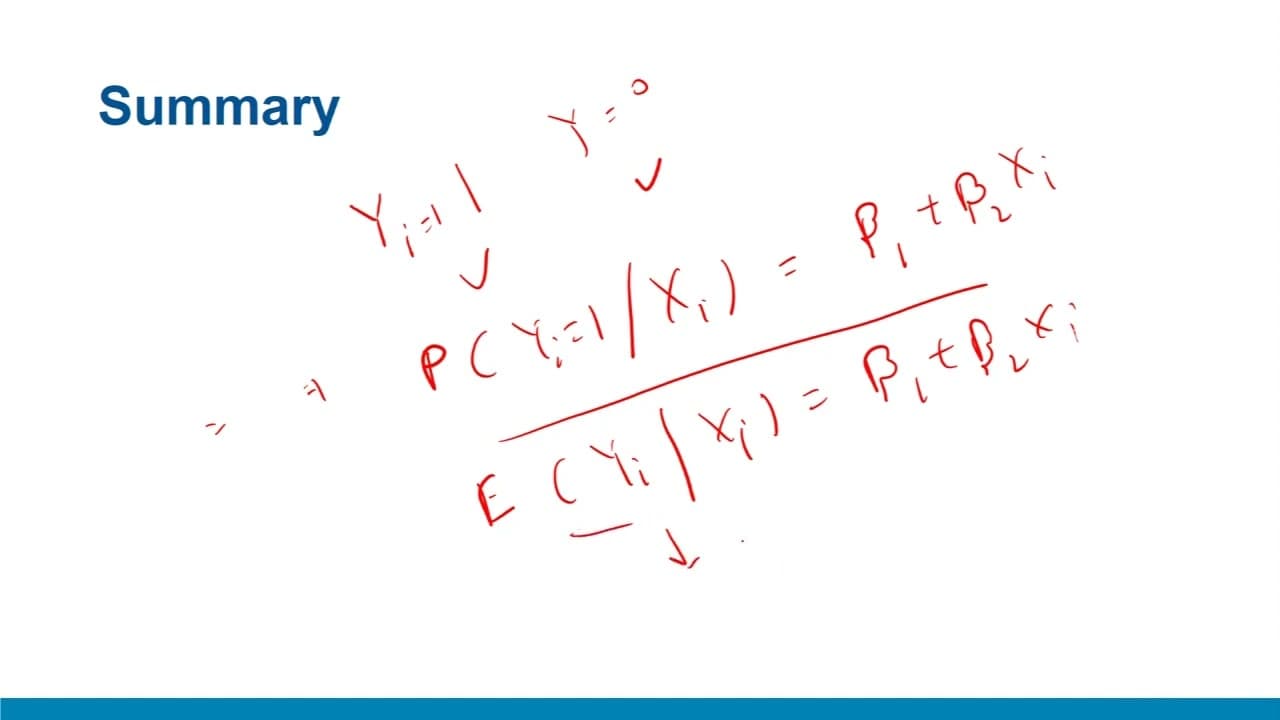
Modeling binary dependent variables requires specialized techniques like logit and probit models instead of traditional linear regression, which is ineffective. These models maintain probabilities between 0 and 1, providing a bounded output, and their performance is evaluated through tools like confusion matrices and ROC curves. Additionally, maximum likelihood estimation is employed to handle the non-linear nature of these models.
Transcript
thank you linear regression modeling is less effective in the case where dependent variable is binary and of the form like yes no or zero one kind of variable such dependent variables are called limited dependent variables or binary Choice variables a simple OLS ordinarily Square regression model approach is referred to as linear probability modeli... Read More
Key Insights
- Linear regression models are inadequate for binary dependent variables, which are better modeled using logit and probit models.
- Logit and probit models use cumulative probability distribution functions to ensure predicted probabilities remain between 0 and 1.
- The classification confusion matrix and ROC curve are essential tools for evaluating the performance of classification models.
- Logit models transform the probability function to a logistic distribution, providing a bounded probability output.
- Marginal effects in logit models help interpret the impact of changes in independent variables on the probability of the dependent variable.
- Thresholding is used to convert predicted probabilities into binary outcomes, balancing false positives and negatives.
- Maximum likelihood estimation is used to estimate parameters in logit and probit models due to their non-linear nature.
- Goodness-of-fit measures for logit and probit models differ from linear models, focusing on classification accuracy.
Install to Summarize YouTube Videos and Get Transcripts
Explore YouTube Video Summarizer or Get YouTube Transcript Extractor
Questions & Answers
Q: Why are linear regression models inadequate for binary dependent variables?
Linear regression models are inadequate for binary dependent variables because they can produce predicted probabilities outside the 0-1 range and assume a linear relationship that isn't appropriate for binary outcomes. These models also suffer from issues like non-normality and heteroscedasticity of error terms when applied to binary data.
Q: What are logit and probit models used for?
Logit and probit models are used to model binary dependent variables, ensuring that predicted probabilities remain within the 0-1 range. They use cumulative probability distribution functions, logistic for logit and normal for probit, to provide a more accurate representation of binary outcomes compared to linear models.
Q: How do logit models differ from linear probability models?
Logit models differ from linear probability models in that they use a logistic function to transform the probability output, ensuring that it stays within the 0-1 range and providing a more realistic S-shaped curve. Linear probability models can produce probabilities outside this range and assume a linear relationship, which isn't suitable for binary outcomes.
Q: What is the purpose of the classification confusion matrix?
The classification confusion matrix is used to evaluate the performance of a classification model by comparing the predicted classifications to the actual outcomes. It helps in identifying the number of true positives, true negatives, false positives, and false negatives, which are essential for calculating metrics like sensitivity, specificity, and overall accuracy.
Q: How is the ROC curve used in evaluating model performance?
The ROC curve is used to evaluate the performance of a classification model by plotting the true positive rate (sensitivity) against the false positive rate (1-specificity) at various threshold settings. The area under the ROC curve (AUC) provides a single metric to assess the model's ability to distinguish between classes, with higher AUC values indicating better performance.
Q: What is the role of maximum likelihood estimation in logit models?
Maximum likelihood estimation (MLE) is used in logit models to estimate the model parameters because these models are non-linear in nature, making ordinary least squares (OLS) unsuitable. MLE finds the parameter values that maximize the likelihood of observing the given sample data, providing the best fit for the model.
Q: Why are traditional R-squared measures not suitable for logit models?
Traditional R-squared measures are not suitable for logit models because these models focus on classification accuracy rather than minimizing residual sum of squares. R-squared doesn't appropriately capture the goodness-of-fit for models that predict probabilities and classify outcomes, leading to the use of alternative measures like the percentage of correctly predicted values and pseudo R-squared.
Q: How are marginal effects interpreted in logit models?
Marginal effects in logit models are interpreted as the change in the probability of the dependent variable occurring due to a one-unit change in an independent variable, holding other variables constant. They provide insight into the impact of each independent variable on the probability of the outcome, calculated at the mean values of the independent variables.
Summary & Key Takeaways
-
Linear regression models are not suitable for binary dependent variables, leading to the use of logit and probit models. These models use probability distribution functions to ensure probabilities remain between 0 and 1.
-
Logit models transform the probability function into a logistic distribution, providing a bounded probability output. Marginal effects are used to interpret the impact of independent variables on the probability of the dependent variable.
-
Classification performance is evaluated using tools like the confusion matrix and ROC curve. Maximum likelihood estimation is employed for parameter estimation in logit and probit models due to their non-linear nature.
Read in Other Languages (beta)
Share This Summary 📚
Summarize YouTube Videos and Get Video Transcripts with 1-Click
Try YouTube Summary with ChatGPT & Claude or YouTube Transcript Generator
Explore More Summaries from IIT KANPUR-NPTEL 📚


Summarize YouTube Videos and Get Video Transcripts with 1-Click
Try YouTube Summary with ChatGPT & Claude or YouTube Transcript Generator