Lecture 32
TL;DR
Explores active and passive portfolio management strategies and their evaluation.
Transcript
thank you in this lesson we'll discuss the fundamental strategies of portfolio management and portfolio performance evaluation we start the discussion with passive portfolio management strategies and performance evaluation with index portfolios and tracking error then we'll discuss active portfolio management strategies we'l... Read More
Key Insights
- Passive portfolio management involves minimal effort and aims to replicate benchmark indices like the S&P 500, leading to lower management fees.
- Active portfolio management seeks to outperform benchmarks through intensive research, incurring higher management costs.
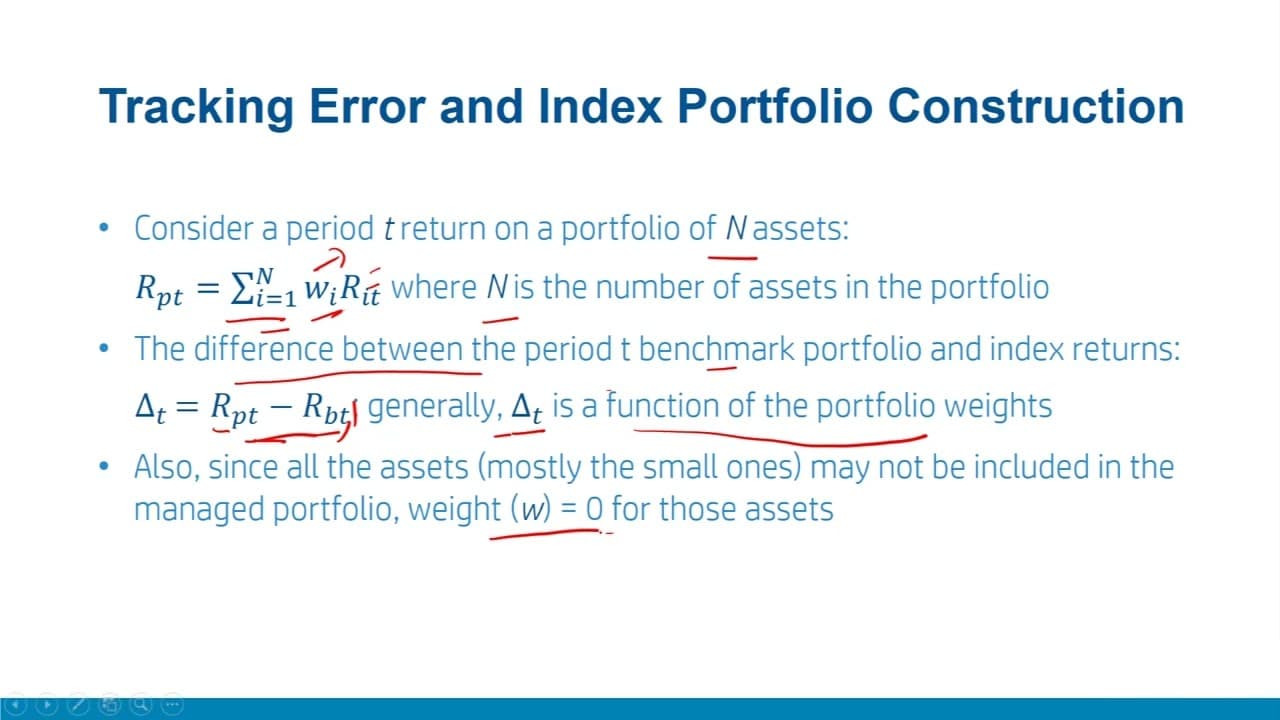
- Tracking error measures the deviation between a passive fund's performance and its benchmark, with the goal of minimizing this error.
- Active strategies include fundamental analysis, technical analysis, and exploiting market anomalies to achieve higher returns.
- Passive strategies include full replication, sampling, and quadratic programming, each with its own balance of tracking efficiency and transaction costs.
- Value investing focuses on stocks perceived as undervalued based on current prices, while growth investing targets stocks with high future earnings potential.
- Investment style analysis can help identify the actual strategies employed by fund managers, beyond their stated approaches.
- Sector rotation strategies involve adjusting portfolio weights based on market-favored attributes, like small-cap stocks, to maximize returns.
Install to Summarize YouTube Videos and Get Transcripts
Explore YouTube Video Summarizer or Get YouTube Transcript Extractor
Questions & Answers
Q: What is the primary goal of passive portfolio management?
The primary goal of passive portfolio management is to replicate the performance of a benchmark index, such as the S&P 500, with minimal deviation. This approach involves a buy-and-hold strategy with occasional rebalancing to reflect changes in the index. Passive management aims to minimize tracking error, which is the difference between the fund's performance and the benchmark's performance, rather than trying to outperform the benchmark.
Q: How do active portfolio managers aim to generate higher returns?
Active portfolio managers aim to generate higher returns by conducting extensive research and analysis to identify undervalued securities or sectors expected to outperform the market. They employ various strategies, including fundamental analysis of company financials, technical analysis of price trends, and exploiting market anomalies. This approach involves higher risk and management costs, as active managers seek to achieve returns that exceed the benchmark, known as alpha.
Q: What are the three main passive portfolio management strategies?
The three main passive portfolio management strategies are full replication, sampling, and quadratic programming. Full replication involves purchasing all securities in the benchmark index in their exact proportions, ensuring high tracking efficiency but incurring high transaction costs. Sampling uses a representative subset of securities to reduce costs, though it may increase tracking error. Quadratic programming employs historical data to construct a portfolio with minimal return deviations from the benchmark, relying heavily on past information.
Q: What is the difference between value and growth investing?
Value investing focuses on stocks that are perceived as undervalued based on current prices and earnings, expecting a market correction to increase their value. These stocks typically have low price-to-earnings and price-to-book ratios. In contrast, growth investing targets stocks with high future earnings potential, often trading at a premium due to anticipated growth. Growth investors prioritize earnings growth over current valuations, while value investors seek stocks that appear cheap relative to their peers.
Q: How can style analysis help in understanding fund manager strategies?
Style analysis helps in understanding fund manager strategies by examining the correlation between a fund's performance and various style indices, such as market capitalization or value versus growth. This analysis can reveal the actual investment style a manager follows, which may differ from their stated approach. Techniques like style grid analysis and regression modeling can identify whether a manager is adhering to the claimed investment mandate or drifting towards different styles over time.
Q: What are the trade-offs between active and passive portfolio management?
The trade-offs between active and passive portfolio management involve cost, effort, and potential returns. Passive management is low-cost and aims to mimic benchmark performance, offering predictable returns with minimal effort. Active management seeks higher returns by outperforming benchmarks, requiring significant research and higher management fees. However, the higher costs and risks involved in active management can sometimes result in net returns that are inferior to passive strategies, especially if the market is efficient.
Q: What role does tracking error play in evaluating passive funds?
Tracking error is a critical metric in evaluating passive funds, measuring the deviation between a fund's returns and its benchmark index. A low tracking error indicates that the fund closely follows the benchmark, achieving its primary objective. Investors use tracking error to assess a passive fund's efficiency in replicating the benchmark's performance. Minimizing tracking error is essential for passive fund managers, as it reflects their ability to deliver returns consistent with the index.
Q: How do sector rotation strategies work in active management?
Sector rotation strategies in active management involve adjusting portfolio weights based on market-favored attributes or sectors. Fund managers increase exposure to sectors or stocks that are expected to perform well due to favorable market conditions or attributes, such as small-cap stocks during a period of economic growth. Conversely, they reduce exposure to less favored sectors or attributes. This strategy aims to capitalize on market trends and anomalies, enhancing returns by aligning the portfolio with current market preferences.
Summary & Key Takeaways
-
The video introduces active and passive portfolio management strategies, highlighting their differences in terms of management effort, costs, and objectives. Passive strategies aim to replicate benchmark indices with minimal deviation, while active strategies seek to outperform these benchmarks through detailed analysis and higher risk exposure.
-
Various passive strategies, including full replication, sampling, and quadratic programming, are discussed, each with different levels of transaction costs and tracking efficiency. Active strategies are classified into fundamental, technical, and market anomaly-based approaches, focusing on undervalued stocks or market trends.
-
The video also delves into investment styles, such as value versus growth investing, and the use of style analysis to assess fund manager strategies. It concludes with a discussion on the trade-offs between these strategies, emphasizing the importance of understanding management fees and potential returns.
Read in Other Languages (beta)
Share This Summary 📚
Summarize YouTube Videos and Get Video Transcripts with 1-Click
Try YouTube Summary with ChatGPT & Claude or YouTube Transcript Generator
Explore More Summaries from IIT KANPUR-NPTEL 📚



Summarize YouTube Videos and Get Video Transcripts with 1-Click
Try YouTube Summary with ChatGPT & Claude or YouTube Transcript Generator