How to Manage Portfolio Risk and Returns
TL;DR
Portfolio management involves understanding the computation of expected returns and risks associated with a portfolio. By diversifying investments across multiple securities, investors can mitigate specific risks and focus on systematic risks, which are inherent and non-diversifiable. Diversification is achieved by selecting securities with low correlations, reducing the overall risk of the portfolio.
Transcript
thank you in this lesson we'll introduce the concept of portfolio management we'll discuss the competition of expected returns and risk of a portfolio we'll discuss the concept of portfolio construction with two security keys and multi-security case lastly we'll examine the concept of risk diversification with portfo... Read More
Key Insights
- Portfolio management is about balancing expected returns and risks across multiple securities.
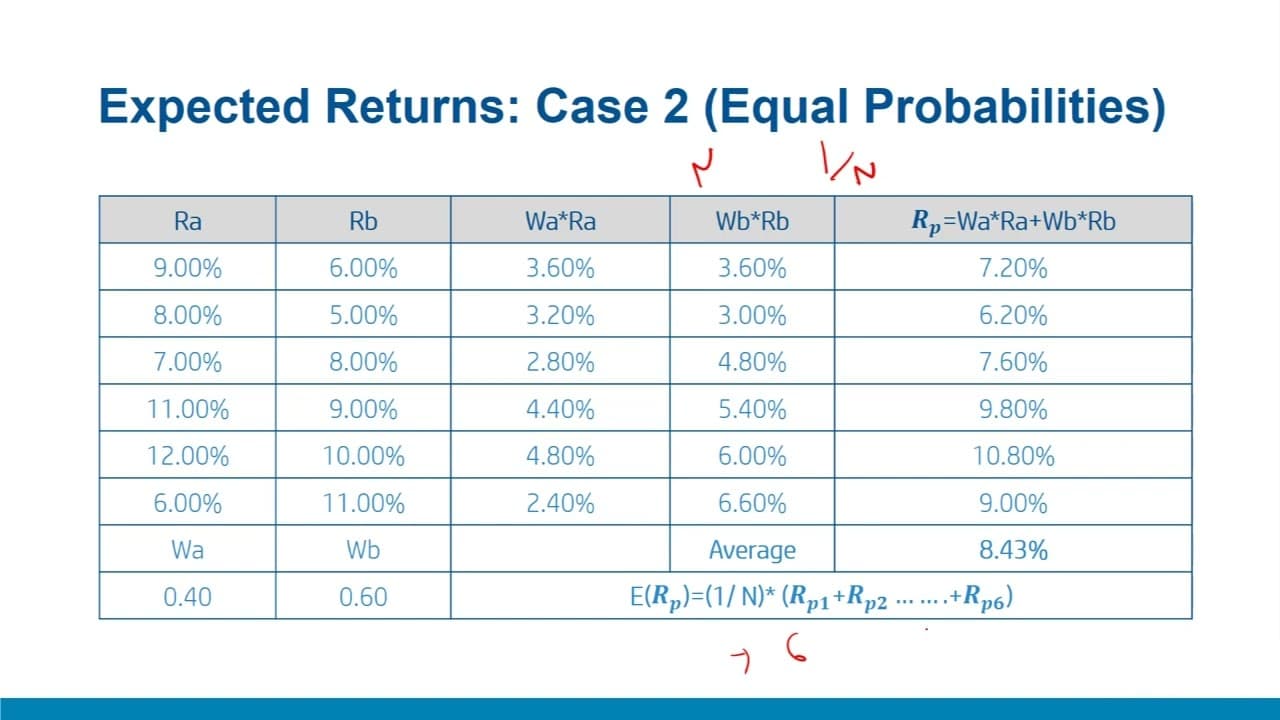
- Expected returns for a portfolio are the weighted average of the returns of individual securities.
- Risk diversification reduces idiosyncratic risk but not systematic risk in a portfolio.
- Systematic risk, also known as market risk, cannot be diversified away.
- The key to diversification is selecting securities with low correlations.
- In a two-security portfolio, risk is calculated using a formula involving weights, variances, and correlation.
- Adding more securities to a portfolio reduces specific risk but not the overall market risk.
- Market risk is the component of risk that remains even when a portfolio is fully diversified.
Install to Summarize YouTube Videos and Get Transcripts
Explore YouTube Video Summarizer or Get YouTube Transcript Extractor
Questions & Answers
Q: How to compute expected returns for a portfolio?
Expected returns for a portfolio are computed as the weighted average of the expected returns of individual securities within the portfolio. The weights correspond to the proportion of total investment allocated to each security. This calculation assumes knowledge of each security's expected return and the proportionate investment in each.
Q: What is risk diversification in portfolio management?
Risk diversification in portfolio management is the process of spreading investments across various securities to reduce idiosyncratic or specific risks. By selecting securities with low correlations, investors can decrease the overall risk of the portfolio, focusing on managing systematic risks that cannot be diversified away.
Q: Why is systematic risk important in portfolio management?
Systematic risk, also known as market risk, is important because it represents the inherent risk that cannot be diversified away. It is a key focus for portfolio managers as it affects all securities to some extent. Understanding and managing systematic risk is crucial for constructing portfolios that offer optimal risk-adjusted returns.
Q: How does correlation affect portfolio diversification?
Correlation affects portfolio diversification by determining how securities move in relation to each other. Lower correlations between securities lead to better diversification, reducing the overall portfolio risk. Securities with high correlations do not provide diversification benefits, as they tend to move in the same direction.
Q: What is the difference between specific risk and systematic risk?
Specific risk, also known as idiosyncratic risk, is unique to a particular security and can be reduced through diversification. Systematic risk, or market risk, affects all securities and cannot be diversified away. Portfolio managers focus on managing systematic risk to optimize portfolio performance.
Q: How is portfolio risk calculated in a two-security case?
In a two-security portfolio, risk is calculated using a formula that involves the weights of the securities, their individual variances, and the correlation between them. This formula helps determine the overall portfolio risk, taking into account how the securities' returns move in relation to each other.
Q: What happens to portfolio risk as more securities are added?
As more securities are added to a portfolio, the specific risk decreases due to diversification. However, the systematic risk remains constant. The overall portfolio risk tends towards the average covariance of the securities, which represents the non-diversifiable market risk that cannot be eliminated.
Q: Why do markets reward systematic risk but not specific risk?
Markets reward systematic risk because it is inherent and cannot be diversified away, affecting all securities. Investors are compensated for bearing this unavoidable risk. In contrast, specific risk can be mitigated through diversification, so markets do not provide additional returns for bearing it, as it can be easily managed.
Summary & Key Takeaways
-
Portfolio management focuses on managing the balance between expected returns and associated risks. The expected return of a portfolio is a weighted average of individual securities' returns, while risk involves both specific and systematic components. Diversification reduces specific risks by spreading investments across uncorrelated securities.
-
Risk diversification is crucial in portfolio management, achieved by selecting securities with low correlations. While specific risks can be mitigated through diversification, systematic risks remain constant. Understanding these concepts helps investors construct portfolios that maximize returns while minimizing risks.
-
Systematic risk, or market risk, is inherent and cannot be diversified away. Portfolio managers focus on this risk component when constructing portfolios. Diversification is achieved by adding more securities with low correlations, reducing specific risk but not affecting the systematic risk inherent in the market.
Read in Other Languages (beta)
Share This Summary 📚
Summarize YouTube Videos and Get Video Transcripts with 1-Click
Try YouTube Summary with ChatGPT & Claude or YouTube Transcript Generator
Explore More Summaries from IIT KANPUR-NPTEL 📚



Summarize YouTube Videos and Get Video Transcripts with 1-Click
Try YouTube Summary with ChatGPT & Claude or YouTube Transcript Generator