How to Analyze Employee Satisfaction Data
TL;DR
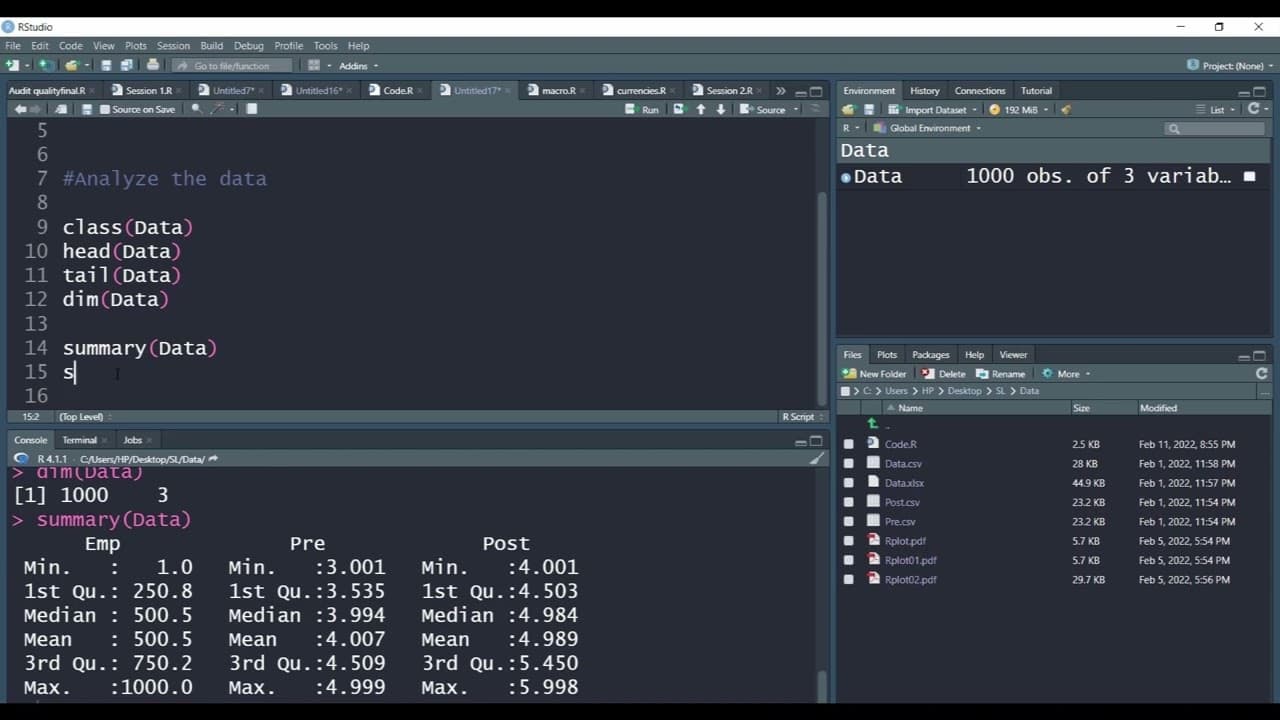
To assess the impact of a training program on employee satisfaction, analyze pre- and post-training survey data using R. Key steps include summarizing data, visualizing with plots, and examining measures of central tendency and variability. Statistical tests for normality help determine significant changes in satisfaction levels.
Transcript
thank you let's start with this case study problem on auto parts manufacturing company zero Limited in this case study we'll apply the concepts learned on the topics related to inferential statistics and hypothesis testing an auto parts manufacturing company is your limited conducts regular training and development programs for its ... Read More
Key Insights
- Inferential statistics and hypothesis testing are crucial for analyzing employee satisfaction data.
- Employee satisfaction data is collected on a scale of 1 to 8, adjusted for bias through scaling.
- Data visualization using R helps identify trends, outliers, and distribution patterns.
- Measures of central tendency, such as mean and median, provide insights into data distribution shifts.
- Variability measures like range, variance, and standard deviation assess data spread.
- Shape measures, including skewness and kurtosis, evaluate data symmetry and peakness.
- Normality tests, such as the Agustino test, determine if data deviates from a normal distribution.
- Central limit theorem justifies using normal distribution for hypothesis testing with large samples.
Install to Summarize YouTube Videos and Get Transcripts
Explore YouTube Video Summarizer or Get YouTube Transcript Extractor
Questions & Answers
Q: How to assess the impact of a training program on employee satisfaction?
Assess the impact by analyzing pre- and post-training survey data using inferential statistics and hypothesis testing. Key steps involve summarizing data, visualizing with plots, and examining measures of central tendency and variability. Statistical tests for normality help determine significant changes in satisfaction levels.
Q: What is the importance of data visualization in this analysis?
Data visualization is crucial as it helps identify trends, outliers, and distribution patterns in the survey data. Using R, plots can reveal shifts in satisfaction levels and provide a visual understanding of the data's central tendency, variability, and overall distribution.
Q: What are measures of central tendency and why are they important?
Measures of central tendency, such as mean, median, and mode, provide insights into the data's typical value or center point. They are important because they help assess shifts in distribution, indicating changes in employee satisfaction levels pre- and post-training.
Q: How do measures of variability contribute to data analysis?
Measures of variability, including range, variance, and standard deviation, describe the spread or dispersion of data. They are essential for understanding the extent of data variation, which helps determine the consistency and reliability of satisfaction levels across the employee population.
Q: Why are skewness and kurtosis important in data analysis?
Skewness and kurtosis are shape measures that evaluate data symmetry and peakness, respectively. They help identify deviations from normal distribution, which is crucial for understanding the data's distribution characteristics and for performing accurate statistical tests.
Q: What is the role of normality tests in this analysis?
Normality tests, such as the Agustino test, assess whether data deviates from a normal distribution. They provide statistical confidence in determining the data's normality, which is important for selecting appropriate statistical methods for further analysis, such as hypothesis testing.
Q: How does the central limit theorem apply to this analysis?
The central limit theorem states that the distribution of sample means approaches a normal distribution as sample size increases. In this analysis, it justifies using normal distribution for hypothesis testing, even when the data exhibits non-normal characteristics, as long as the sample size is sufficiently large.
Q: What are the key steps in analyzing employee satisfaction data using R?
Key steps include reading and summarizing data, visualizing with plots, examining measures of central tendency and variability, and conducting normality tests. These steps help assess the impact of training on employee satisfaction and determine statistical significance in satisfaction level changes.
Summary & Key Takeaways
-
Employee satisfaction is gauged using pre- and post-training survey data, analyzed for statistical significance. Key steps include data summarization, visualization, and examining central tendency and variability. Statistical tests, such as skewness and kurtosis, assess data normality.
-
Data visualization with R plots reveals shifts in satisfaction levels, while central tendency measures like mean and median indicate distribution changes. Variability measures such as range and standard deviation provide insights into data spread.
-
Statistical tests, including normality assessments, help determine significant changes in satisfaction levels. The central limit theorem supports using normal distribution for hypothesis testing, even when data shows non-normal characteristics.
Read in Other Languages (beta)
Share This Summary 📚
Summarize YouTube Videos and Get Video Transcripts with 1-Click
Try YouTube Summary with ChatGPT & Claude or YouTube Transcript Generator
Explore More Summaries from IIT KANPUR-NPTEL 📚



Summarize YouTube Videos and Get Video Transcripts with 1-Click
Try YouTube Summary with ChatGPT & Claude or YouTube Transcript Generator