Lecture 35
TL;DR
This lesson covers implementing the Markowitz mean-variance framework using R programming.
Transcript
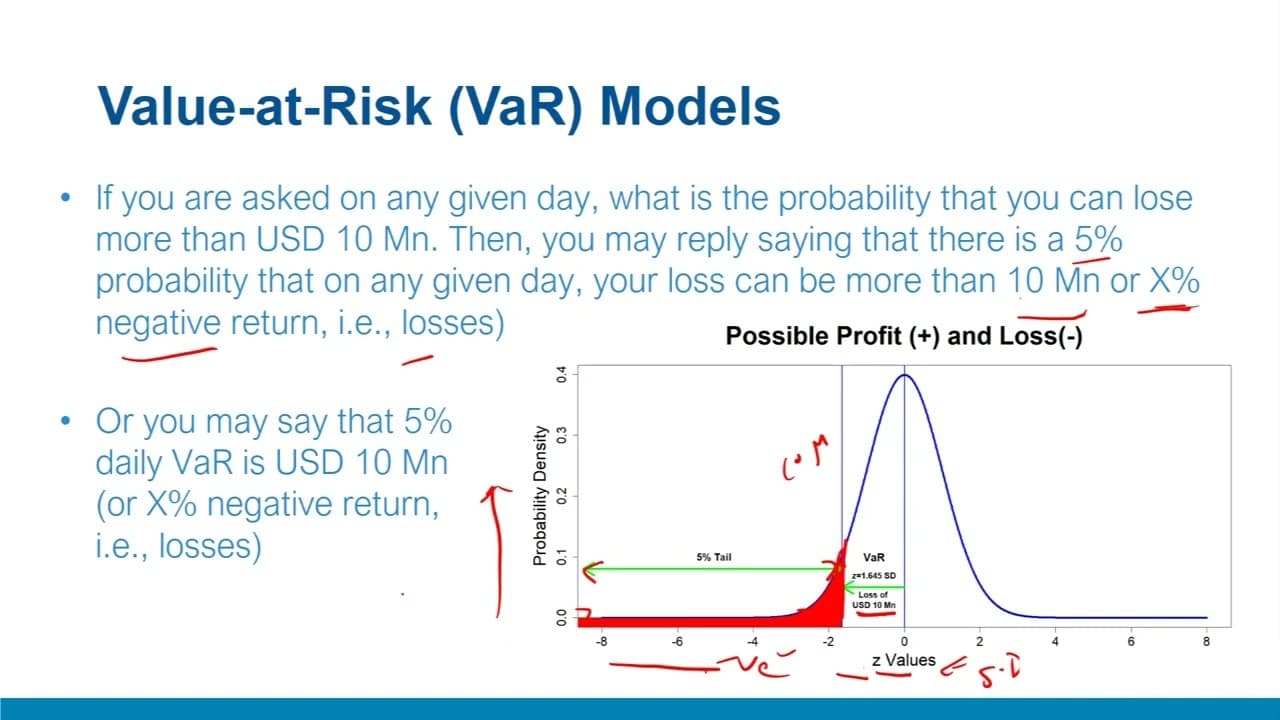
thank you in this lesson we'll implement the Hari markovitz mean variance framework with our programming first we'll recap the mean variance framework subsequently we'll discuss the tail risk measures namely value address that is our conditional value at risk c bar and expected shortfall ES next we'll download Securi... Read More
Key Insights
- The Markowitz mean-variance framework is a fundamental concept in portfolio optimization, focusing on balancing risk and return.
- Tail risk measures like Value at Risk (VaR) and Conditional VaR (CVaR) are crucial for understanding potential extreme losses.
- Securities data can be downloaded from Yahoo Finance for analysis, with adjusted prices being important for accuracy.
- Portfolio constraints such as box, group, and risk budget constraints help in formulating diverse portfolio strategies.
- Efficient Frontier represents the best risk-return combinations, with the global minimum variance portfolio offering the lowest risk.
- The Two-Portfolio Theorem simplifies portfolio selection by focusing on a risk-free asset and a tangency portfolio.
- Value at Risk (VaR) provides a probabilistic estimate of potential losses, while Conditional VaR (CVaR) offers insights into extreme loss scenarios.
- Data visualization, including density plots, helps in understanding the distribution and behavior of returns.
Install to Summarize YouTube Videos and Get Transcripts
Explore YouTube Video Summarizer or Get YouTube Transcript Extractor
Questions & Answers
Q: What is the Markowitz mean-variance framework?
The Markowitz mean-variance framework is a foundational concept in portfolio theory, focusing on optimizing the balance between risk and return. It involves constructing portfolios that minimize risk for a given level of expected return, or maximize return for a given level of risk, using the variance of portfolio returns as the measure of risk.
Q: How is the Efficient Frontier related to portfolio optimization?
The Efficient Frontier is a key concept in portfolio optimization, representing the set of portfolios that offer the highest expected return for a given level of risk, or the lowest risk for a given level of return. It is depicted as a curve in the risk-return space, where each point represents an optimal portfolio. Investors choose portfolios along this frontier based on their risk tolerance.
Q: What are Value at Risk (VaR) and Conditional Value at Risk (CVaR)?
Value at Risk (VaR) is a statistical measure used to assess the risk of investment portfolios. It estimates the maximum potential loss over a specified time frame with a given confidence level. Conditional Value at Risk (CVaR), also known as Expected Shortfall, goes further by estimating the expected loss in scenarios where VaR is breached, providing insights into extreme loss scenarios.
Q: How does the Two-Portfolio Theorem simplify portfolio selection?
The Two-Portfolio Theorem, or Separation Theorem, states that any investor's optimal portfolio can be constructed from a combination of a risk-free asset and a tangency portfolio on the Efficient Frontier. This simplifies the decision-making process by reducing the need to consider multiple portfolios, focusing instead on the risk-free rate and the tangency portfolio to achieve desired risk-return profiles.
Q: What is the significance of downloading securities data from Yahoo Finance?
Downloading securities data from Yahoo Finance is crucial for performing empirical analysis and portfolio optimization. It provides historical price data, including adjusted prices that account for dividends and splits, which are essential for accurate return calculations. This data serves as the foundation for constructing and analyzing portfolios using the Markowitz framework.
Q: Why is data visualization important in portfolio analysis?
Data visualization is important in portfolio analysis as it helps in understanding the distribution and behavior of asset returns. Visual tools like plots and density graphs allow investors to identify patterns, assess risk, and make informed decisions. Visualization aids in comparing different securities and understanding their impact on portfolio performance.
Q: How does the lesson incorporate R programming in portfolio optimization?
The lesson incorporates R programming by demonstrating how to implement the Markowitz mean-variance framework using R. It involves downloading data from Yahoo Finance, computing returns, visualizing data, and constructing portfolios with various constraints. R programming facilitates complex calculations and visualizations, making it a powerful tool for portfolio optimization.
Q: What role do portfolio constraints play in optimization?
Portfolio constraints, such as box, group, and risk budget constraints, play a crucial role in optimization by defining the limits within which portfolios can be constructed. They ensure that portfolios meet specific criteria, such as maximum exposure to a single asset or sector, and help in aligning the portfolio with an investor's risk tolerance and investment objectives.
Summary & Key Takeaways
-
The lesson introduces the Markowitz mean-variance framework, discussing its application in portfolio optimization. It covers tail risk measures like Value at Risk and Conditional Value at Risk, essential for understanding potential extreme losses. The lesson includes data acquisition from Yahoo Finance and visualizing returns.
-
Efficient Frontier and the Two-Portfolio Theorem are explained, highlighting their roles in portfolio selection. Efficient Frontier represents optimal risk-return combinations, while the Two-Portfolio Theorem simplifies selection to a risk-free asset and a tangency portfolio. These concepts aid in constructing diversified portfolios.
-
Value at Risk (VaR) and Conditional VaR (CVaR) are key risk measures. VaR estimates potential losses with a certain confidence level, while CVaR provides insights into extreme losses beyond VaR levels. The lesson emphasizes the importance of these measures in managing portfolio risk.
Read in Other Languages (beta)
Share This Summary 📚
Summarize YouTube Videos and Get Video Transcripts with 1-Click
Try YouTube Summary with ChatGPT & Claude or YouTube Transcript Generator
Explore More Summaries from IIT KANPUR-NPTEL 📚

Summarize YouTube Videos and Get Video Transcripts with 1-Click
Try YouTube Summary with ChatGPT & Claude or YouTube Transcript Generator