JWST Discovered The Farthest Star Ever Seen!
TL;DR
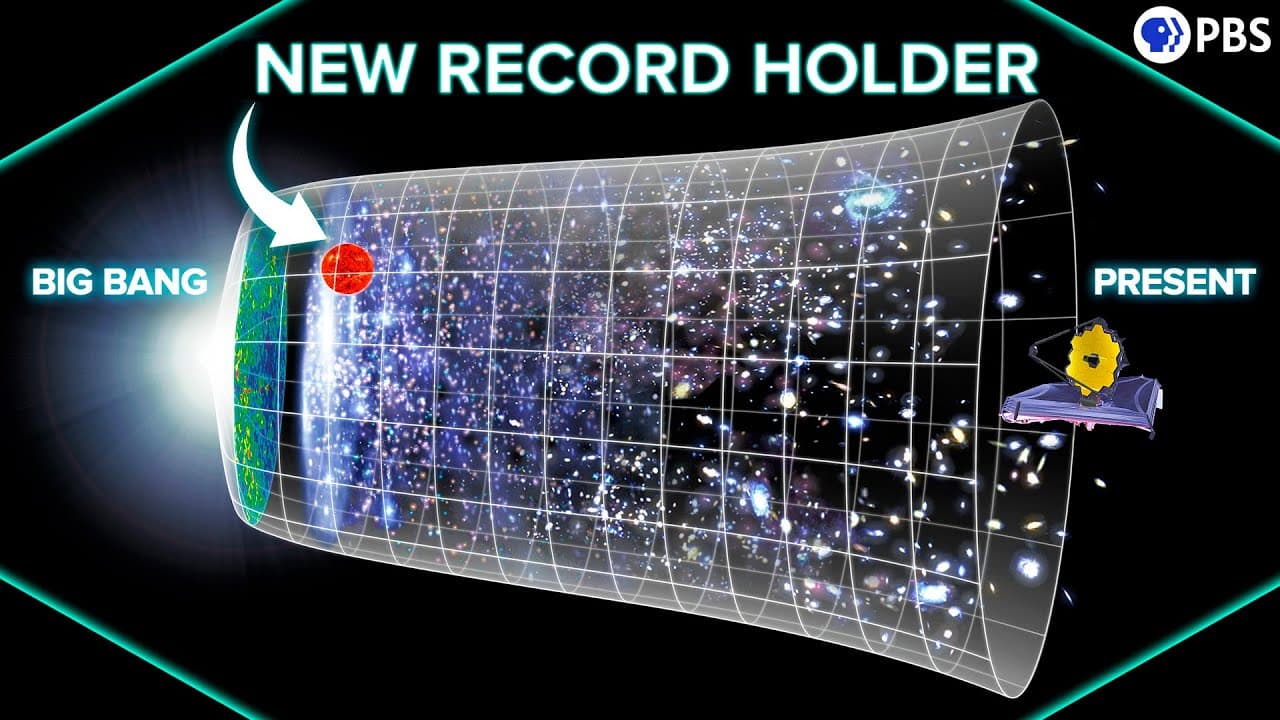
JWST and Hubble discovered the farthest star, Earendel.
Transcript
To understand where we came from—how earth, the solar system, the galaxy became what they are today—we need to understand how it all began. For example, how did the first galaxies pull themselves together from the dark universe-filling ocean of gas that followed the Big Bang? With the James Webb Space Telescope we’re starting to be able to find tho... Read More
Key Insights
- The James Webb Space Telescope (JWST) and Hubble have identified Earendel, the most distant star ever observed, located 28 billion light years away, thanks to gravitational lensing.
- Earendel was first spotted by Hubble in 2022 during the Reionization Lensing Cluster Survey (RELICS), which aimed to find extremely distant galaxies.
- Gravitational lensing, a phenomenon where light is amplified by the gravitational field of intervening galaxies, allowed astronomers to observe Earendel.
- Earendel's light has been traveling for nearly 13 billion years and has a redshift of 6.2, indicating significant expansion of the universe since its light was emitted.
- The star is classified as a blue-ish white type B main sequence star, potentially 50 times more massive than the Sun with a surface temperature of over 20,000 Kelvin.
- Earendel might be part of a binary system, with a possible red giant companion star, complicating the determination of its exact characteristics.
- The discovery of Earendel provides crucial data for understanding early star formation and the composition of the universe shortly after the Big Bang.
- Future observations and discoveries of similar stars can help refine our understanding of star formation in the early universe and the prevalence of massive stars.
Install to Summarize YouTube Videos and Get Transcripts
Explore YouTube Video Summarizer or Get YouTube Transcript Extractor
Questions & Answers
Q: What is Earendel and why is it significant?
Earendel is the most distant star ever observed, located 28 billion light years away. It was discovered using gravitational lensing, a technique that amplifies light from distant objects. This discovery provides crucial insights into the early universe and star formation shortly after the Big Bang.
Q: How was Earendel discovered?
Earendel was discovered by the Hubble Space Telescope in March 2022 during the Reionization Lensing Cluster Survey (RELICS). The discovery was made possible through gravitational lensing, where the light from the star was amplified by the gravitational field of intervening galaxies, allowing it to be observed.
Q: What is gravitational lensing and how did it help in discovering Earendel?
Gravitational lensing is a phenomenon where light from a distant object is bent and amplified by the gravitational field of an intervening massive object, like a galaxy cluster. This effect allowed astronomers to observe Earendel, which would otherwise be too faint and distant to detect.
Q: What does the redshift of Earendel's light indicate?
Earendel's light has a redshift of 6.2, indicating it has been stretched by a factor of more than 7. This suggests its light has been traveling for nearly 13 billion years, providing evidence of the universe's expansion since the star's light was emitted, offering insights into the early universe.
Q: What are the characteristics of Earendel?
Earendel is classified as a blue-ish white type B main sequence star, potentially 50 times more massive than the Sun with a surface temperature exceeding 20,000 Kelvin. It may be part of a binary system with a red giant companion, complicating the determination of its exact characteristics.
Q: What can Earendel teach us about the early universe?
Earendel provides crucial data on the early universe, particularly star formation shortly after the Big Bang. Observations of Earendel and similar stars can help refine our understanding of the universe's composition and the prevalence of massive stars during its early formation stages.
Q: What role does the James Webb Space Telescope play in studying Earendel?
The James Webb Space Telescope, with its larger collecting area and infrared sensitivity, complements Hubble's observations by capturing more of Earendel's redshifted light. This allows for more detailed study of the star's characteristics and provides insights into early star formation and the universe's evolution.
Q: What future observations are planned for Earendel?
Future observations aim to better understand Earendel's characteristics, such as its true brightness and composition. Further studies may confirm its status as an early-generation star and provide population statistics of massive stars in the early universe, enhancing our understanding of star formation shortly after the Big Bang.
Summary & Key Takeaways
-
The James Webb Space Telescope, alongside Hubble, has discovered Earendel, the farthest star observed, at a distance of 28 billion light years. This discovery was made possible through gravitational lensing, which amplified the star's light, allowing for its detection.
-
Earendel's light has been traveling for nearly 13 billion years, with a significant redshift indicating the universe's expansion since the star's light was emitted. This provides a glimpse into the early universe and the formation of the first stars.
-
The star is a blue-ish white type B main sequence star, possibly part of a binary system with a red giant companion. This discovery offers valuable insights into early star formation and the composition of the universe shortly after the Big Bang.
Read in Other Languages (beta)
Share This Summary 📚
Summarize YouTube Videos and Get Video Transcripts with 1-Click
Try YouTube Summary with ChatGPT & Claude or YouTube Transcript Generator
Explore More Summaries from PBS Space Time 📚


Summarize YouTube Videos and Get Video Transcripts with 1-Click
Try YouTube Summary with ChatGPT & Claude or YouTube Transcript Generator