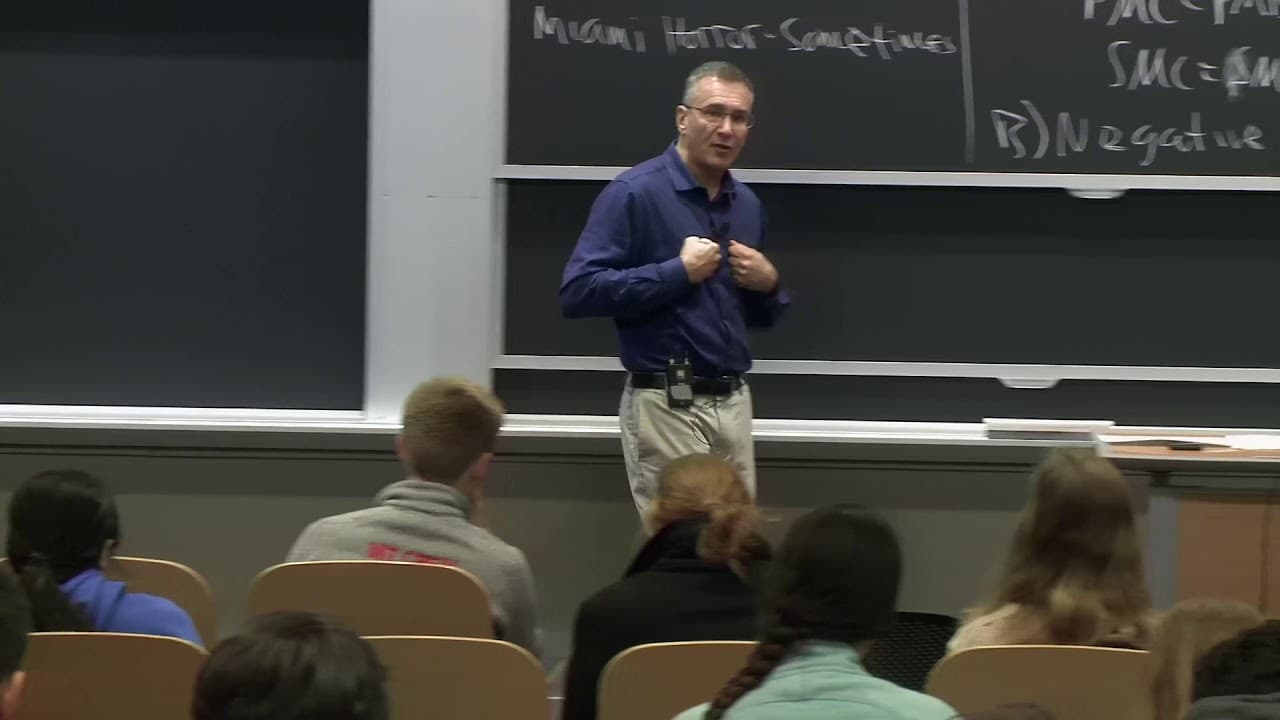
23. Market Failures I: Externalities
TL;DR
Externalities can cause market failures by imposing costs or benefits on third parties, and can be addressed through corrective taxes or subsidies, regulation, or information dissemination.
Transcript
[SQUEAKING] [RUSTLING] [CLICKING] JONATHAN GRUBER: Externalities, so, so far in the class, we once again remember the big picture. We started with the first fundamental theorem overall for economics, which is that the competitive market will maximize total social welfare. Then we said that will not be true under conditions of market failure. Rememb... Read More
Key Insights
- 🥺 Externalities can lead to market failures when private actions ignore the costs or benefits imposed on others.
- ❓ Corrective taxes and subsidies are effective methods to internalize externalities and achieve socially optimal outcomes.
- 🌐 Environmental externalities, such as global warming, require international cooperation and regulation to mitigate the damage.
Install to Summarize YouTube Videos and Get Transcripts
Explore YouTube Video Summarizer or Get YouTube Transcript Extractor
Questions & Answers
Q: What are externalities?
Externalities occur when one party's actions affect another party, either positively or negatively, without bearing the consequences of their actions. They can arise in both production and consumption.
Q: How can negative production externalities be resolved?
Negative production externalities can be addressed through corrective taxes or regulation. By imposing taxes equal to the damage caused, firms will internalize the externality and produce the socially optimal amount.
Q: What are positive consumption externalities?
Positive consumption externalities occur when an individual's consumption benefits others. An example is research and development (R&D), which generates spillover benefits for society. However, firms underinvest in R&D due to not capturing all the social benefits.
Q: How can positive consumption externalities be addressed?
Positive consumption externalities can be resolved through corrective subsidies or government investment in R&D. By providing incentives or direct funding, firms will increase their investments in R&D, leading to higher social benefits.
Summary & Key Takeaways
-
Externalities occur when one party's actions affect another party, either positively or negatively, without bearing the consequences of their actions.
-
Negative production externalities, such as pollution, can lead to overproduction and a socially inefficient outcome.
-
Positive consumption externalities, like research and development, are underproduced by firms due to not capturing the full social benefits.
Read in Other Languages (beta)
Share This Summary 📚
Summarize YouTube Videos and Get Video Transcripts with 1-Click
Try YouTube Summary with ChatGPT & Claude or YouTube Transcript Generator
Explore More Summaries from MIT OpenCourseWare 📚






Summarize YouTube Videos and Get Video Transcripts with 1-Click
Try YouTube Summary with ChatGPT & Claude or YouTube Transcript Generator