L14.4 The Bayesian Inference Framework
TL;DR
Bayesian Inference is a framework that treats unknown variables as random and uses prior beliefs and data observations to calculate conditional distributions.
Transcript
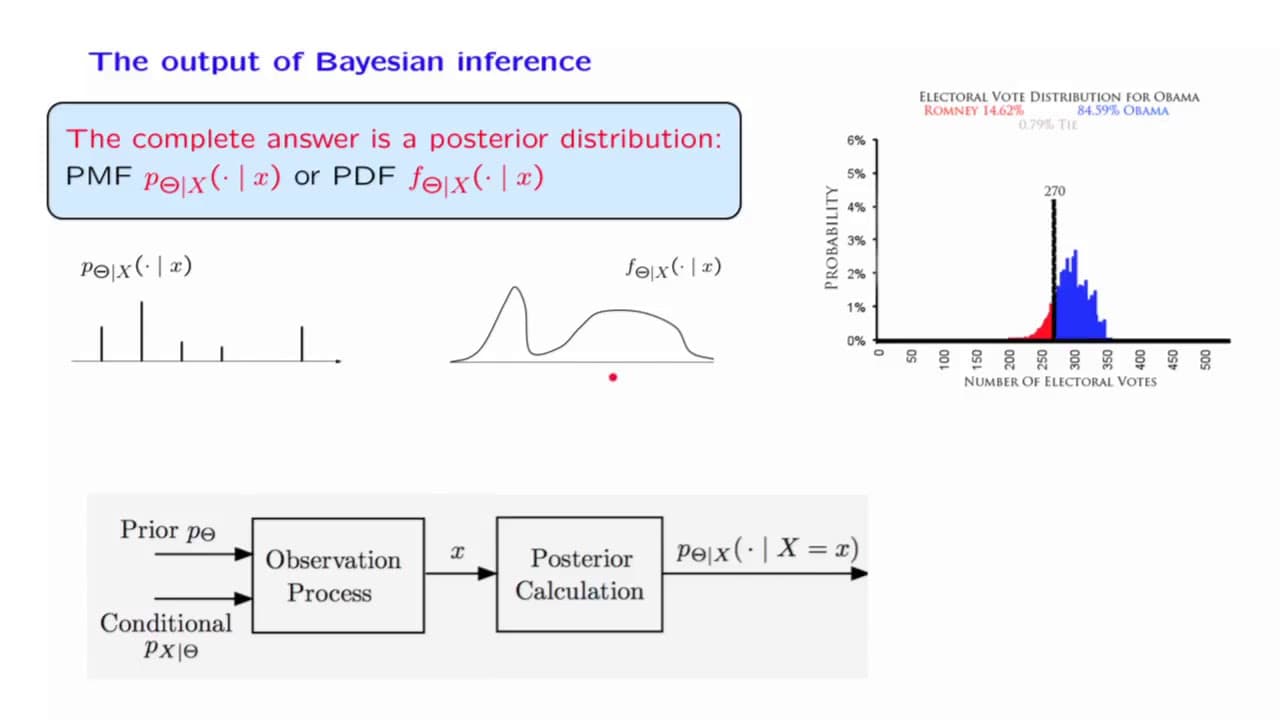
We can finally go ahead and introduce the basic elements of the Bayesian inference framework. There is an unknown quantity, which we treat as a random variable, and this is what's special and why we call this the Bayesian inference framework. This is in contrast to other frameworks in which the unknown quantity theta is just treated as an unknown c... Read More
Key Insights
- 👻 Bayesian inference treats unknown variables as random, allowing for the incorporation of prior beliefs and data observations.
- ⚾ Prior distributions can be chosen based on symmetry, knowledge from previous studies, or subjective beliefs about the relative likelihoods of different choices.
- ❓ The complete solution in Bayesian inference is the posterior distribution of the unknown variable, which represents the updated beliefs after incorporating data.
- 😒 Bayesian inference can provide more informative results than simple statements or predictions, through the use of probability distributions.
- 📏 Estimating the unknown variable can be done using the maximum a posteriori probability rule or the conditional expectation estimator.
- 📏 An estimate is a specific numerical value obtained from an estimator, which is the rule used to process the data.
Install to Summarize YouTube Videos and Get Transcripts
Explore YouTube Video Summarizer or Get YouTube Transcript Extractor
Questions & Answers
Q: How is Bayesian inference different from other frameworks?
In Bayesian inference, unknown variables are treated as random variables with prior distributions, while other frameworks consider them as unknown constants.
Q: What is the role of the prior distribution in Bayesian inference?
The prior distribution represents prior beliefs about the unknown variable before any data is obtained. It serves as a starting point for the inference process.
Q: How is the observation process modeled in Bayesian inference?
The observation process is modeled using a probabilistic model, specifying the conditional distribution of the observations given specific values of the unknown variable.
Q: How is the posterior distribution calculated in Bayesian inference?
Once specific observations are obtained, Bayes' rule is used to calculate the conditional distribution of the unknown variable (Theta). This provides a complete solution to the Bayesian inference problem.
Summary & Key Takeaways
-
The Bayesian inference framework treats unknown variables as random, with a prior distribution representing prior beliefs before data is obtained.
-
Data observations are modeled using a probabilistic model, specifying the conditional distribution of the observations given specific values of the unknown variable.
-
Using Bayes' rule, the conditional distribution of the unknown variable (Theta) can be calculated, providing a complete solution to the Bayesian inference problem.
Read in Other Languages (beta)
Share This Summary 📚
Summarize YouTube Videos and Get Video Transcripts with 1-Click
Try YouTube Summary with ChatGPT & Claude or YouTube Transcript Generator
Explore More Summaries from MIT OpenCourseWare 📚
Summarize YouTube Videos and Get Video Transcripts with 1-Click
Try YouTube Summary with ChatGPT & Claude or YouTube Transcript Generator