How to Calculate Matrix Elements in QED Processes
TL;DR
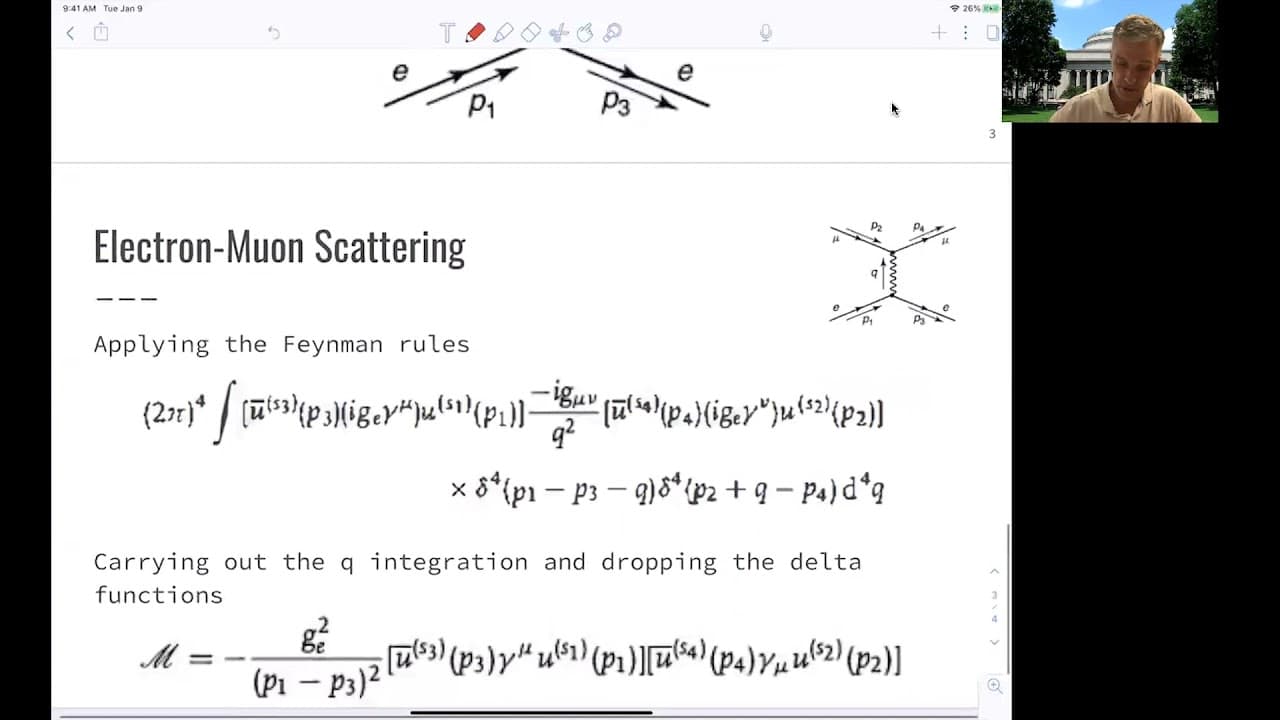
Calculating matrix elements in QED processes involves using Feynman diagrams and applying specific rules for vertex vectors and propagators. This video focuses on the simplest example, muon-electron scattering, to illustrate the method, while also mentioning the need to handle particle spins for accurate evaluations.
Transcript
MARKUS KLUTE: Welcome back to 8.701. So in this lecture, we are going to start looking at an example of the QED process, for which we can now, with all the tools we have in hand, calculate the matrix elements' transition amplitude. All right. In more general terms, we can look at all the examples. And they are listed here-- second-order processes a... Read More
Key Insights
- 🏑 QED processes involve the interaction between charged particles and electromagnetic fields.
- ❓ Muon-electron scattering is a simple example used to understand the calculation of matrix elements in QED processes.
- 🪡 Multiple diagrams need to be considered in processes where the outgoing particle is changed.
- 🅰️ QED processes include elastic scattering, various types of scattering, and inelastic processes like pair annihilation.
- 📏 The Feynman diagram and Feynman rules are used to calculate the matrix element.
- 🖐️ Spinors play a crucial role in handling the spin of particles in QED processes.
Install to Summarize YouTube Videos and Get Transcripts
Explore YouTube Video Summarizer or Get YouTube Transcript Extractor
Questions & Answers
Q: What is the QED process?
The QED process stands for Quantum Electrodynamics, which is a theoretical framework that describes the interaction between charged particles and electromagnetic fields.
Q: Why is muon-electron scattering chosen as the example for studying QED processes?
Muon-electron scattering is chosen as it represents a simple case with only one leading-order diagram, making it easier to understand the calculation of matrix elements' transition amplitude.
Q: What is the purpose of considering multiple diagrams in electron-electron scattering?
In electron-electron scattering, multiple diagrams need to be considered because the outgoing electron leg is changed in some diagrams, requiring the calculation of additional diagrams to accurately represent the process.
Q: What are some examples of other QED processes?
Other examples of QED processes include electron-positron scattering, Bhabha scattering, Compton scattering, pair annihilation, and pair production. Each process involves different interactions and diagrams.
Summary & Key Takeaways
-
The lecture discusses different examples of QED processes, including elastic scattering, muon-electron scattering, electron-electron scattering, electron-positron scattering, Bhabha scattering, Compton scattering, pair annihilation, and pair production.
-
Muon-electron scattering is chosen as the simplest case to study, with only one leading-order diagram.
-
The Feynman diagram is used to calculate the matrix element by following Feynman rules, analyzing vertex vectors, considering propagators, and integrating over momentum.
Read in Other Languages (beta)
Share This Summary 📚
Summarize YouTube Videos and Get Video Transcripts with 1-Click
Try YouTube Summary with ChatGPT & Claude or YouTube Transcript Generator
Explore More Summaries from MIT OpenCourseWare 📚


Summarize YouTube Videos and Get Video Transcripts with 1-Click
Try YouTube Summary with ChatGPT & Claude or YouTube Transcript Generator