The Oort Cloud: Crash Course Astronomy #22
TL;DR
Comets originate from Kuiper Belt, Scattered Disk, and Oort Cloud.
Transcript
Well, look where we are now. With our backs to the Sun, and the planets, asteroids, and comets behind us, we face deep space. There’s nothing between us and the stars, so terribly terribly far away. … or is there? The empty space past Neptune isn’t exactly empty. In episode 21 I mentioned that comets come in two varieties: Those with orbital period... Read More
Key Insights
- Comets come in two varieties: short-period from the scattered disk and long-period from the Oort Cloud, each with distinct orbital characteristics.
- The Kuiper Belt is a donut-shaped region beyond Neptune, containing icy bodies with stable orbits, unaffected by Neptune's gravity.
- The scattered disk consists of icy bodies with highly tilted orbits influenced by Neptune, serving as the source of short-period comets.
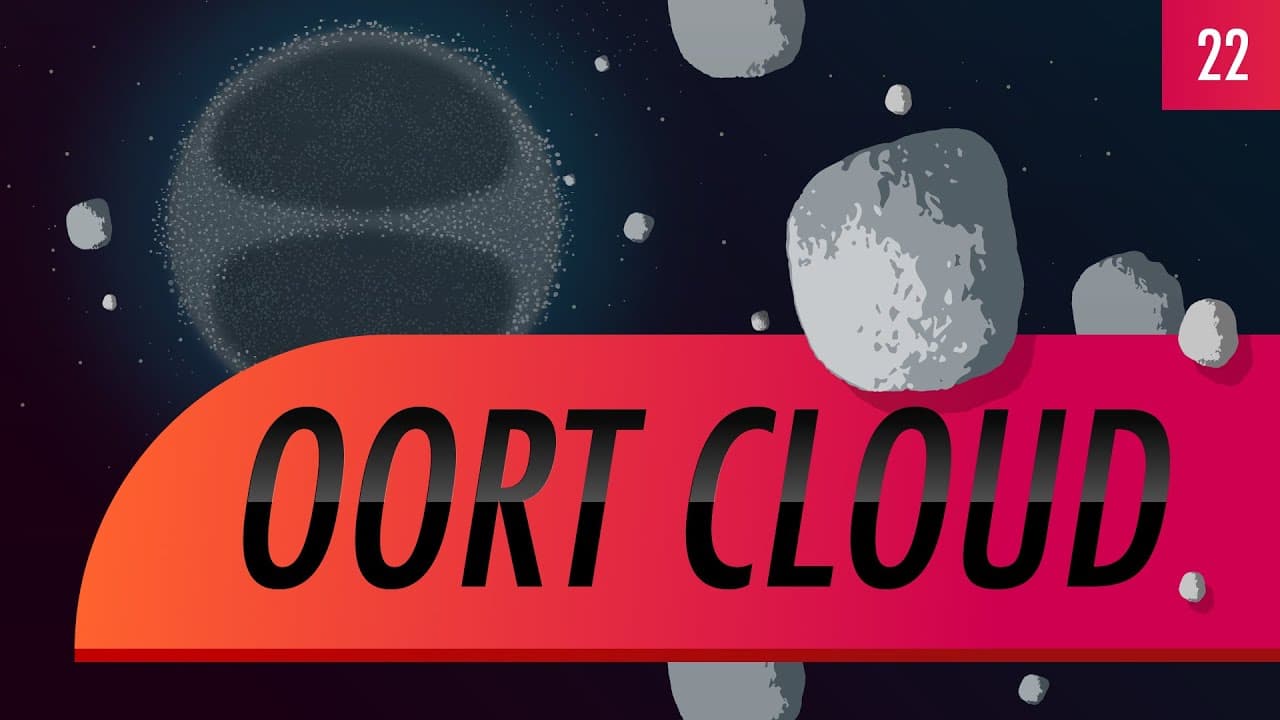
- The Oort Cloud is a vast, spherical region starting 300 billion kilometers from the Sun, extending up to a light-year, and is the source of long-period comets.
- Pluto, a Kuiper Belt Object, has a unique orbit due to its resonance with Neptune, preventing collisions despite crossing Neptune's path.
- Pluto's discovery led to the identification of more than a thousand Kuiper Belt Objects, with Eris being one of the largest and most massive.
- The New Horizons mission, launched in 2006, aimed to provide detailed observations of Pluto and its moons, potentially revealing new features.
- Speculation exists about an undiscovered planet beyond Neptune, possibly influencing the orbits of some Kuiper Belt and Oort Cloud objects.
Install to Summarize YouTube Videos and Get Transcripts
Explore YouTube Video Summarizer or Get YouTube Transcript Extractor
Questions & Answers
Q: What are the main regions beyond Neptune in the solar system?
Beyond Neptune, the solar system consists of three main regions: the Kuiper Belt, the Scattered Disk, and the Oort Cloud. The Kuiper Belt is a donut-shaped region aligned with the solar system's plane, the Scattered Disk contains objects with eccentric, tilted orbits, and the Oort Cloud is a vast, spherical shell surrounding the solar system, extending up to a light-year away.
Q: How do short-period and long-period comets differ?
Short-period comets originate from the Scattered Disk and have orbits influenced by Neptune, leading them to the inner solar system more frequently. Long-period comets come from the Oort Cloud, with orbits that take them far from the Sun, often returning only after thousands of years. Their orbits are highly elliptical and can approach parabolic shapes.
Q: Why doesn't Pluto collide with Neptune despite their intersecting orbits?
Pluto's orbit is tilted and elliptical, causing it to cross Neptune's orbit without physical intersection. Additionally, Pluto is in a 3:2 resonance with Neptune, meaning it orbits the Sun twice for every three Neptune orbits. This resonance ensures that Pluto and Neptune are never close enough to collide, maintaining a safe distance.
Q: What discoveries did the New Horizons mission aim to achieve?
The New Horizons mission, launched in 2006, aimed to fly by Pluto and provide the first detailed images and data of the dwarf planet and its moons. The mission sought to uncover surface features, discover potential new moons, and enhance our understanding of Pluto's atmosphere and geology, significantly advancing our knowledge of the Kuiper Belt.
Q: What is the significance of the Kuiper Belt in astronomy?
The Kuiper Belt is significant as it contains remnants from the early solar system, offering insights into planetary formation processes. It is home to numerous icy bodies, including dwarf planets like Pluto, and serves as a source of short-period comets. Studying the Kuiper Belt helps astronomers understand the dynamic and evolutionary history of our solar system.
Q: How did the discovery of Pluto influence the study of the solar system?
Pluto's discovery in 1930 marked the first identification of a Kuiper Belt Object, leading to the hypothesis of more such objects beyond Neptune. This discovery spurred interest in studying the outer solar system and eventually led to the identification of over a thousand similar objects, reshaping our understanding of the solar system's structure and composition.
Q: What challenges exist in studying the Oort Cloud?
Studying the Oort Cloud is challenging due to its vast distance from the Sun, extending up to a light-year away, and its sparse distribution of objects. Direct observations are difficult, and most knowledge comes from studying long-period comets. Theoretical models and indirect evidence guide our understanding, but much remains speculative and unconfirmed.
Q: What theories exist about a potential undiscovered planet beyond Neptune?
Some theories suggest a potential undiscovered planet, often called 'Planet Nine,' beyond Neptune, possibly influencing the orbits of certain Kuiper Belt and Oort Cloud objects. This hypothesis arises from observed orbital alignments that suggest a gravitational influence. However, direct evidence is lacking, and the search for such a planet continues, driven by indirect observations and theoretical models.
Summary & Key Takeaways
-
The solar system's outskirts are populated by the Kuiper Belt, Scattered Disk, and Oort Cloud, regions rich in icy bodies that occasionally become comets. These bodies were likely formed closer to the Sun and were ejected outward by gravitational interactions with the outer planets.
-
Pluto, a prominent Kuiper Belt Object, has a unique orbital resonance with Neptune, preventing collisions. Discovered in 1930, it led to the discovery of many other similar objects, though it took decades to find the next one after Pluto.
-
The New Horizons mission to Pluto aims to provide unprecedented insights into the dwarf planet and its moons, potentially altering our understanding of the Kuiper Belt. Speculation about a potential undiscovered planet beyond Neptune continues to intrigue astronomers.
Read in Other Languages (beta)
Share This Summary 📚
Summarize YouTube Videos and Get Video Transcripts with 1-Click
Try YouTube Summary with ChatGPT & Claude or YouTube Transcript Generator
Explore More Summaries from CrashCourse 📚


Summarize YouTube Videos and Get Video Transcripts with 1-Click
Try YouTube Summary with ChatGPT & Claude or YouTube Transcript Generator