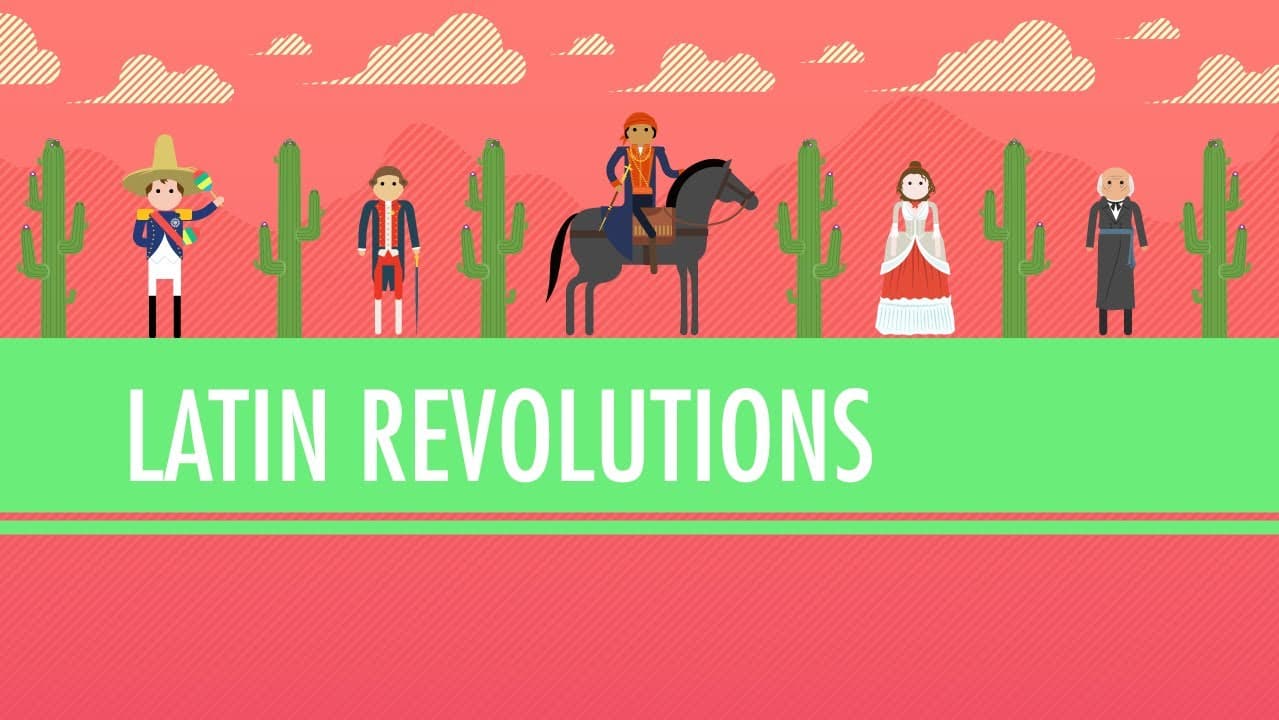
Latin American Revolutions: Crash Course World History #31
TL;DR
Latin America gained independence from European powers through complex revolutions.
Transcript
Hi, I’m John Green, this is Crash Course World History, and today things are going to get a little bit confusing, because we’re going to talk about revolution and independence in Latin America. It’s a bit confusing because:
- Latin America is big, 2. It’s very diverse,
- Napoleon makes everything complicated, and
- As we’ve seen in the past, som... Read More
Key Insights
- Latin America was under Spanish and Portuguese control for nearly 300 years before the independence movements began, fueled by revolutionary ideas from the United States and France.
- Three main institutions controlled pre-independence Latin America: the Spanish Crown, the Catholic Church, and the Patriarchy, each exerting significant influence over society.
- Transculturation played a significant role in shaping Latin American culture, blending influences from European, Native American, and African traditions.
- Brazil's independence was relatively peaceful, with Prince Pedro declaring independence from Portugal and maintaining the social hierarchy, delaying the abolition of slavery until 1888.
- Mexico's independence was marked by complex alliances and revolts, with Creoles and mestizos playing key roles in overthrowing the Peninsulares and establishing a republic.
- Simón Bolívar, known as 'el Libertador,' was instrumental in liberating several South American countries, although his dream of a united South America was not realized.
- Latin American independence movements enshrined the idea of popular sovereignty, but often maintained existing social hierarchies and strong church influences.
- Despite gaining independence, many Latin American countries experienced military dictatorships and struggled with egalitarian governance, reflecting the complexities of freedom and revolution.
Install to Summarize YouTube Videos and Get Transcripts
Explore YouTube Video Summarizer or Get YouTube Transcript Extractor
Questions & Answers
Q: What were the main institutions controlling Latin America before independence?
Before independence, Latin America was controlled by three main institutions: the Spanish Crown, which collected revenue through taxes; the Catholic Church, which influenced daily life and even controlled time; and the Patriarchy, which enforced strict social norms, particularly regarding gender roles and property rights.
Q: How did transculturation shape Latin American culture?
Transculturation in Latin America led to a unique cultural blend, combining elements from European, Native American, and African traditions. This cultural mixing was evident in various aspects of life, including religion, where indigenous and African influences melded with Christianity, as well as in food, music, and fashion, creating a distinct Latin American identity.
Q: What characterized Brazil's path to independence?
Brazil's path to independence was relatively peaceful compared to other Latin American countries. Prince Pedro declared Brazil an independent constitutional monarchy in 1822, maintaining the existing social hierarchy and delaying the abolition of slavery until 1888. This conservative approach ensured minimal bloodshed and stability during the transition from Portuguese control.
Q: What role did Simón Bolívar play in the Latin American revolutions?
Simón Bolívar, known as 'el Libertador,' played a crucial role in the Latin American revolutions, leading military campaigns that liberated several countries from Spanish rule. Despite his efforts to unite South America, regional divisions persisted. Bolívar's legacy includes numerous places and currencies named in his honor, reflecting his significant impact on the region's history.
Q: How did Mexico achieve independence from Spain?
Mexico's independence from Spain involved complex alliances and revolts. Initially, Creoles and mestizos, led by figures like Padre Hidalgo and Father Morelos, sought to overthrow the Peninsulares. The movement gained momentum when Mexican elites joined forces with Creoles, leading to the establishment of a republic after a brief monarchy under Iturbide.
Q: What were the outcomes of the Latin American independence movements?
The Latin American independence movements resulted in the enshrinement of popular sovereignty and the end of European colonial rule. However, they often maintained existing social hierarchies, with creoles at the top, and the Catholic Church retained significant influence. Many countries experienced military dictatorships, highlighting the challenges of achieving true democratic governance.
Q: How did the revolutions impact the social hierarchy in Latin America?
While the revolutions ended European colonial rule, they often preserved the existing social hierarchy, with wealthy creoles maintaining their privileges. The rigid caste system persisted, and the Catholic Church remained a powerful institution. The revolutions did not significantly alter the patriarchal structures or address issues of racial and economic inequality.
Q: What were some challenges faced by Latin American countries post-independence?
Post-independence, many Latin American countries faced challenges such as military dictatorships, social inequality, and the struggle to establish stable, egalitarian governance. Despite achieving independence, issues like land reform and economic justice remained unresolved, and the influence of the Catholic Church and patriarchal norms persisted in shaping societal structures.
Summary & Key Takeaways
-
Latin American revolutions in the 19th century were complex, influenced by revolutionary ideas from the United States and France. The region, under Spanish and Portuguese control for centuries, saw diverse groups seeking independence and a sense of South American identity.
-
Brazil's independence was achieved with minimal bloodshed, maintaining social hierarchies. In contrast, Mexico and Venezuela experienced violent revolutions, with key figures like Simón Bolívar playing significant roles in liberating South American countries.
-
The revolutions enshrined popular sovereignty but retained rigid social structures and strong church influence. Despite independence, many countries faced military dictatorships, highlighting the challenges of achieving true freedom and autonomy.
Read in Other Languages (beta)
Share This Summary 📚
Summarize YouTube Videos and Get Video Transcripts with 1-Click
Try YouTube Summary with ChatGPT & Claude or YouTube Transcript Generator
Explore More Summaries from CrashCourse 📚





Summarize YouTube Videos and Get Video Transcripts with 1-Click
Try YouTube Summary with ChatGPT & Claude or YouTube Transcript Generator