A Call for More Clarity on How to Use the CLA: The 3 Questions Paper
TL;DR
Discusses criticisms and misconceptions of constraints-led approach in coaching.
Transcript
hi everyone this is Rob Gray from ASU and the perception and action podcast back with another article review today's episode is going to be uh start in a series of episodes where I want to do uh looking at papers that are making commentaries about the CLA and ecological Dynamics and this is going to relate to my my new book coming out I'm going to ... Read More
Key Insights
- The constraints-led approach (CLA) in coaching is gaining popularity but faces criticisms regarding its complexity and lack of guidance.
- Critics argue that CLA is difficult for coaches due to its complexity and the need for experiential expertise.
- Some believe CLA is not falsifiable, but the author argues it is, as it has specific purposes and goals.
- The paper reviewed calls for more detailed guidelines on using CLA, such as which constraints to use and when to change them.
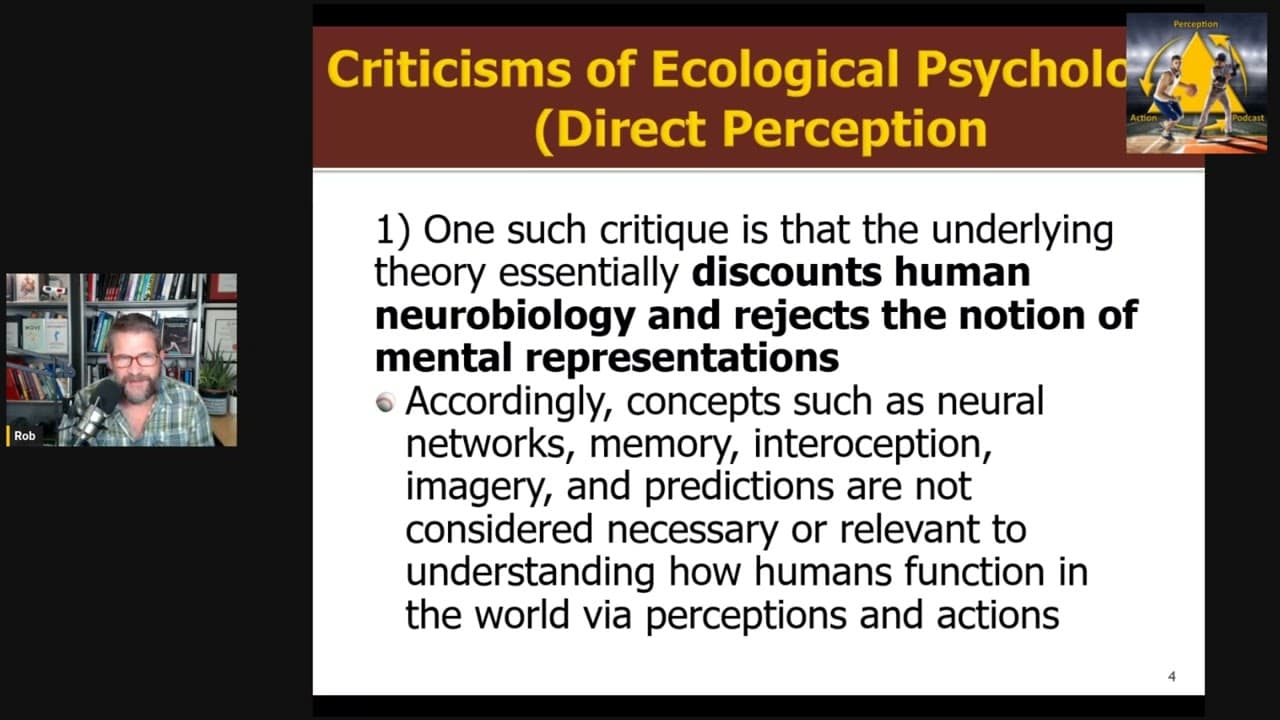
- Ecological dynamics and CLA reject the notion of mental representations, focusing instead on self-organization and adaptability.
- The paper's authors critique CLA for its rigidity and refusal to blend with other theories, which the author defends as a strength.
- The author emphasizes the need for understanding the method before using it and suggests that guidance does exist, albeit not prescriptive.
- The author plans to address these issues in his upcoming book, aiming to provide practical examples and discussions.
Install to Summarize YouTube Videos and Get Transcripts
Explore YouTube Video Summarizer or Get YouTube Transcript Extractor
Questions & Answers
Q: Why is the constraints-led approach (CLA) criticized?
The constraints-led approach (CLA) faces criticism for being complex and lacking clear guidelines for application. Critics argue that it requires too much expertise from coaches and is not falsifiable. Additionally, some believe it is rigid and refuses to blend with other theories, making it difficult to integrate with traditional coaching methods.
Q: How does the author defend the constraints-led approach (CLA)?
The author defends the constraints-led approach (CLA) by emphasizing its focus on self-organization and adaptability, which are seen as strengths rather than weaknesses. He argues that CLA is falsifiable with specific purposes and goals, and that its perceived rigidity is actually a commitment to its theoretical foundations. The author also highlights the importance of experiential expertise in coaching.
Q: What guidance does the author suggest exists for using CLA?
The author suggests that while prescriptive rules for using the constraints-led approach (CLA) may not exist, there is guidance available through understanding the method and focusing on outcomes. He emphasizes the importance of experiential knowledge, observing performance outcomes, and using constraints to guide self-organization. The author argues that understanding invariant properties and adapting practice activities can provide direction.
Q: What is the author's view on blending CLA with other theories?
The author believes that blending the constraints-led approach (CLA) with other theories is not necessary and that the refusal to do so is not a weakness. He argues that CLA is a different theoretical framework that should stand on its own merits. The author emphasizes that blending theories can dilute the unique strengths of CLA, which focuses on ecological dynamics and self-organization.
Q: How does the author address the criticism of CLA's complexity?
The author acknowledges that the constraints-led approach (CLA) involves complex concepts and terminology, but he argues that this is true of any scientific discipline. He suggests that understanding the method and its principles is essential before applying it. The author believes that the perceived complexity of CLA is overstated and that practical examples and discussions can help clarify its application.
Q: What are the key criticisms highlighted in the reviewed paper?
The reviewed paper highlights several key criticisms of the constraints-led approach (CLA), including its complexity, lack of clear guidelines, rigidity, and refusal to integrate with other theories. The paper calls for more detailed guidance on using CLA, such as which constraints to use, how much to manipulate them, and when to change them. It also critiques CLA for not addressing errors and undesired skills effectively.
Q: How does the author plan to address the criticisms of CLA in his book?
The author plans to address the criticisms of the constraints-led approach (CLA) in his upcoming book by providing practical examples and discussions. He aims to clarify the application of CLA, focusing on identifying invariant properties and using constraints to guide self-organization. The author intends to provide guidance through examples rather than prescriptive rules, acknowledging the complexity and variability inherent in CLA.
Q: What is the author's response to the demand for prescriptive rules in CLA?
The author responds to the demand for prescriptive rules in the constraints-led approach (CLA) by emphasizing that such rules are not feasible due to the complex and variable nature of human behavior. He argues that CLA embraces the messiness of human systems and that deterministic solutions are not possible. The author suggests that experiential knowledge and observation are key to effectively implementing CLA, rather than relying on rigid guidelines.
Summary & Key Takeaways
-
The podcast discusses a paper critiquing the constraints-led approach (CLA) in coaching, highlighting criticisms such as its complexity, lack of guidance, and perceived rigidity. The author defends CLA, emphasizing its focus on self-organization and adaptability, and argues that its perceived weaknesses are actually strengths.
-
Critics of CLA argue it is difficult for coaches due to its complexity and need for experiential expertise. The author contends that all coaching requires skill and that CLA is falsifiable with specific purposes, unlike critics' claims. The podcast reviews a paper calling for more detailed guidelines on using CLA.
-
The author plans to address the criticisms in his upcoming book, providing practical examples and discussions on CLA. He emphasizes the need for understanding the method before using it, suggesting that guidance does exist, though not prescriptive. The author defends CLA's rejection of mental representations and its focus on ecological dynamics.
Read in Other Languages (beta)
Share This Summary 📚
Summarize YouTube Videos and Get Video Transcripts with 1-Click
Try YouTube Summary with ChatGPT & Claude or YouTube Transcript Generator
Explore More Summaries from Rob Gray 📚



Summarize YouTube Videos and Get Video Transcripts with 1-Click
Try YouTube Summary with ChatGPT & Claude or YouTube Transcript Generator