Lewis Dot Structures - How To Calculate The Number of Lone Pairs Using a Formula
TL;DR
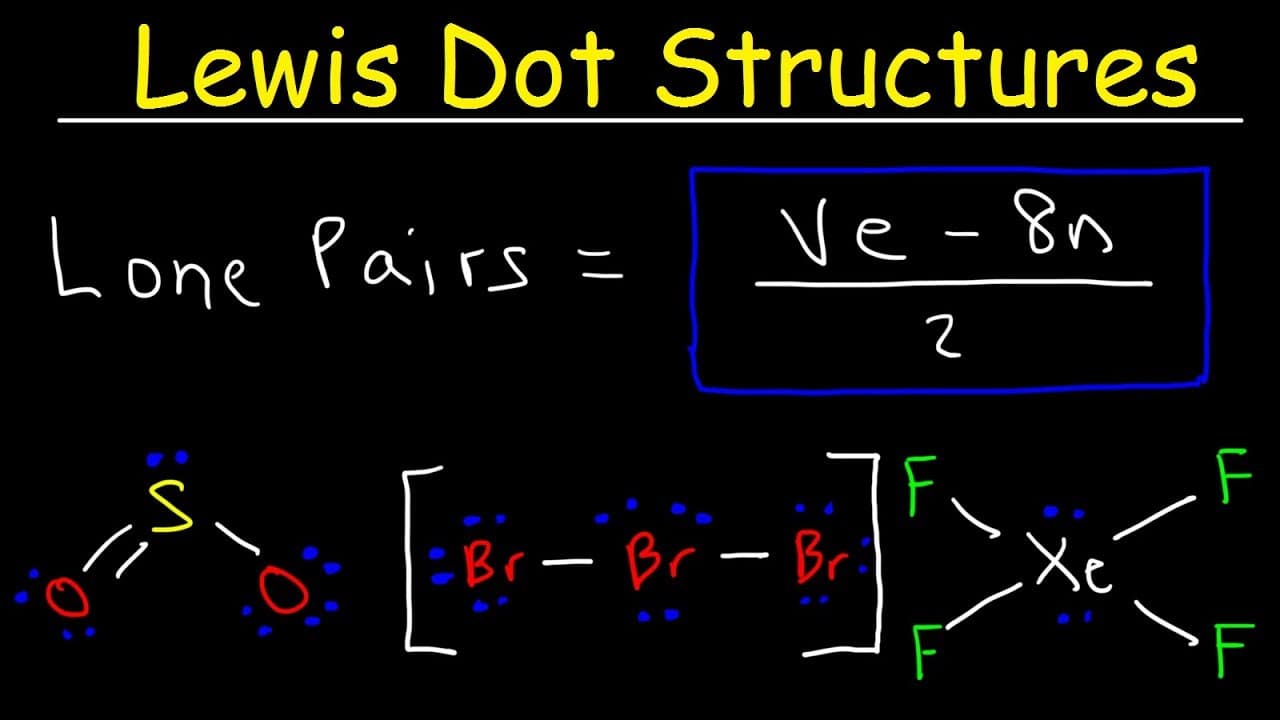
Learn how to calculate the number of lone pairs on the central atom of a molecule using a formula.
Transcript
in this video i want to give you a formula that will help you to calculate the number of lone pairs on the center atom of a molecule and so here's the formula so the number of lone pairs on the center atom is equal to the total number of valence electrons in the molecule minus eight n divided by two where n is the number of atoms attached to the ce... Read More
Key Insights
- 🫀 The number of lone pairs on the central atom can be calculated using the formula (total valence electrons - 8n) / 2.
- 🫀 Lewis structures aim to distribute electrons so that each atom has 8 electrons, satisfying the octet rule.
- 🤨 Some atoms, especially in the third row or below, can have expanded octets with more than 8 electrons.
- #️⃣ Lone pairs help determine the shape and geometry of molecules in addition to the number of bonds.
- 🦻 The formula simplifies the process of determining lone pairs and aids in drawing accurate Lewis structures.
- 🫀 The central atom in a Lewis structure can have more than one atom attached, but there is typically only one central atom.
- 📏 Hydrogen is an exception to the octet rule, as it can only have 2 electrons.
Install to Summarize YouTube Videos and Get Transcripts
Explore YouTube Video Summarizer or Get YouTube Transcript Extractor
Questions & Answers
Q: What is the formula for calculating the number of lone pairs on the central atom of a molecule?
The formula is (total valence electrons - 8n) / 2, where n is the number of atoms attached to the central atom. It helps determine the electron distribution in a molecule.
Q: How do you calculate the lone pairs in sulfur dioxide?
Sulfur dioxide has 18 valence electrons. With sulfur as the central atom and 2 oxygen atoms attached, the formula becomes (18 - 8*2) / 2. This results in 1 lone pair on sulfur.
Q: Can atoms have more than 8 electrons around them?
The outer atoms in a Lewis structure typically have 8 electrons to satisfy the octet rule. However, the central atom can have an expanded octet with more than 8 electrons, especially in third-row and below elements.
Q: How do you draw the Lewis structure for the tri-bromide ion?
The tri-bromide ion has 22 valence electrons. With bromine as the central atom and 3 bromine atoms attached, the formula becomes (22 - 8*2) / 2. This results in 3 lone pairs on the central bromine atom.
Summary & Key Takeaways
-
The formula for calculating the number of lone pairs on the central atom is (total valence electrons - 8n) / 2, where n is the number of atoms attached to the central atom.
-
Use the formula to calculate lone pairs for different molecules, such as sulfur dioxide (1 lone pair), nitrogen trifluoride (1 lone pair), and xenon tetrafluoride (2 lone pairs).
-
In drawing Lewis structures, ensure that each atom has 8 electrons around it and fill up the outer atoms with lone pairs to satisfy the octet rule.
Read in Other Languages (beta)
Share This Summary 📚
Summarize YouTube Videos and Get Video Transcripts with 1-Click
Try YouTube Summary with ChatGPT & Claude or YouTube Transcript Generator
Explore More Summaries from The Organic Chemistry Tutor 📚



Summarize YouTube Videos and Get Video Transcripts with 1-Click
Try YouTube Summary with ChatGPT & Claude or YouTube Transcript Generator