How to Blend Time and Price for Short-Term Trading
TL;DR
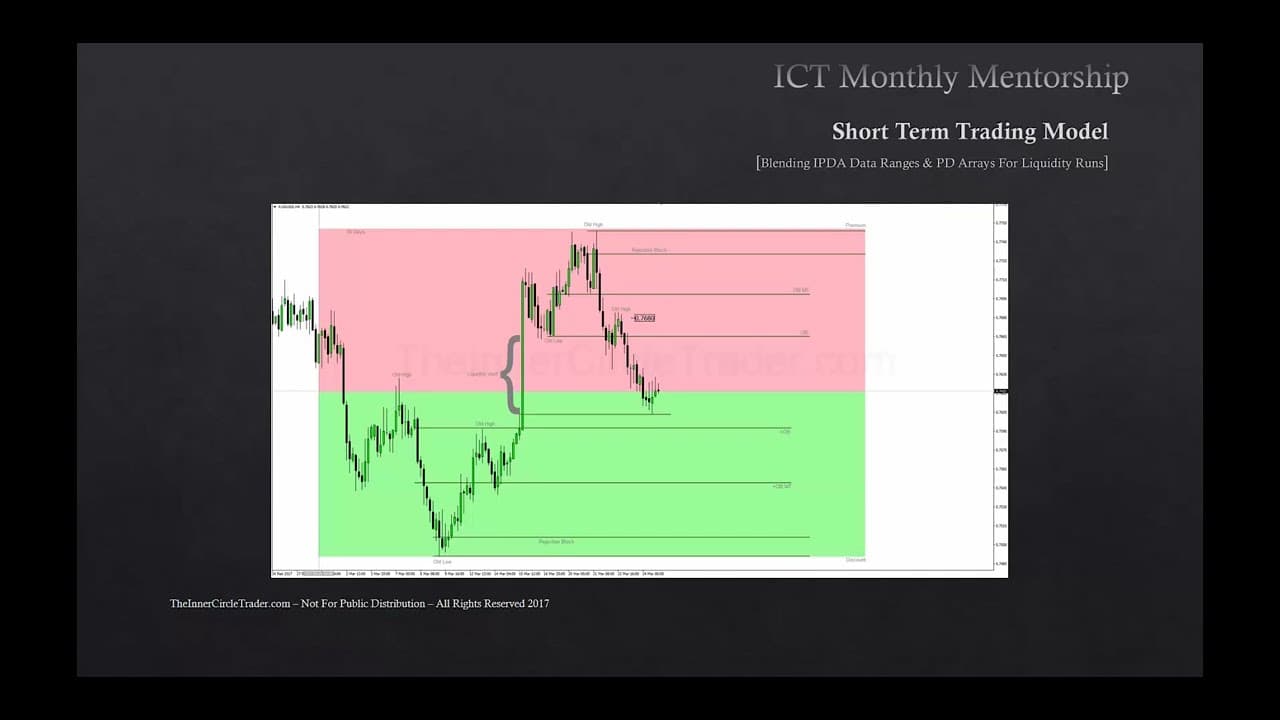
Blend historical data ranges with PD arrays to refine your short-term trading strategy. Use insights from the last 20, 40, and 60 trading days to identify premium and discount price levels, adapting your approach based on market conditions for effective trading outcomes.
Transcript
welcome back folks this is Lesson Four short-term Trading blending Gupta data ranges and PD arrays for liquidity runs okay when we're looking at if the data ranges we're referring to specifically time and PD arrays are dealing specifically with price so blending the two elements together you're blending time and price theore... Read More
Key Insights
- Blending time and price involves analyzing data ranges and PD arrays to predict market movements effectively.
- The algorithm uses historical data from 20, 40, and 60 trading days to determine price movements.
- Premium and discount PD arrays guide traders in identifying resistance and support levels in bearish and bullish markets.
- Not all PD arrays will be present in every trading scenario, requiring traders to adapt their strategies accordingly.
- The Australian dollar example highlights the importance of adjusting trading strategies based on market conditions.
- Short-term trading does not require predicting every market move but adapting to changes effectively.
- Market maker manipulation templates help identify potential trading opportunities by analyzing market profiles.
- The importance of understanding hypothetical trading limitations and associated risks in real-world trading scenarios.
Install to Summarize YouTube Videos and Get Transcripts
Explore YouTube Video Summarizer or Get YouTube Transcript Extractor
Questions & Answers
Q: How does blending time and price help in trading?
Blending time and price involves using historical data ranges and PD arrays to predict market movements. By analyzing data from 20, 40, and 60 trading days, traders can identify premium and discount PD arrays, helping them determine resistance and support levels. This approach enables traders to make informed decisions and adapt to market changes effectively.
Q: What role do PD arrays play in trading?
PD arrays guide traders in identifying resistance and support levels in bearish and bullish markets. Premium PD arrays indicate resistance points, while discount PD arrays help identify support levels. By understanding these arrays, traders can better predict market movements and adjust their strategies accordingly, enhancing their trading effectiveness.
Q: Why is the Australian dollar example significant?
The Australian dollar example highlights the importance of adapting trading strategies based on market conditions. Initially bullish expectations shifted to bearish due to market behavior. This example demonstrates the necessity of flexibility in trading and the value of using market maker manipulation templates to identify potential opportunities and adjust strategies effectively.
Q: How do market maker manipulation templates aid traders?
Market maker manipulation templates help traders identify potential trading opportunities by analyzing market profiles. These templates provide a structured approach to understanding market movements, enabling traders to spot shifts in order flow and adjust their strategies accordingly. This aids in maximizing trading opportunities and minimizing risks.
Q: What are the limitations of hypothetical trading results?
Hypothetical trading results have inherent limitations as they are often prepared with the benefit of hindsight and do not involve financial risk. They may not accurately reflect real-world trading conditions, such as market liquidity and emotional factors. Traders should be aware that actual trading results can differ significantly from hypothetical outcomes.
Q: Why is it important to understand trading risks?
Understanding trading risks is crucial because trading involves the potential for significant financial losses. Traders must be aware of the risks and be willing to accept them to make informed decisions. This includes understanding market conditions, potential losses, and the limitations of trading strategies to manage risks effectively.
Q: How should traders adapt to market changes?
Traders should adapt to market changes by continuously analyzing market conditions and adjusting their strategies accordingly. This involves using tools like PD arrays and market maker manipulation templates to identify shifts in order flow and potential trading opportunities. Flexibility and the ability to reverse strategies when necessary are key to successful trading.
Q: What factors should traders consider in real-world trading?
In real-world trading, traders should consider factors such as market liquidity, emotional resilience, and the ability to withstand losses. They should also be aware of the limitations of trading strategies and hypothetical results. Understanding these factors helps traders manage risks effectively and make informed decisions in dynamic market environments.
Summary & Key Takeaways
-
The video discusses blending time and price using data ranges and PD arrays for short-term trading. It explains how traders can use historical data from 20, 40, and 60 trading days to predict market movements and identify premium and discount PD arrays.
-
The Australian dollar example illustrates the importance of adapting trading strategies based on market conditions. The video emphasizes not forcing PD arrays into trading scenarios and using market maker manipulation templates to identify opportunities.
-
The video cautions about the limitations of hypothetical trading results and the risks involved in real-world trading. It advises traders to be aware of potential losses and adapt their strategies based on market changes.
Read in Other Languages (beta)
Share This Summary 📚
Summarize YouTube Videos and Get Video Transcripts with 1-Click
Try YouTube Summary with ChatGPT & Claude or YouTube Transcript Generator
Explore More Summaries from The Inner Circle Trader 📚


Summarize YouTube Videos and Get Video Transcripts with 1-Click
Try YouTube Summary with ChatGPT & Claude or YouTube Transcript Generator