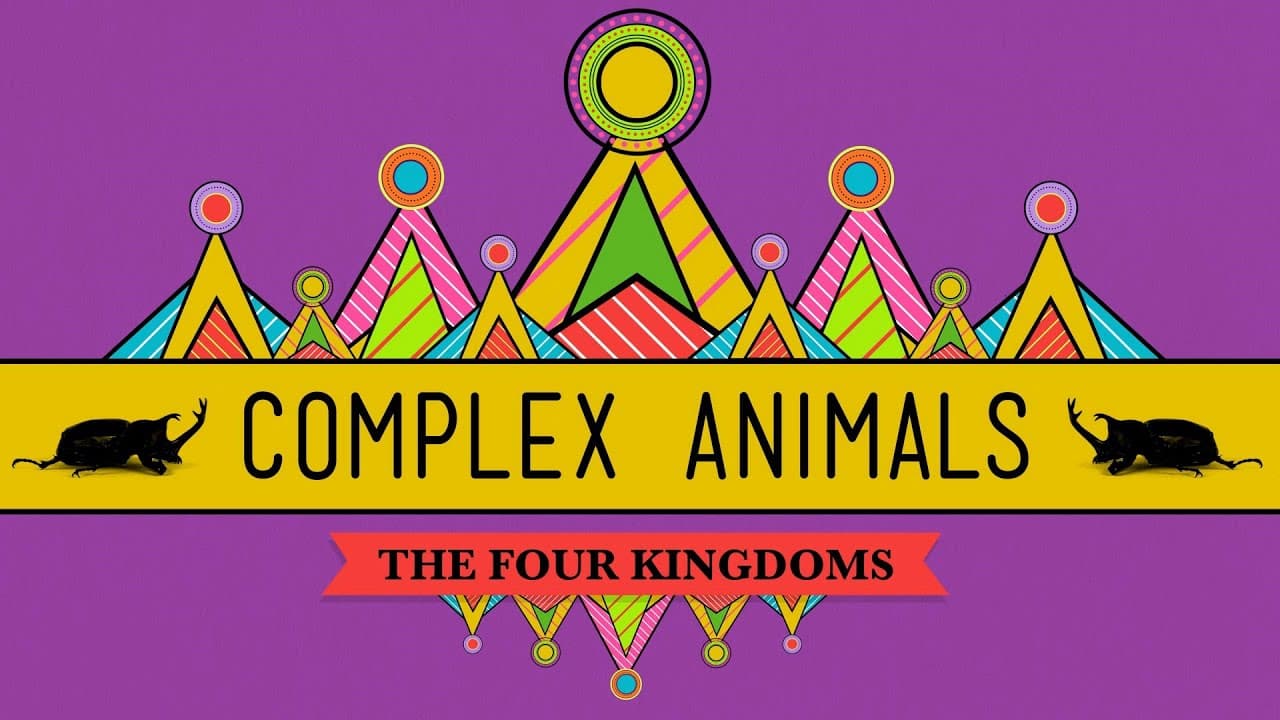
Complex Animals: Annelids & Arthropods - CrashCourse Biology #23
TL;DR
Explores complexity and evolution of annelids and arthropods.
Transcript
Hey there, I'm just hanging out with some distant relatives here. I've got to say I've got a lot of respect for these guys, because they are some of the most successful organisms on the earth. We think we run things on this planet, but we don't. They do. On one acre of cultivated land, annelids like this earthworm process about 16,000 pounds of soi... Read More
Key Insights
- Annelids and arthropods are among the most successful organisms, with arthropods comprising 80% of known animal species.
- Segmentation is a key evolutionary trait shared by annelids, arthropods, and chordates, enhancing complexity and adaptability.
- Annelids, including earthworms and leeches, exhibit segmentation and have unique traits like chaetae for movement.
- Arthropods, with segmented bodies, exoskeletons, and jointed appendages, are incredibly diverse, including insects, crustaceans, and arachnids.
- Insects, a subphylum of arthropods, are the most numerous and diverse, having adapted to fly and undergo metamorphosis.
- Crustaceans, primarily aquatic arthropods, have specialized appendages and some exhibit bioluminescence.
- The evolutionary success of insects is linked to their co-evolution with flowering plants, enhancing biodiversity.
- Synapomorphies and plesiomorphies help classify and understand evolutionary relationships among these complex organisms.
Install to Summarize YouTube Videos and Get Transcripts
Explore YouTube Video Summarizer or Get YouTube Transcript Extractor
Questions & Answers
Q: What is the significance of segmentation in annelids and arthropods?
Segmentation is a crucial evolutionary trait that allows for the repetition of anatomical units, which can be modified for different functions. This trait enhances complexity and adaptability, contributing to the evolutionary success of annelids, arthropods, and chordates. It enables these organisms to develop specialized body parts, improving their survival and diversification.
Q: How do annelids like earthworms contribute to the ecosystem?
Earthworms play a vital role in soil ecosystems by processing large amounts of soil, which improves soil aeration and nutrient availability. Their movement through the soil allows air and water to circulate, and their waste enriches the soil with essential nutrients like nitrogen, calcium, magnesium, and phosphorus, promoting plant growth and overall soil health.
Q: What are the main characteristics that define arthropods?
Arthropods are defined by their segmented bodies, exoskeletons made of chitin, and jointed appendages. These features contribute to their adaptability and diversity, allowing them to occupy various ecological niches. Their segmented bodies can be specialized for different functions, and their exoskeleton provides protection and support while jointed appendages facilitate movement and interaction with the environment.
Q: Why are insects considered the most diverse group of animals?
Insects are the most diverse group of animals due to their ability to adapt to various environments and their evolutionary innovations, such as flight and metamorphosis. Their co-evolution with flowering plants has also contributed to their success, as they play a crucial role in pollination. This diversity allows them to exploit a wide range of ecological niches, resulting in a vast number of species.
Q: How do crustaceans differ from other arthropods?
Crustaceans differ from other arthropods in that they are primarily aquatic and possess specialized appendages for various functions, such as feeding, locomotion, and defense. Some crustaceans exhibit unique adaptations like bioluminescence. Their body structure often includes a cephalothorax, and they have a diverse range of forms, including crabs, lobsters, and shrimp, which are adapted to their specific aquatic environments.
Q: What role did high oxygen levels play in the evolution of insects?
High oxygen levels during the Carboniferous period allowed insects to grow to large sizes, as their respiratory systems could support their increased body mass. However, as oxygen levels decreased, these large insects could no longer sustain themselves and died off. This period of high oxygen facilitated the evolution of diverse insect forms, contributing to their current diversity and adaptability.
Q: What is the process of complete metamorphosis in insects?
Complete metamorphosis is a process where an insect undergoes a dramatic transformation in body form. It involves several stages: the larva hatches from an egg and grows while feeding, then enters a pupal stage where it undergoes significant reorganization, and finally emerges as an adult. This process allows insects to exploit different ecological niches during their life cycle, enhancing their survival and adaptability.
Q: How have insects and flowering plants co-evolved?
Insects and flowering plants have co-evolved mutualistic relationships, where insects aid in the pollination of plants while obtaining food resources like nectar. This relationship has driven the diversification of both groups, with plants evolving specialized structures to attract specific pollinators and insects developing adaptations to efficiently gather and transport pollen, resulting in increased biodiversity and ecological interdependence.
Summary & Key Takeaways
-
The video explores the complexity and evolutionary significance of annelids and arthropods, highlighting segmentation as a key trait. Annelids, like earthworms, are segmented and have chaetae, while arthropods, including insects and crustaceans, have exoskeletons and jointed appendages.
-
Arthropods are the most diverse animal group, with insects being the most numerous. Their success is attributed to traits like flight and metamorphosis. Insects and flowering plants have co-evolved, benefiting both groups and enhancing biodiversity.
-
Crustaceans, a subphylum of arthropods, are mainly aquatic and have specialized appendages. They exhibit diverse adaptations, including bioluminescence. The video emphasizes the evolutionary importance of synapomorphies and plesiomorphies in classifying these organisms.
Read in Other Languages (beta)
Share This Summary 📚
Summarize YouTube Videos and Get Video Transcripts with 1-Click
Try YouTube Summary with ChatGPT & Claude or YouTube Transcript Generator
Explore More Summaries from CrashCourse 📚




Summarize YouTube Videos and Get Video Transcripts with 1-Click
Try YouTube Summary with ChatGPT & Claude or YouTube Transcript Generator