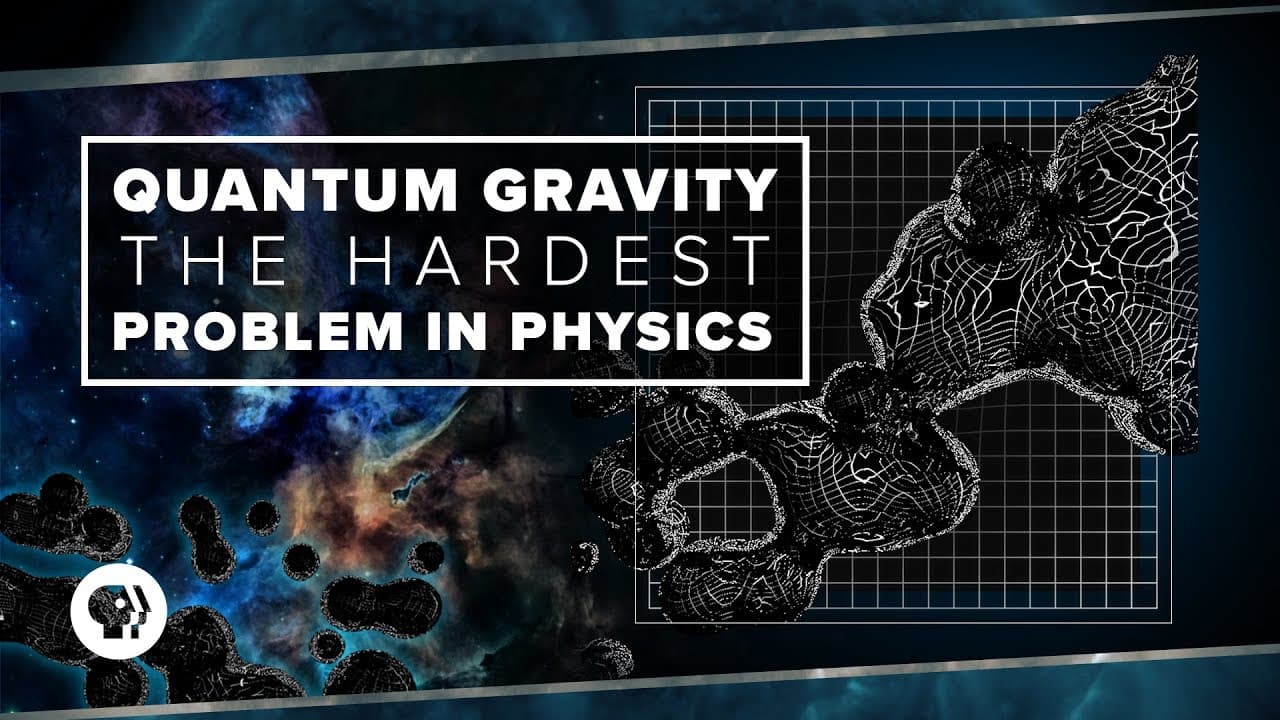
Quantum Gravity and the Hardest Problem in Physics | Space Time
TL;DR
Exploring the unresolved conflict between general relativity and quantum mechanics.
Transcript
[MUSIC PLAYING] MATT O'DOWD: Between them, general relativity and quantum mechanics seem to describe all of observable reality. And yet, they can't be simultaneously true. They must be united in a deeper, yet undiscovered, theory. After a century of work by the greatest minds in all of physics, why does this union still elude us? [MUSIC PLAYING] Th... Read More
Key Insights
- General relativity and quantum mechanics describe observable reality but contradict each other fundamentally, needing a unified theory.
- Einstein's relativity and the quantum revolution reshaped our understanding of space, time, and subatomic particles.
- Despite explaining many phenomena, general relativity and quantum mechanics need reconciliation for a complete theory of everything.
- Quantum mechanics describes particles as waves of possibilities, while general relativity involves the warping of space-time by mass and energy.
- Black hole information paradox highlights conflicts between quantum theory and general relativity, with Hawking radiation offering partial solutions.
- Attempts to quantize gravity face challenges due to space-time being the gravitational field itself, complicating the application of quantum principles.
- Non-renormalizability of quantized general relativity leads to infinite corrections, indicating flaws in current quantum gravity approaches.
- Efforts to reconcile these theories include loop quantum gravity and string theory, aiming to unify space-time and quantum mechanics.
Install to Summarize YouTube Videos and Get Transcripts
Explore YouTube Video Summarizer or Get YouTube Transcript Extractor
Questions & Answers
Q: What are the main conflicts between general relativity and quantum mechanics?
The main conflicts arise from general relativity treating gravity as the warping of space-time by mass and energy, while quantum mechanics describes particles as probabilistic waves. These differences lead to contradictions in extreme conditions, such as black holes and the Big Bang, where both theories are expected to apply.
Q: How does the black hole information paradox illustrate the conflict between these theories?
The black hole information paradox highlights the conflict as it suggests information swallowed by black holes is lost, contradicting quantum mechanics, which asserts that information cannot be destroyed. Hawking radiation offers a partial solution by proposing that information can be radiated back into the universe, but a complete resolution requires a unified theory.
Q: Why is quantizing gravity particularly challenging?
Quantizing gravity is challenging because the gravitational field is space-time itself, unlike other forces that lie on top of space-time. This complicates the application of quantum principles, leading to issues like non-renormalizability and infinite corrections, indicating that our current understanding is incomplete.
Q: What is the significance of the Planck scale in this context?
The Planck scale is significant because it represents the limits of our current theories. At this scale, attempts to measure space and time lead to absurdities like the formation of black holes, indicating that our understanding of space-time and quantum mechanics breaks down, necessitating a new theory of quantum gravity.
Q: What approaches are being explored to reconcile these theories?
Approaches include loop quantum gravity, which seeks to quantize general relativity while avoiding infinities, and string theory, which assumes space-time as an emergent phenomenon from a deeper quantum theory. Both aim to provide a coherent framework that unifies general relativity and quantum mechanics.
Q: How does Hawking radiation relate to the information paradox?
Hawking radiation relates to the information paradox by suggesting that information swallowed by black holes can be emitted back into the universe through radiation. This concept offers a partial solution to the paradox, indicating that information might not be permanently lost, but a full resolution requires further theoretical development.
Q: What is the role of renormalization in quantum field theories?
Renormalization is a process used in quantum field theories to handle infinite corrections by relating them to physical measurements, such as mass and charge. It allows for precise calculations of particle interactions. However, this process fails in quantized general relativity, highlighting the need for new theoretical approaches.
Q: Why do physicists pursue a theory of quantum gravity?
Physicists pursue a theory of quantum gravity to resolve the fundamental contradictions between general relativity and quantum mechanics. Such a theory would provide a comprehensive understanding of the universe, particularly in extreme conditions, and potentially lead to new insights into the nature of space, time, and matter.
Summary & Key Takeaways
-
General relativity and quantum mechanics are two pillars of modern physics, yet they fundamentally contradict each other, necessitating a unified theory to fully explain the universe. Despite significant advancements, physicists continue to struggle with reconciling these theories, particularly in extreme conditions like black holes and the Big Bang.
-
The conflict arises from general relativity's treatment of gravity as the warping of space-time by mass and energy, while quantum mechanics describes particles as probabilistic waves. Attempts to unify these theories face challenges, such as the black hole information paradox and the non-renormalizability of quantized gravity.
-
Various approaches, including loop quantum gravity and string theory, aim to resolve these discrepancies by either quantizing general relativity or assuming space-time as an emergent phenomenon. These efforts represent the ongoing quest for a comprehensive theory of quantum gravity and a deeper understanding of the universe.
Read in Other Languages (beta)
Share This Summary 📚
Summarize YouTube Videos and Get Video Transcripts with 1-Click
Try YouTube Summary with ChatGPT & Claude or YouTube Transcript Generator
Explore More Summaries from PBS Space Time 📚
Summarize YouTube Videos and Get Video Transcripts with 1-Click
Try YouTube Summary with ChatGPT & Claude or YouTube Transcript Generator