Class Takeaways—Managerial Economics
TL;DR
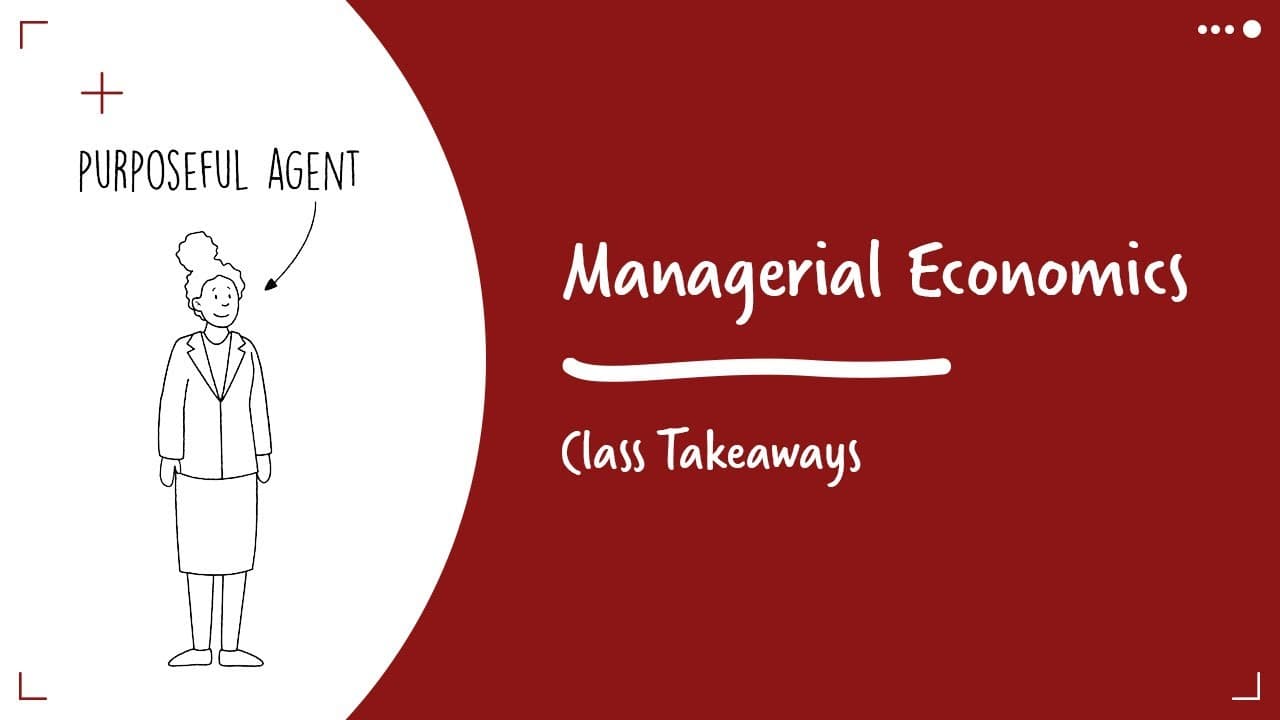
Understanding economics helps guide decision making by modeling economic entities as purposeful agents and utilizing marginal thinking.
Transcript
[MUSIC] Hi, my name is Takuo Sugaya, I'm an associate professor of economics at Stanford Graduate School of Business. My favorite class is managerial economics which I have been teaching for more than ten years. Today I will talk about five takeaways from the class. [MUSIC] When we hear the word economics, we often think about business cycles, GDP,... Read More
Key Insights
- ❓ Economics is not just about economic indicators but about understanding human behavior and its consequences.
- ❓ Economic entities are purposeful agents with objectives and constraints.
- 🤔 Marginal thinking is a helpful rule for maximizing objectives.
- ❓ Equilibrium is reached when each participant maximizes their own objective in interactions with others.
- 👨💼 Adverse selection is crucial to consider for effective business strategies.
- 💄 Lessons from economics can be applied to various decision-making scenarios.
- ❓ Economics provides a framework for analyzing and optimizing outcomes in complex situations.
Install to Summarize YouTube Videos and Get Transcripts
Explore YouTube Video Summarizer or Get YouTube Transcript Extractor
Questions & Answers
Q: How does learning economics benefit decision making?
Learning economics helps us understand how economists think about human behavior and its consequences, providing insights that can guide our decision making process.
Q: What is the key aspect of modeling economic entities in economics?
In economics, economic entities are modeled as purposeful agents with objectives and constraints, allowing for the analysis of decision making and outcomes in various situations.
Q: What is marginal thinking and how can it be applied in decision making?
Marginal thinking suggests considering the impact of small changes in behavior and assessing whether they improve or reduce the objective. By adjusting behavior towards the direction that improves the objective, decision makers can maximize their outcomes.
Q: How does the concept of equilibrium come into play when multiple decision makers interact?
In interactions involving multiple decision makers, an equilibrium is reached when each participant maximizes their own objective, taking into account the decisions of others. This stable outcome defines the state of the system.
Summary & Key Takeaways
-
Economics helps us understand human behavior and its consequences, allowing for better decision making.
-
Economic entities are modeled as purposeful agents with objectives and constraints.
-
Marginal thinking is a simple yet powerful rule of thumb to maximize objectives.
-
Multiple decision makers interact and strive to maximize their own objectives, leading to equilibrium.
-
Adverse selection is an important concept to consider when developing business strategies.
Read in Other Languages (beta)
Share This Summary 📚
Summarize YouTube Videos and Get Video Transcripts with 1-Click
Try YouTube Summary with ChatGPT & Claude or YouTube Transcript Generator
Explore More Summaries from Stanford Graduate School of Business 📚






Summarize YouTube Videos and Get Video Transcripts with 1-Click
Try YouTube Summary with ChatGPT & Claude or YouTube Transcript Generator