7. Cost Estimation
TL;DR
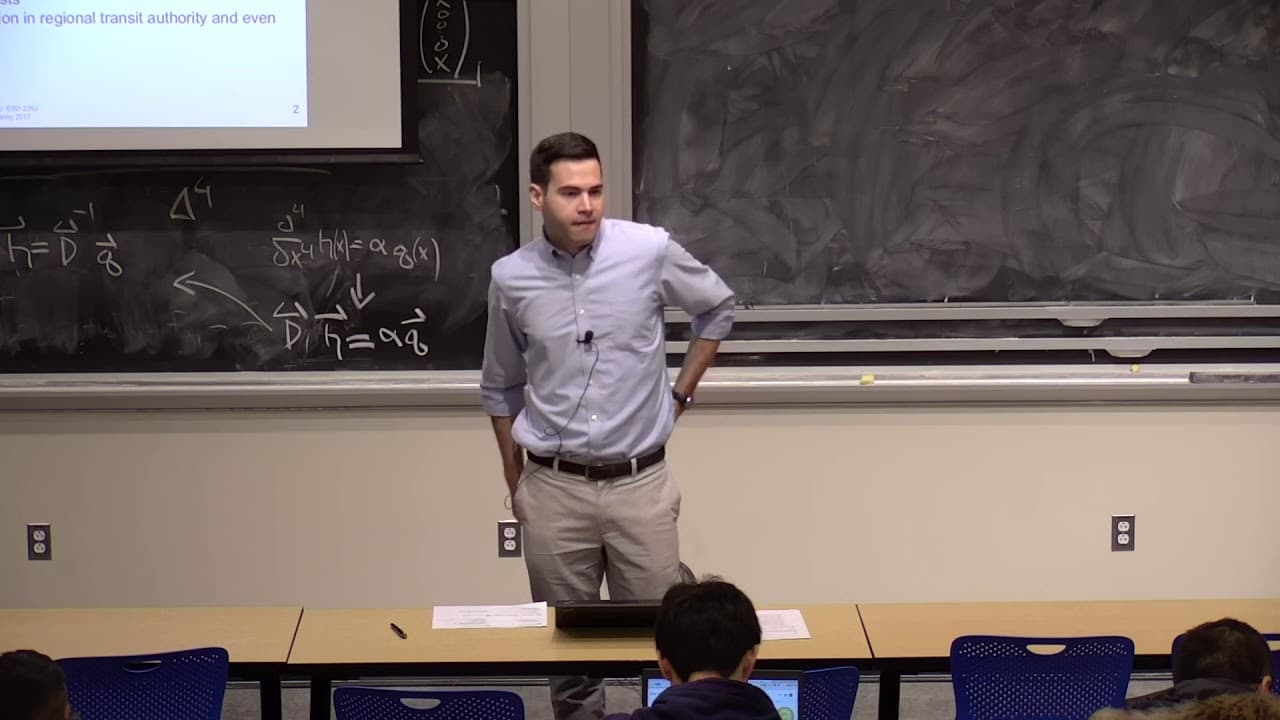
This content explains the different roles and categories of cost models in transit agencies and provides examples of how these models can be used to calculate and allocate costs.
Transcript
The following content is provided under a Creative Commons license. Your support will help MIT OpenCourseWare continue to offer high-quality educational resources for free. To make a donation or to view additional materials from hundreds of MIT courses, visit MIT OpenCourseWare at ocw.mit.edu. GABRIEL SANCHEZ-MARTINEZ: So today, we'll talk about co... Read More
Key Insights
- 🇨🇷 Cost models in transit agencies are used to predict the costs of service changes, monitor performance, and allocate subsidies.
- 🥅 Different cost models have their own strengths and weaknesses, and the choice of model depends on the specific needs and goals of the agency.
Install to Summarize YouTube Videos and Get Transcripts
Explore YouTube Video Summarizer or Get YouTube Transcript Extractor
Questions & Answers
Q: What are cost models in transit agencies used for?
Cost models are used for predicting the costs of service changes, monitoring performance, and allocating subsidies.
Q: Why is it important to have a cost model that is sensitive to time periods?
Some costs can vary significantly based on the time period, so having a cost model that accounts for this can provide more accurate estimates.
Q: How do fully allocated causal factor models work?
These models assign costs to different factors or explanatory variables and calculate unit costs for each factor. The total cost is then calculated by multiplying the unit costs by the corresponding explanatory variables.
Q: How do you allocate costs in the incremental fixed/variable cost model?
In this model, costs are classified as variable, semi-variable, or fixed, and costs are allocated based on the associated explanatory variables, such as vehicle hours, vehicle miles, and peak vehicles.
Summary & Key Takeaways
-
Cost models in transit agencies are mathematical models that predict different costs associated with service changes or production process changes.
-
These models can be used to predict the cost of service changes, routine performance monitoring, and allocation of subsidy required by jurisdiction.
-
There are three types of cost models: fully allocated causal factor models, incremental fixed/variable cost models, and time-sensitive models.
Read in Other Languages (beta)
Share This Summary 📚
Summarize YouTube Videos and Get Video Transcripts with 1-Click
Try YouTube Summary with ChatGPT & Claude or YouTube Transcript Generator
Explore More Summaries from MIT OpenCourseWare 📚



Summarize YouTube Videos and Get Video Transcripts with 1-Click
Try YouTube Summary with ChatGPT & Claude or YouTube Transcript Generator