What Are Operators and Eigenvalues in Quantum Mechanics?
TL;DR
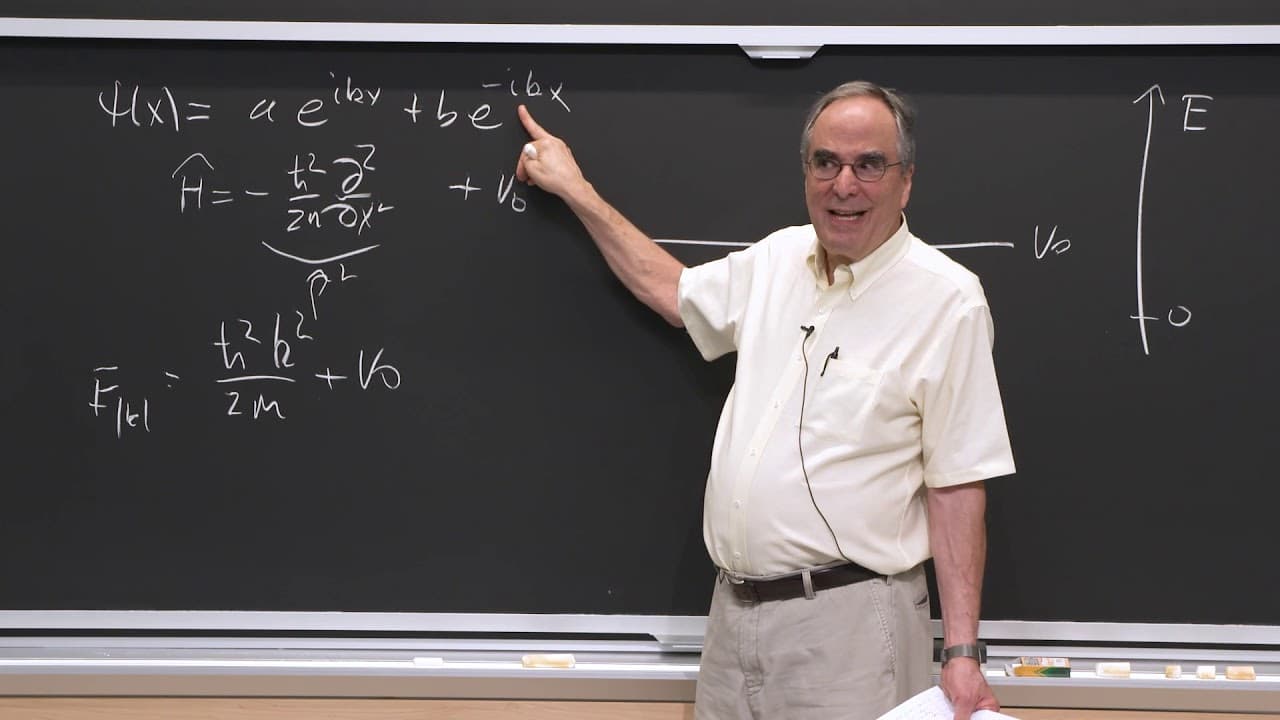
In quantum mechanics, operators are linear mathematical entities acting on wave functions, and eigenvalue equations relate these operators to their eigenfunctions. Commutation rules define the relationships between operators, crucial for understanding physical observables like position and momentum. The expectation value of an operator is calculated by integrating the product of the wave function and the operator, allowing predictions of measurable quantities.
Transcript
The following content is provided under a Creative Commons license. Your support will help MIT OpenCourseWare continue to offer high-quality educational resources for free. To make a donation or to view additional materials from hundreds of MIT courses, visit MIT OpenCourseWare at ocw.mit.edu. ROBERT FIELD: Well, we're now well underway into quantu... Read More
Key Insights
- 🦾 Quantum mechanics uses quantum mechanical operators represented by little hats to act on functions or states.
- 🦾 Eigenvalue equations describe the relationship between operators and eigenfunctions in quantum mechanics.
- 👋 The expectation value of an operator can be calculated by integrating the product of the wave function and operator squared.
- 🦾 Commutation rules, such as the one between position and momentum operators, form the foundation of quantum mechanics.
- 🏛️ The spatial modulation frequency of a wave function can be related to the classical momentum in semi-classical quantum mechanics.
- 😵 The presence of nodes in a wave function indicates the number of times it crosses zero or changes sign.
- ❓ The principle of orthogonal eigenfunctions simplifies calculations by ensuring that different eigenfunctions are orthogonal to each other.
Install to Summarize YouTube Videos and Get Transcripts
Explore YouTube Video Summarizer or Get YouTube Transcript Extractor
Questions & Answers
Q: What does the little hat symbol represent in quantum mechanics?
The little hat symbol represents a quantum mechanical operator that acts on a function or a state to produce the outcome of a certain measurement or observable.
Q: What is an eigenvalue equation in quantum mechanics?
An eigenvalue equation describes a relationship between a quantum mechanical operator and its corresponding eigenfunction. The eigenvalue is a constant that is obtained when the operator operates on the eigenfunction.
Q: What is the linear operator for momentum in quantum mechanics?
The linear operator for momentum is given by minus ih bar times the partial derivative with respect to position (x). Although the presence of 'i' and the partial derivative may seem bothersome, this operator is found to exhibit the expected behavior of momentum when applied to functions.
Q: What is the commutation rule xp - px equal to in quantum mechanics?
The commutation rule xp - px is equal to i times h bar, where 'x' is the position operator and 'p' is the momentum operator. This commutation rule is a foundation of quantum mechanics and is used in deriving various results.
Q: How is the expectation value of an operator calculated in quantum mechanics?
The expectation value of an operator 'A' is calculated by taking the integral of the product of the function (wave function) and the operator, squared, over a given range. This integral represents the average value of the operator for that particular wave function.
Q: What is the significance of the presence of nodes in a wave function in quantum mechanics?
The number of nodes in a wave function indicates the number of times the function crosses zero or changes sign. The number of nodes is related to the energy level of the system, with each energy level requiring a specific number of nodes.
Q: How does the spatial modulation frequency in a one-dimensional problem relate to the classical momentum?
In semi-classical quantum mechanics, the spatial modulation frequency, or the rate at which the wave function oscillates, is inversely proportional to the square root of the classical momentum. This relationship helps understand the behavior of wave functions in different regions of the potential.
Q: How does the principle of orthogonal eigenfunctions simplify calculations in quantum mechanics?
The principle of orthogonal eigenfunctions states that eigenfunctions corresponding to different eigenvalues of a given operator are orthogonal to each other. This simplifies calculations as it allows us to easily calculate integrals and determine the probabilities or observables related to different eigenfunctions.
Summary & Key Takeaways
-
The content introduces quantum mechanics and its importance in representing quantum mechanical operators using linear operators.
-
It explains the concept of eigenvalue equations and how they are used to describe quantum mechanics.
-
The content discusses the linear operators for position and momentum, as well as the commutation rules between them.
-
It also covers the calculation of expectation values and the normalization integral in quantum mechanics.
-
The content briefly introduces the free particle and the particle in a box problems, and their corresponding eigenvalues and eigenfunctions.
-
It concludes with an overview of the 3D particle in a box and the use of semi-classical quantum mechanics.
Read in Other Languages (beta)
Share This Summary 📚
Summarize YouTube Videos and Get Video Transcripts with 1-Click
Try YouTube Summary with ChatGPT & Claude or YouTube Transcript Generator
Explore More Summaries from MIT OpenCourseWare 📚


Summarize YouTube Videos and Get Video Transcripts with 1-Click
Try YouTube Summary with ChatGPT & Claude or YouTube Transcript Generator