What Are Read-Only Memories and How Are They Used?
TL;DR
Read-only memories (ROMs) generate multiple outputs from the same inputs, making them ideal for implementing truth tables with several output columns. They consist of decoders controlling a switch matrix, ensuring only one output is HIGH at a time. ROMs can be programmed for any function based on the number of inputs and outputs, but they may experience glitches as output values stabilize.
Transcript
Here's a final logic implementation strategy using read-only memories. This strategy is useful when you need to generate many different outputs from the same set of inputs, a situation we'll see a lot when we get to finite state machines later on in the course. Where MUXes are good for implementing truth tables with one output column, read-only mem... Read More
Key Insights
- 😫 Read-only memories (ROMs) are useful for generating many different output values from the same set of inputs.
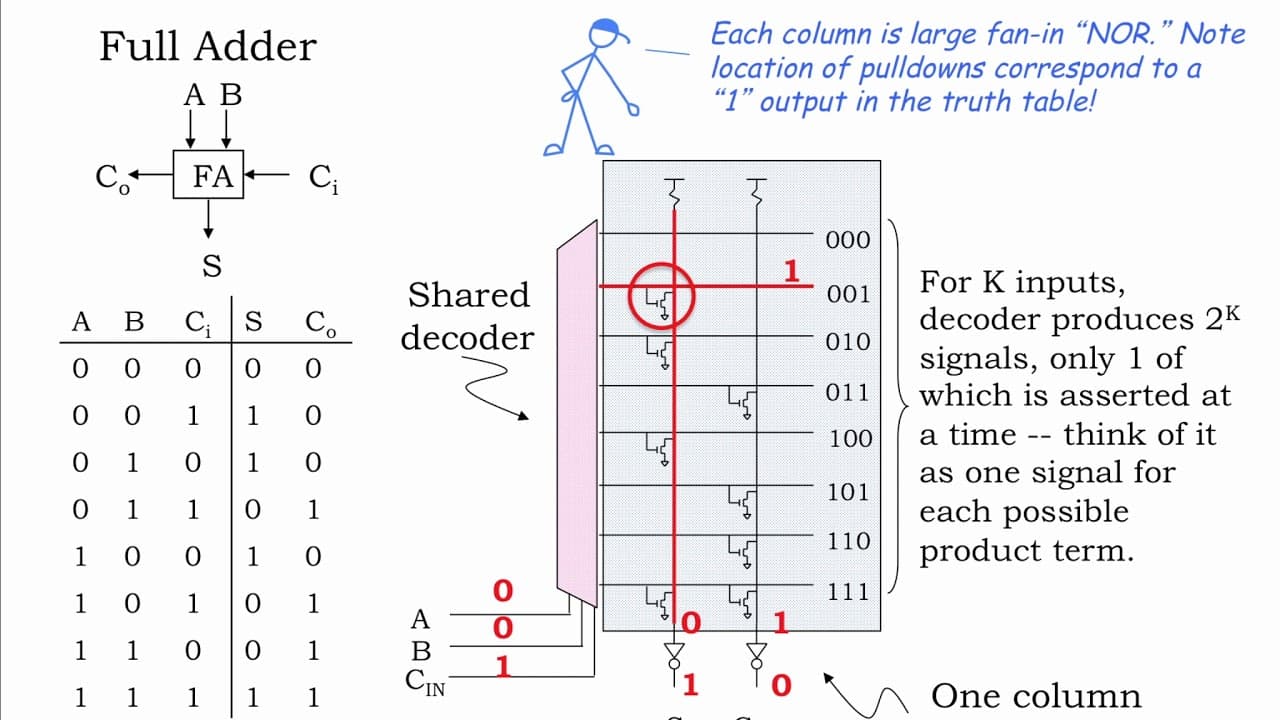
- 😤 ROMs consist of decoders and a switch matrix, with the decoders controlling the switch matrix to produce the desired output values.
- 🔢 ROMs can be programmed to implement any function with a specific number of inputs and outputs.
- 😒 The use of smaller decoders and output MUXes can improve the speed and efficiency of ROM implementations.
- 🔢 The size and layout of a ROM are determined by the number of inputs and outputs.
- 🫥 The glitchy behavior of ROMs can occur due to the delay in changing output values as the decoder lines cycle.
Install to Summarize YouTube Videos and Get Transcripts
Explore YouTube Video Summarizer or Get YouTube Transcript Extractor
Questions & Answers
Q: What is the main purpose of using read-only memories (ROMs) in logic design?
ROMs are used to implement truth tables with multiple output columns, allowing for the generation of many different output values from the same set of inputs.
Q: How does a decoder in a ROM work?
A decoder in a ROM has select inputs and data outputs, where only one data output is HIGH at any given time. The value on the select inputs determines which data output will be HIGH.
Q: How are pulldown switches used in a ROM implementation?
Pulldown switches controlled by the decoder outputs connect the vertical columns of the switch matrix to ground, forcing them to a LOW value when the switch is on. The column circuitry ensures that if no pulldown switches force its value to 0, its value will be 1.
Q: Can a ROM be programmed to implement any function?
Yes, a ROM can be programmed to implement any function with a specific number of inputs and outputs. By changing the locations of the pulldown switches, a ROM can be programmed to implement any desired function.
Summary & Key Takeaways
-
Read-only memories (ROMs) are used to generate many different outputs from the same set of inputs, making them useful for implementing truth tables with multiple output columns.
-
ROMs consist of decoders with select inputs and data outputs, where only one data output is HIGH at a time based on the select inputs.
-
The decoder outputs control a matrix of pulldown switches, and the vertical columns of the matrix are connected to the decoder outputs to produce output values.
Read in Other Languages (beta)
Share This Summary 📚
Summarize YouTube Videos and Get Video Transcripts with 1-Click
Try YouTube Summary with ChatGPT & Claude or YouTube Transcript Generator
Explore More Summaries from MIT OpenCourseWare 📚


Summarize YouTube Videos and Get Video Transcripts with 1-Click
Try YouTube Summary with ChatGPT & Claude or YouTube Transcript Generator