How Does Time Dilation Affect Observers?
TL;DR
Time dilation demonstrates that time is not absolute; moving objects experience time differently compared to stationary ones. This concept arises from Einstein's theories, particularly the relativity of simultaneity, which shows that observers in different states of motion may disagree on the timing of events. Understanding this phenomenon is crucial in the study of special relativity.
Transcript
[SQUEAKING] [RUSTLE] [CLICKING] PROFESSOR: Welcome back to 8.20. In this section, we're going to talk about time, timekeeping, and how to relate time between two different reference point. Now, let me start with a quote by Albert Einstein. "Everything should be as simple as possible, but not simpler." So let's start with this in mind. And recall th... Read More
Key Insights
- 🙂 Einstein's postulates of the principle of relativity and the constancy of the speed of light are foundational concepts in special relativity.
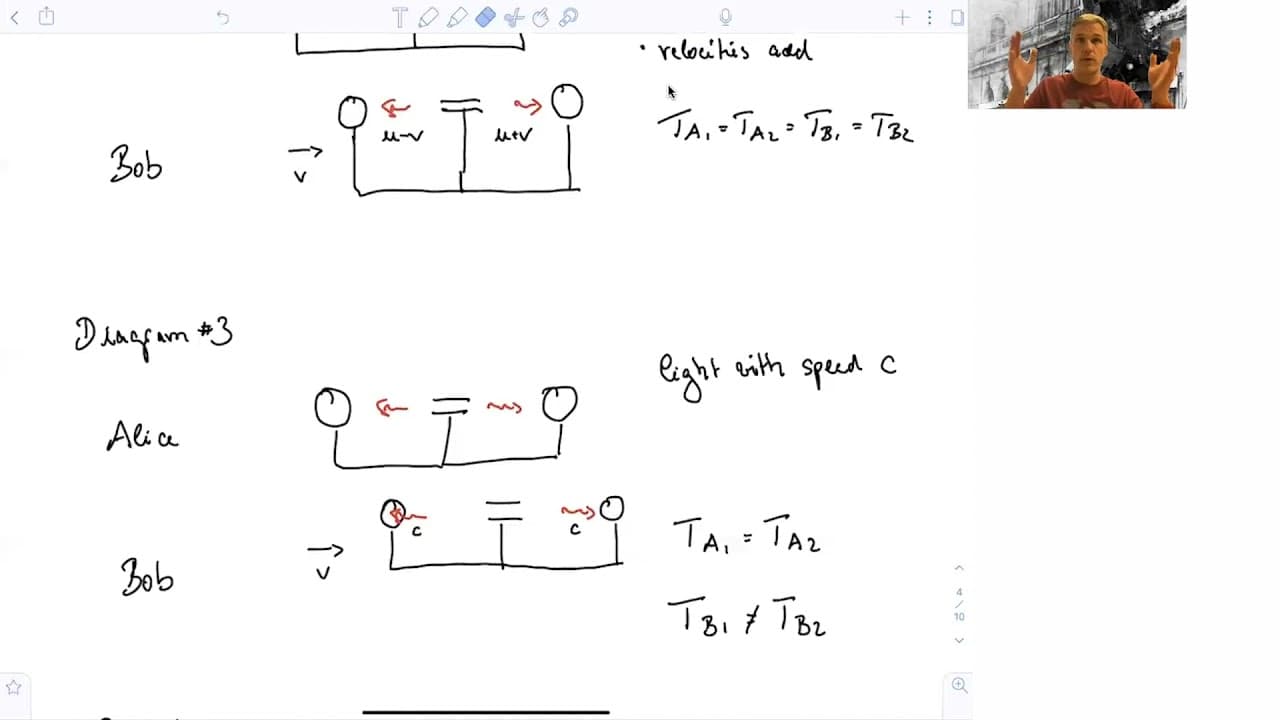
- 🖼️ The relativity of simultaneity means that simultaneous events may not be perceived as simultaneous by different observers in different reference frames.
- ⏲️ Optical clocks can be used to demonstrate time dilation, showing that moving clocks appear to tick slower.
- 🧑🏭 The Lorentz factor and relativistic velocity are mathematical tools used to quantify the effects of special relativity.
Install to Summarize YouTube Videos and Get Transcripts
Explore YouTube Video Summarizer or Get YouTube Transcript Extractor
Questions & Answers
Q: How did Einstein approach the problem of the inconsistency between experimental results and theoretical predictions?
Einstein postulated the principle of relativity, stating that the same laws of electrodynamics apply to all reference frames where the laws of mechanics hold true. He also postulated that light is always propagated at the constant speed of light, independent of the motion of the emitting body.
Q: What is the relativity of simultaneity?
The relativity of simultaneity means that two observers may not agree on whether two events happen simultaneously. The perception of simultaneous events depends on the observer's reference frame.
Q: How does the relativity of simultaneity affect the perception of time?
Different observers in different reference frames may perceive different times for the occurrence of events. What may be simultaneous for one observer may not be simultaneous for another observer.
Q: How can time dilation be demonstrated using optical clocks?
Optical clocks use light to measure time. By comparing the readings of two identical clocks in different reference frames, it is possible to observe that the moving clock appears to tick slower, indicating time dilation.
Summary & Key Takeaways
-
The video discusses Albert Einstein's postulates of the principle of relativity and the constancy of the speed of light.
-
It introduces the concept of the relativity of simultaneity and how it affects the perception of time for observers in different reference frames.
-
The video also explains how optical clocks can be used to demonstrate time dilation, and introduces the Lorentz factor and relativistic velocity.
Read in Other Languages (beta)
Share This Summary 📚
Summarize YouTube Videos and Get Video Transcripts with 1-Click
Try YouTube Summary with ChatGPT & Claude or YouTube Transcript Generator
Explore More Summaries from MIT OpenCourseWare 📚


Summarize YouTube Videos and Get Video Transcripts with 1-Click
Try YouTube Summary with ChatGPT & Claude or YouTube Transcript Generator