What Is the Central Limit Theorem and Why Is It Important?
TL;DR
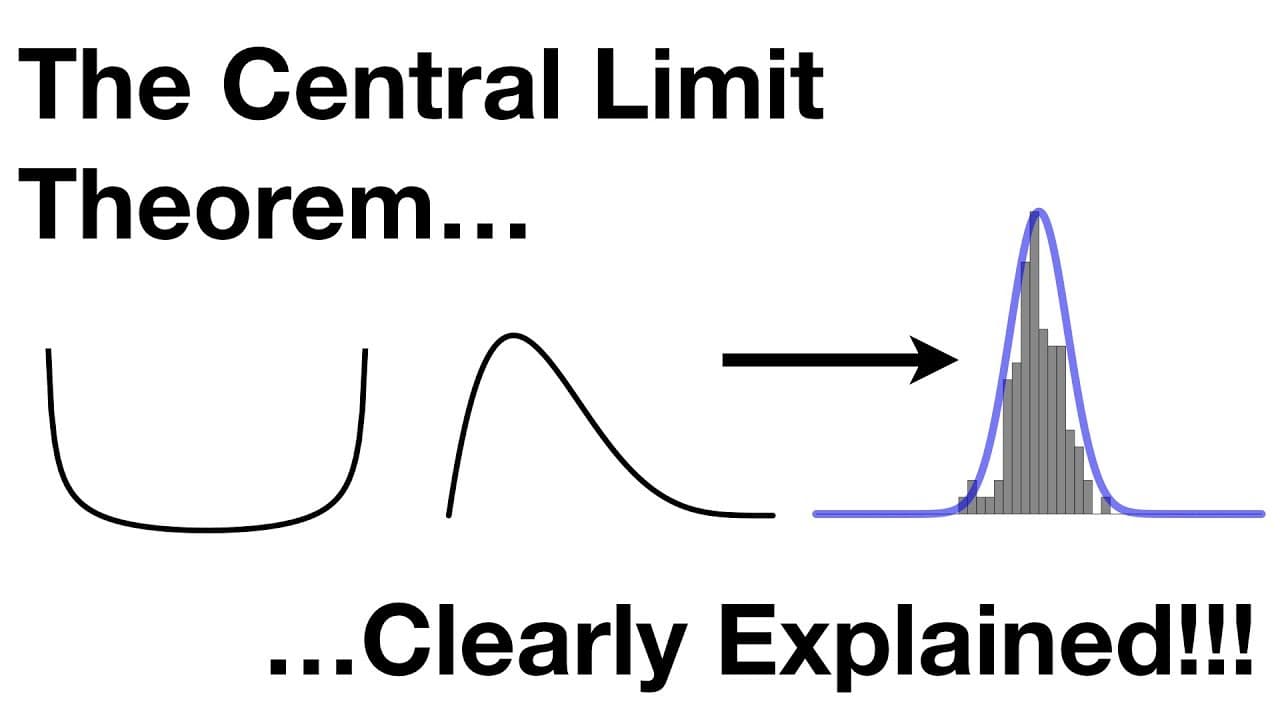
The Central Limit Theorem states that the means of samples drawn from any distribution will approximate a normal distribution as sample size increases. This principle is essential for simplifying statistical analyses, allowing the use of normal distribution methods for confidence intervals, t-tests, and ANOVA, even when the original data distribution is unknown.
Transcript
even if you're not normal the average is normal hello I'm Josh starmer and welcome to stat Quest today we're going to talk about the central limit theorem and it's going to be clearly explained note for this stat quest to make any sense at all you should be familiar with the normal distribution if not check out the normal distribution clearly expla... Read More
Key Insights
- 🇨🇫 Central Limit Theorem states that sample means are normally distributed, simplifying statistical analysis.
- 👻 Sample means from any distribution tend towards normality, allowing for confident statistical inferences.
- 🏆 The theorem's practical implications include making confidence intervals, t-tests, and ANOVA more reliable.
- 🛩️ A sample size of 30 is commonly suggested, but smaller samples can still exhibit the Central Limit Theorem.
- 🪡 Knowing that sample means are normally distributed reduces the need to know the original data distribution, making statistical analysis more accessible.
- 🏆 Practical applications of the theorem include various statistical tests that rely on sample means.
- 🇨🇫 Understanding the Central Limit Theorem enhances the foundation of statistical analysis and inference.
Install to Summarize YouTube Videos and Get Transcripts
Explore YouTube Video Summarizer or Get YouTube Transcript Extractor
Questions & Answers
Q: What is the Central Limit Theorem and its significance?
The Central Limit Theorem states that sample means are normally distributed, making statistical analyses simpler, independent of the original data distribution. It allows for making accurate inferences even when distribution type is unknown.
Q: Can you explain how the Central Limit Theorem applies to different distributions like uniform and exponential?
Yes, the Central Limit Theorem holds true regardless of the starting distribution. By collecting sample means from any distribution, they will tend towards normal distribution, aiding in statistical testing and confidence intervals.
Q: Why is it important to know that sample means are normally distributed?
Understanding this property enables researchers to apply statistical tests confidently, knowing that sample means will follow the normal distribution. It simplifies analysis, eliminates the need to know the original data distribution, and ensures robust inferential statistics.
Q: How does the sample size factor into the Central Limit Theorem?
While 30 is a common rule of thumb for sample size, the Central Limit Theorem can still hold with smaller samples, as demonstrated in the examples provided. The focus should be on calculating sample means accurately rather than adhering strictly to a specific sample size guideline.
Summary & Key Takeaways
-
The Central Limit Theorem explains how sample means become normally distributed, illustrated with examples from uniform and exponential distributions.
-
This theorem simplifies statistical analyses by allowing us to use the normal distribution for confidence intervals, t-tests, and ANOVA.
-
Sample size of 30 for the Central Limit Theorem is a rule of thumb but not a strict requirement, enabling broader applicability.
Read in Other Languages (beta)
Share This Summary 📚
Summarize YouTube Videos and Get Video Transcripts with 1-Click
Try YouTube Summary with ChatGPT & Claude or YouTube Transcript Generator
Explore More Summaries from StatQuest with Josh Starmer 📚


Summarize YouTube Videos and Get Video Transcripts with 1-Click
Try YouTube Summary with ChatGPT & Claude or YouTube Transcript Generator