How Does the ReLU Activation Function Work in Neural Networks?
TL;DR
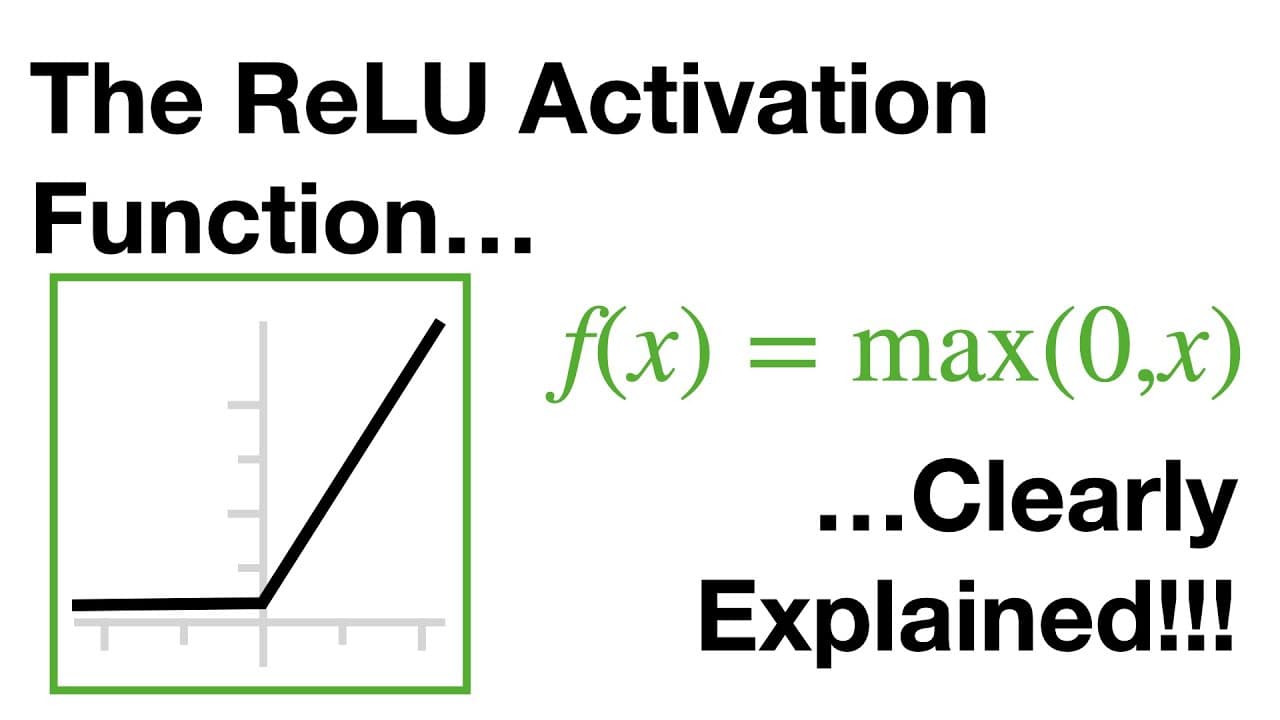
The ReLU activation function outputs the maximum value between zero and the input, allowing only positive values to pass through and creating a piecewise linear function. It simplifies neural network computations but can pose challenges for gradient descent due to its non-differentiability at zero. Overall, ReLU is a widely-used activation function known for its effectiveness in deep learning.
Transcript
some people say i mispronounce value but that is okay at least it's okay with me stackquest hello i'm josh starmer and welcome to statquest today we're going to do neural networks part 3 the relu activation function in action note this stat quest assumes that you are already familiar with the main ideas behind neural networks if not check out the q... Read More
Key Insights
- ❓ The ReLU activation function is commonly used in deep learning and convolutional neural networks.
- 0️⃣ It outputs the maximum value between zero and the input, creating a linear shape.
- 🏋️ The ReLU function is simple, but its weights and biases can transform and combine shapes to fit data.
- 🍱 The bent shape of the ReLU function can pose a challenge for gradient descent, but it can be addressed by assigning a derivative at the bent part.
- 👻 Supporting StatQuest through various means allows access to additional study materials and supports the production of more educational videos.
- ❓ The ReLU activation function is powerful and widely utilized in neural network models.
- 🎮 The video emphasizes the importance of understanding different activation functions in neural networks.
Install to Summarize YouTube Videos and Get Transcripts
Explore YouTube Video Summarizer or Get YouTube Transcript Extractor
Questions & Answers
Q: What is the ReLU activation function and how does it differ from the soft plus activation function?
The ReLU activation function outputs the maximum value between zero and the input value, while the soft plus function outputs the natural logarithm of the exponential function of the input value.
Q: How does the ReLU activation function fit data in a neural network?
The ReLU function helps create a new shape by multiplying the input values by weights, adding biases, and combining them in a neural network.
Q: What is the impact of the bent shape of the ReLU activation function on gradient descent?
The derivative of the ReLU function is not defined where it is bent, but this can be resolved by assigning a derivative of zero or one at the bent part during gradient descent.
Q: How can I support StatQuest and access additional study materials?
You can support StatQuest by subscribing to the YouTube channel, contributing to the Patreon campaign, purchasing songs, t-shirts, or hoodies, or making a donation. Study guides are also available on the StatQuest website.
Summary & Key Takeaways
-
The video introduces the ReLU activation function and compares it to the soft plus activation function.
-
It explains how the ReLU function outputs the maximum value between zero and the input value.
-
The video demonstrates how the ReLU function is used in a neural network to fit data and create a new shape.
Read in Other Languages (beta)
Share This Summary 📚
Summarize YouTube Videos and Get Video Transcripts with 1-Click
Try YouTube Summary with ChatGPT & Claude or YouTube Transcript Generator
Explore More Summaries from StatQuest with Josh Starmer 📚

Summarize YouTube Videos and Get Video Transcripts with 1-Click
Try YouTube Summary with ChatGPT & Claude or YouTube Transcript Generator