How Does Gradient Boosting Work for Regression?
TL;DR
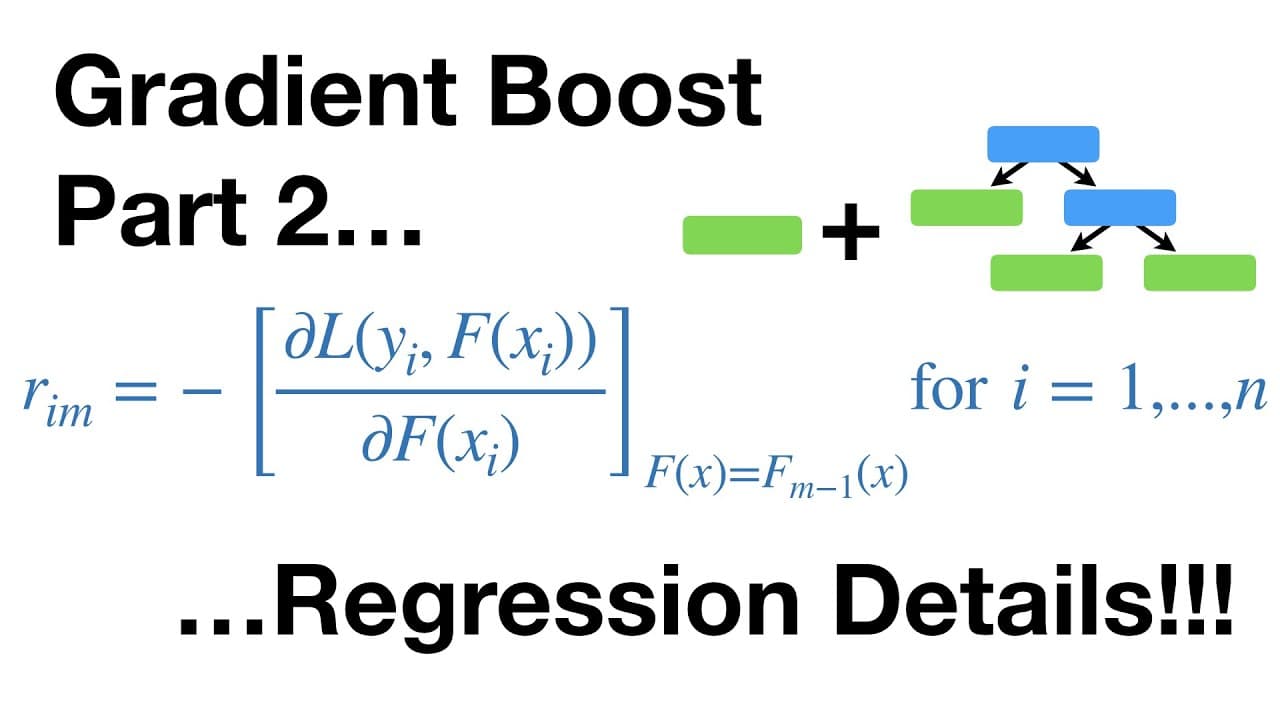
Gradient boosting for regression initializes a model with a constant value based on a loss function, typically the squared residual, and iteratively fits regression trees to predict residuals. The output values for each leaf in the trees are computed to minimize the loss, ultimately improving predictions for the observed values.
Transcript
gradient boost is awesome gradient boost is cool now we're going to dive into some regression details stack Quest hello I'm Josh starmer and welcome to stack Quest today we're going to continue our series on gradient boost specifically we're going to dive into the algorithmic details of how gradient boost is used for regression note this stat Quest... Read More
Key Insights
- 😒 Gradient boost for regression uses a loss function, typically the squared residual, to evaluate the fit of the model and calculate the gradient.
- 🌲 The algorithm iteratively fits regression trees to the residuals, adjusting the predictions based on the output values of the trees.
- 🌸 Output values for each leaf in the regression tree are determined by finding the value of gamma that minimizes the loss function.
Install to Summarize YouTube Videos and Get Transcripts
Explore YouTube Video Summarizer or Get YouTube Transcript Extractor
Questions & Answers
Q: What is the main purpose of the gradient boost algorithm for regression?
The main purpose of the gradient boost algorithm for regression is to improve the accuracy of predictions by iteratively fitting regression trees to the residuals and adjusting the predictions based on the output values of the trees.
Q: How is the loss function used in gradient boost for regression?
The loss function, which is the squared residual in this case, is used to measure the difference between the observed and predicted values. It helps in evaluating the fit of the model and is differentiated to calculate the gradient.
Q: How are output values determined for each leaf in the regression tree?
The output values for each leaf in the regression tree are determined by finding the value of gamma that minimizes the summation of the loss function for the samples in the leaf. In this example, the output values are computed as the averages of the residuals.
Q: What is the role of the learning rate in gradient boost for regression?
The learning rate, represented by the Greek character 'new', determines the contribution of each tree to the final prediction. A smaller learning rate reduces the impact of each tree and can lead to improved accuracy in the long run.
Summary & Key Takeaways
-
The video explains the algorithmic details of gradient boost for regression, starting with a simple training dataset of height measurements, favorite colors, genders, and weights.
-
The loss function used for regression with gradient boost is the squared residual, which measures the difference between observed and predicted values.
-
The video walks through the steps of initializing the model, building regression trees to predict residuals, calculating output values for leaf nodes, and making new predictions based on the previous predictions and output values.
Read in Other Languages (beta)
Share This Summary 📚
Summarize YouTube Videos and Get Video Transcripts with 1-Click
Try YouTube Summary with ChatGPT & Claude or YouTube Transcript Generator
Explore More Summaries from StatQuest with Josh Starmer 📚

Summarize YouTube Videos and Get Video Transcripts with 1-Click
Try YouTube Summary with ChatGPT & Claude or YouTube Transcript Generator