What Are One-Hot, Label, and Target Encoding Techniques?
TL;DR
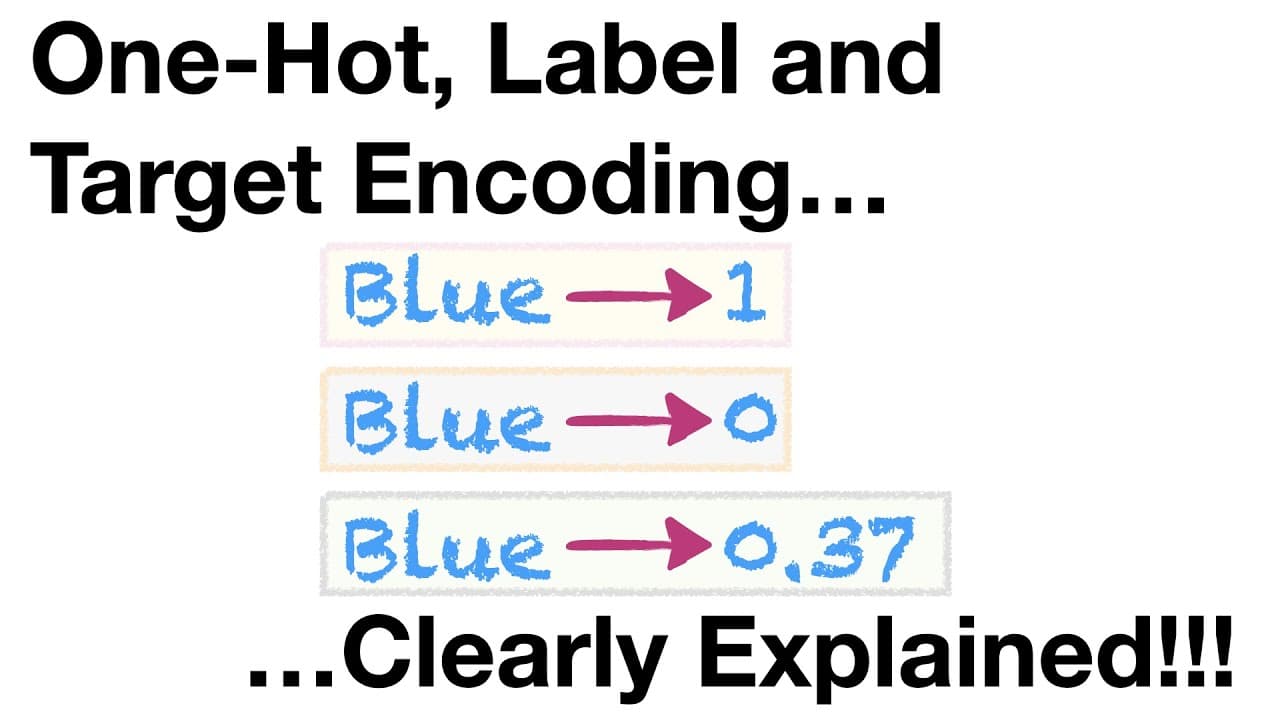
One-hot encoding converts discrete variables into separate binary columns, while label encoding assigns arbitrary numbers to options. Target encoding improves on these methods by using the mean of the target variable to replace discrete options, which may involve using a weighted mean to reduce data scarcity effects. Techniques like k-fold target encoding help mitigate data leakage during this process.
Transcript
one hot label Target encoding yeah yeah stack Quest hello I'm Josh starmer and welcome to statquest today we're going to talk about one hot label and Target encoding and they're going to be clearly explained you don't have to worry about the details of scaling your stuff up in the cloud cause lightning will take care of it for you bam this stat Que... Read More
Key Insights
- 🎰 Discrete variables are often converted into numerical values for machine learning algorithms.
- 😅 One hot encoding and label encoding are two methods used for this conversion.
- 🎯 Target encoding is a more advanced approach that uses the mean value of the target variable to replace discrete options.
- 🎯 Weighted mean can be employed in target encoding to address scarcity of data for certain options.
- 🎯 Data leakage, which can lead to overfitting, is a concern when using target encoding but can be mitigated with techniques like k-fold target encoding.
- 🎯 Leave one out target encoding is an alternative method that uses all target values except one for encoding.
- 🎯 The success of different target encoding approaches may vary depending on the specific dataset.
Install to Summarize YouTube Videos and Get Transcripts
Explore YouTube Video Summarizer or Get YouTube Transcript Extractor
Questions & Answers
Q: Why do popular machine learning algorithms often struggle with discrete variables?
Machine learning algorithms like neural networks are typically designed to work with numerical data, and discrete variables can cause issues in their calculations.
Q: What is the purpose of one hot encoding?
One hot encoding converts discrete variables into multiple columns, each representing an option and having a value of 1 or 0, allowing algorithms to work with them more effectively.
Q: What is the difference between label encoding and target encoding?
Label encoding assigns arbitrary numbers to discrete options, while target encoding calculates the mean value of the target variable for each option and uses it as the replacement value.
Q: How does weighted mean help in target encoding with scarce data?
Weighted mean considers both the mean value of the option and the overall mean of the target variable, allowing the encoding to be more influenced by the available data.
Summary & Key Takeaways
-
Discrete variables are often converted into numerical values for machine learning algorithms, and one method is one hot encoding, where each option gets its own column with 1s and 0s.
-
Another method is label encoding, where options are assigned arbitrary numbers, but this may cause problems with some machine learning algorithms.
-
Target encoding is a more advanced method that uses the mean value of the target variable to replace the discrete options, but it may require a weighted mean to address scarcity of data for some options.
Read in Other Languages (beta)
Share This Summary 📚
Summarize YouTube Videos and Get Video Transcripts with 1-Click
Try YouTube Summary with ChatGPT & Claude or YouTube Transcript Generator
Explore More Summaries from StatQuest with Josh Starmer 📚


Summarize YouTube Videos and Get Video Transcripts with 1-Click
Try YouTube Summary with ChatGPT & Claude or YouTube Transcript Generator