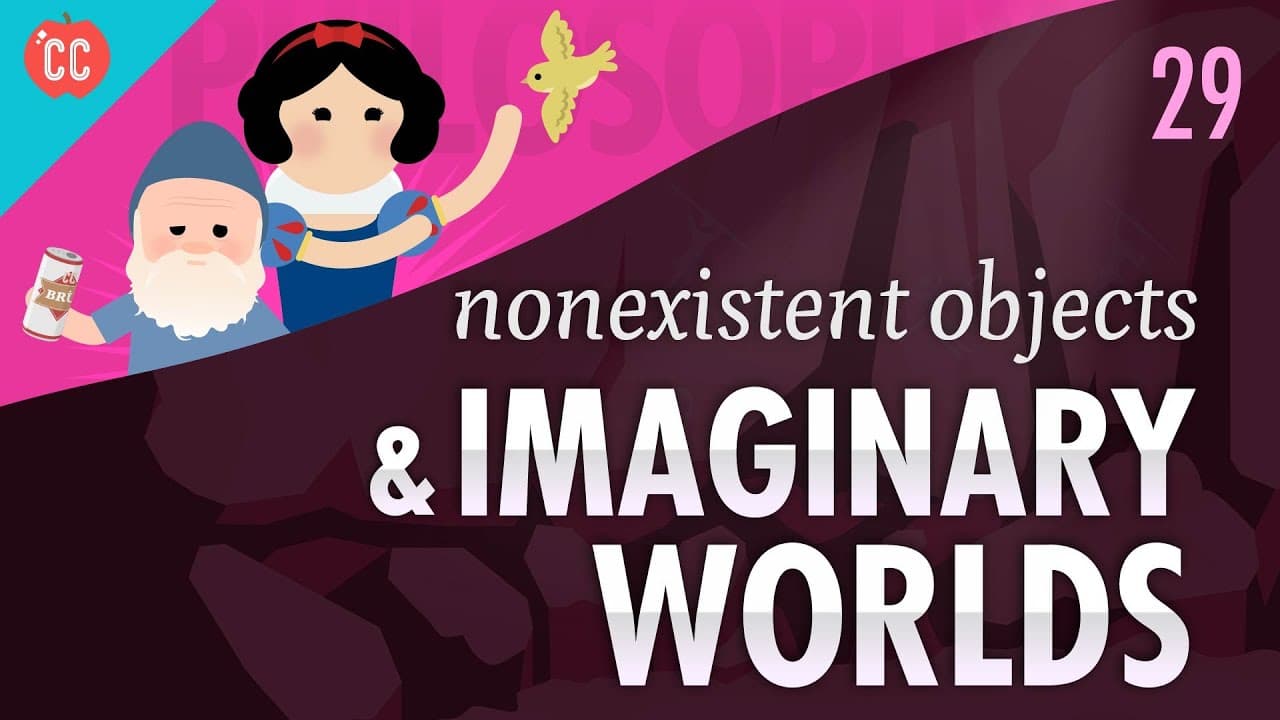
Nonexistent Objects & Imaginary Worlds: Crash Course Philosophy #29
TL;DR
Exploring truth in fictional realms and nonexistent objects.
Transcript
Sherlock Holmes lives at 221C Baker Street. Santa Claus has eight reindeer. Harry Potter’s best friend is Draco Malfoy. If a zombie touches your skin, you’ll become a zombie. I just made a series of assertions. They all make sense, generally speaking. They contain subjects and verbs and are grammatically legit. But what is their truth-value? I’m su... Read More
Key Insights
- Language enables us to conceptualize and communicate about nonexistent objects, allowing us to create and discuss imaginary worlds.
- Assertions about nonexistent objects, like fictional characters, can have truth-values within their own universes of discourse.
- Bertrand Russell argued that statements about nonexistent entities are false due to the lack of a real-world referent.
- Alexius Meinong proposed an ontology where nonexistent objects can still have being, categorized into absistence, subsistence, and existence.
- Fictional universes have their own rules, allowing for true statements within their context, despite being false in the real world.
- The concept of universes of discourse helps us navigate different realities, distinguishing between what is true in each context.
- Our ability to engage with fictional realities enhances our understanding of hypothetical scenarios and future possibilities.
- The discussion of nonexistent objects bridges the gap between language and aesthetics, highlighting the role of imagination in philosophy.
Install to Summarize YouTube Videos and Get Transcripts
Explore YouTube Video Summarizer or Get YouTube Transcript Extractor
Questions & Answers
Q: What role does language play in conceptualizing nonexistent objects?
Language plays a crucial role in conceptualizing nonexistent objects as it allows us to track and communicate ideas that do not correspond with anything in the real world. It enables us to create and discuss imaginary worlds, bridging the gap between physical reality and the abstract constructs of our imagination.
Q: How does Bertrand Russell view assertions about nonexistent entities?
Bertrand Russell views assertions about nonexistent entities as false because there is no real-world referent for such statements. He argues that without an actual object to refer to, any proposition about a nonexistent entity cannot hold true, as demonstrated in his analysis of the statement about the present king of France.
Q: What is Meinong's ontology of nonexistent objects?
Alexius Meinong's ontology categorizes nonexistent objects into three classes: absistence, subsistence, and existence. He posits that even things that do not exist in reality can have being. Absistent objects are those we can think about, subsistent objects include concepts like numbers, and existent objects are those present in the physical world.
Q: What is a universe of discourse?
A universe of discourse is a metaphorical domain where conversations take place, allowing assertions to be true or false within that context. It helps us understand how fictional worlds operate with their own rules, enabling true statements about imaginary objects within their specific universe, even if those statements are false in the real world.
Q: How do fictional universes differ from the real world?
Fictional universes differ from the real world as they operate under their own set of rules, which may not align with real-world laws. Within these universes, certain assertions can be true based on the fictional context, allowing for a unique truth-value system distinct from the actual world.
Q: How does the concept of universes of discourse apply to fictional narratives?
The concept of universes of discourse applies to fictional narratives by providing a framework to understand how truth-values can vary within different contexts. It allows us to distinguish between the reality of fictional worlds and our own, enabling us to engage with stories and characters as if they were real within their narrative universe.
Q: What philosophical skills are developed by engaging with fictional realities?
Engaging with fictional realities develops philosophical skills such as understanding hypothetical scenarios, exploring future possibilities, and distinguishing between different universes of discourse. This engagement enhances our ability to conceptualize complex ontological questions and navigate the intersection between language, imagination, and reality.
Q: What is the philosophical significance of discussing nonexistent objects?
Discussing nonexistent objects holds philosophical significance as it challenges our understanding of reality, existence, and truth. It highlights the role of language and imagination in shaping our perception of the world, bridging the gap between philosophy of language and aesthetics, and expanding our cognitive abilities to conceptualize abstract ideas.
Summary & Key Takeaways
-
The video explores how language allows us to think and talk about nonexistent objects, leading to the creation of imaginary worlds. It delves into the truth-values of assertions about fictional entities and discusses the philosophical implications of such discourse.
-
Bertrand Russell and Alexius Meinong offer differing views on the existence of nonexistent objects, with Meinong proposing an ontology that accommodates imaginary beings. The concept of universes of discourse is introduced to explain how truth-values can vary across different contexts.
-
The ability to conceptualize fictional realities aids in understanding hypothetical scenarios and future possibilities. This skill highlights the intersection of language and aesthetics, showcasing the philosophical significance of imagination in discussing nonexistent and imaginary objects.
Read in Other Languages (beta)
Share This Summary 📚
Summarize YouTube Videos and Get Video Transcripts with 1-Click
Try YouTube Summary with ChatGPT & Claude or YouTube Transcript Generator
Explore More Summaries from CrashCourse 📚
Summarize YouTube Videos and Get Video Transcripts with 1-Click
Try YouTube Summary with ChatGPT & Claude or YouTube Transcript Generator