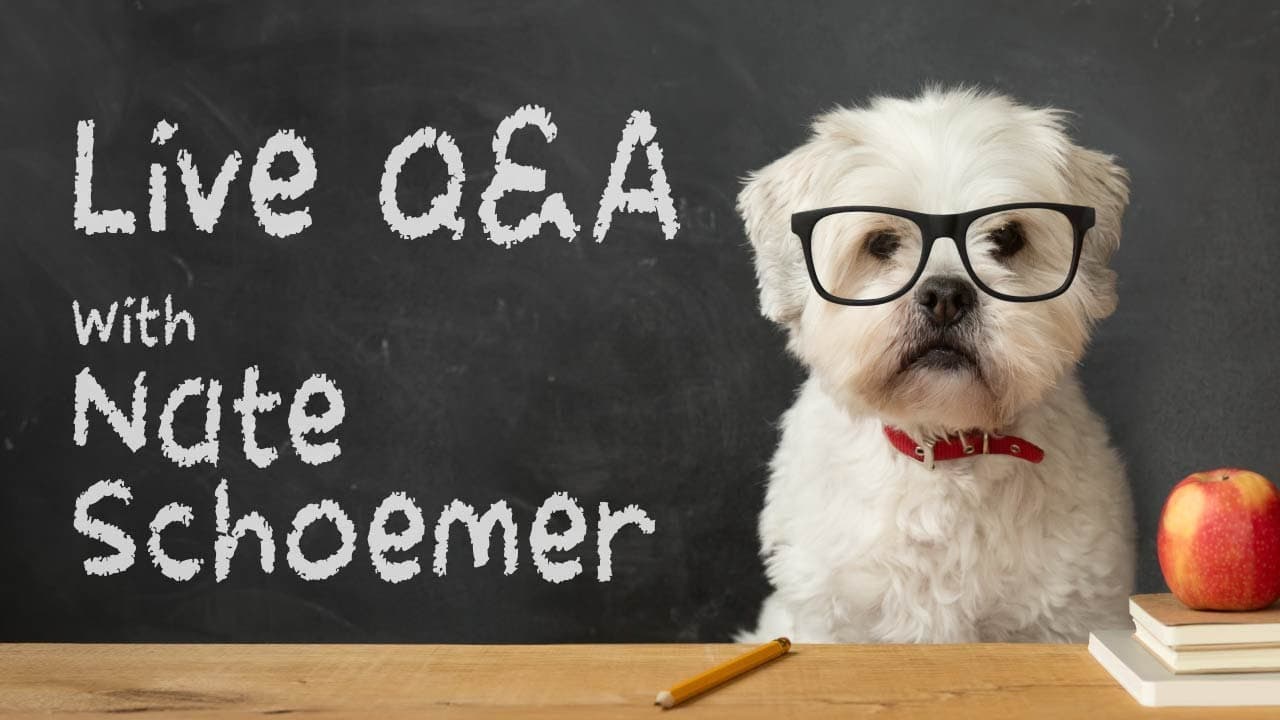
How to Address Dog Behavioral Issues with Nate Schoemer
TL;DR
To address dog behavioral issues, start with foundational training techniques such as engagement, luring, and leash pressure. Gradually increase environmental challenges to generalize obedience. Use appropriate tools like prong or remote collars if necessary, ensuring the dog is directional to the correction. Consistency and patience are key for effective training.
Transcript
happy saturday everybody um sorry i'm running a little bit behind today i was trying to find or get my mic rather but unfortunately i failed to charge it the other day so hopefully the audio sounds okay all right first one is how do we get a better form with post the stand command please describe steps of the process we're not ready for shaping box... Read More
Key Insights
- Engagement training is crucial for building a dog's focus and responsiveness.
- Luring helps guide dogs into desired positions using treats or toys.
- Leash pressure is a method to teach dogs to respond to physical cues.
- Prong collars are useful for dogs that don't respond to martingale corrections.
- Remote collars provide off-leash reliability but require proper introduction.
- Behavioral issues like reactivity should be addressed with gradual exposure.
- Consistency in training helps reinforce desired behaviors over time.
- Filming training sessions can help identify subtle handling mistakes.
Install to Summarize YouTube Videos and Get Transcripts
Explore YouTube Video Summarizer or Get YouTube Transcript Extractor
Questions & Answers
Q: How to teach a dog the stand command effectively?
To teach the stand command, guide the dog with a treat towards their chest, encouraging their back end to pop up. Use walls to prevent lateral movement and incorporate a belly band for additional guidance. Consistent practice and clear cues will help the dog understand and maintain the position.
Q: How to train a puppy to use an indoor potty?
Start by introducing a potty system like the Brilliant Pad where the dog usually goes outside. Gradually move it indoors, rewarding the dog for using it. Use a shallow container with potty pads to ensure accuracy and gradually transition the location closer to the indoor potty area.
Q: How to desensitize a dog to small mammals?
Desensitizing a dog to small mammals involves gradual exposure in controlled environments. Start with basic obedience in a distraction-free area, then slowly introduce more challenging settings. Use positive reinforcement and corrections as needed, ensuring the dog remains focused on commands despite distractions.
Q: What to do if a dog herds other pets?
Address herding behavior by using negative reinforcement markers like 'wrong' paired with leash pressure to redirect the dog to a preferred behavior. Consistency in enforcing rules and providing clear alternatives will help reduce unwanted herding tendencies.
Q: How to handle a dog that doesn't want to move from a spot?
Use a leash to reinforce commands like 'off' when the dog is in a restricted area. If the dog resists, apply gentle pressure until they comply, then reward them for moving. Consistent enforcement of rules will help the dog understand expectations.
Q: How to stop a puppy from jumping and biting guests?
Correct jumping and nipping behavior with a firm 'no' followed by a leash pop. Inform guests about the training process and reinforce the correction consistently. Reward the puppy for calm behavior to encourage positive interactions.
Q: How to help a dog anxious in the car?
Gradually acclimate the dog to the car by rewarding calm behavior in and around the vehicle. Start with short, positive trips and increase duration as the dog becomes more comfortable. Use a crate or barrier for safety and to reduce anxiety.
Q: How to manage a partner not reinforcing training rules?
Focus on training the dog yourself, ensuring consistent reinforcement of rules and commands. Dogs can differentiate between handlers, so maintain structure and consistency in your interactions, even if others do not follow the same guidelines.
Summary & Key Takeaways
-
Engagement training involves getting the dog's attention using treats or toys, setting the foundation for more advanced obedience work. This is crucial for building focus.
-
Leash pressure is a technique where gentle pressure is applied to guide the dog into a position, turning off the pressure as soon as the dog complies, reinforcing the desired behavior.
-
Remote collars offer a way to correct dogs at a distance, providing off-leash reliability. Proper introduction and pairing with leash cues are necessary to ensure the dog understands corrections.
Read in Other Languages (beta)
Share This Summary 📚
Summarize YouTube Videos and Get Video Transcripts with 1-Click
Try YouTube Summary with ChatGPT & Claude or YouTube Transcript Generator
Explore More Summaries from Nate Schoemer 📚

Summarize YouTube Videos and Get Video Transcripts with 1-Click
Try YouTube Summary with ChatGPT & Claude or YouTube Transcript Generator