How Does Cooperation Overcome Conflict in Psychology?
TL;DR
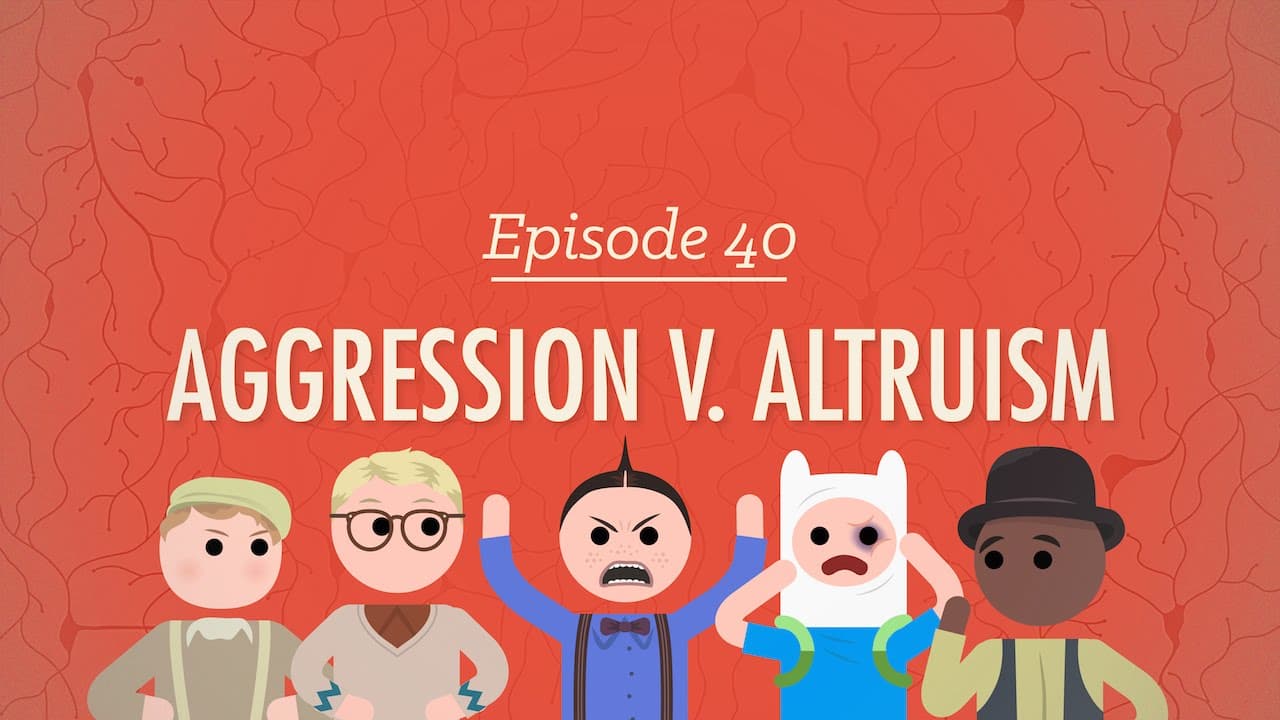
The Robber's Cave Experiment demonstrated that conflict arises from competition and negative prejudices, but shared goals can foster cooperation. Aggression stems from biological and environmental factors, while altruism is influenced by social norms and self-interest. Understanding these dynamics can help address conflicts and promote peaceful interactions.
Transcript
Let me tell you about Robber's Cave. In 1954, a group of 11 boys, all about 12 years old, were invited to a special summer camp in the deep woods of southeastern Oklahoma, at a place called Robber's Cave State Park. None of the boys knew each other, although they all came from similar backgrounds. They spent their days bonding over things like game... Read More
Key Insights
- The Robber's Cave Experiment showed that shared goals can turn rivals into allies.
- Realistic Conflict Theory posits that competition over resources leads to conflict.
- Aggression emerges from a mix of genetic, neurological, and environmental factors.
- The Frustration-Aggression Hypothesis links blocked goals to aggressive behavior.
- Altruism is influenced by social norms and can be hindered by the bystander effect.
- Social Exchange Theory suggests people help others based on cost-benefit analysis.
- Conflict often arises from self-interest, leading to social traps and resource depletion.
- Cooperation has the potential to resolve conflicts and foster peaceful interactions.
Install to Summarize YouTube Videos and Get Transcripts
Explore YouTube Video Summarizer or Get YouTube Transcript Extractor
Questions & Answers
Q: How does the Robber's Cave Experiment demonstrate conflict resolution?
The Robber's Cave Experiment demonstrated conflict resolution by showing that shared goals can turn rivals into allies. Initially, two groups of boys at a summer camp developed hostility due to competition. However, when researchers introduced common objectives that required cooperation, the boys overcame their differences and worked together, illustrating the power of shared goals in resolving conflicts.
Q: What factors contribute to aggression according to psychology?
Aggression in psychology is influenced by a combination of genetic, neurological, and environmental factors. Genetic studies, particularly on twins, suggest a hereditary component. Neurologically, areas like the limbic system facilitate aggression, and diminished frontal lobe activity affects impulse control. Environmental influences, such as experiences and social learning, also play a significant role in aggressive behavior.
Q: What is the Frustration-Aggression Hypothesis?
The Frustration-Aggression Hypothesis posits that aggression arises when individuals are blocked from achieving their goals. This theory suggests that frustration, stemming from obstacles or unmet expectations, can lead to aggressive behavior. An example is found in baseball, where pitchers are more likely to hit batters if frustrated by recent events, such as a home run or a teammate being hit.
Q: How does altruism differ from self-interest?
Altruism involves selfless concern for the welfare of others, often manifested in acts of kindness without expecting personal gain. In contrast, self-interest focuses on actions that benefit oneself. Social Exchange Theory suggests that even altruistic acts may have underlying self-interest, as people weigh the costs and benefits, sometimes expecting reciprocation or social rewards for helping others.
Q: What is the bystander effect and how does it impact altruism?
The bystander effect occurs when individuals are less likely to help in emergencies due to the presence of others. This diffusion of responsibility weakens altruistic instincts, as people assume someone else will intervene. Experiments show that individuals are more likely to help when alone, highlighting how social dynamics can deter altruistic behavior and reduce the likelihood of assistance in group settings.
Q: What is Social Exchange Theory in the context of helping behavior?
Social Exchange Theory in helping behavior suggests that individuals assist others based on a cost-benefit analysis. This theory posits that people are motivated by self-interest, weighing the potential rewards against the effort and risks involved. Helping behavior is influenced by the expectation of reciprocation or social rewards, indicating that altruistic acts may have an underlying self-serving component.
Q: How do social traps contribute to conflict?
Social traps contribute to conflict by encouraging individuals to act in their short-term self-interest, often harming the collective interest. This behavior depletes shared resources or creates long-term negative consequences, fostering competition and rivalry. Examples include environmental degradation from overexploitation or individuals prioritizing personal gain over group well-being, leading to ongoing conflicts and resource scarcity.
Q: What role does cooperation play in conflict resolution?
Cooperation plays a crucial role in conflict resolution by fostering collaboration and mutual understanding. When individuals or groups work towards shared goals, they can overcome differences and build trust. The Robber's Cave Experiment demonstrated how cooperation transformed rival groups into allies, highlighting its potential to resolve conflicts and promote peaceful interactions by prioritizing common interests over individual competition.
Summary & Key Takeaways
-
The Robber's Cave Experiment illustrated how competition and negative prejudices can lead to conflict, but shared goals can foster cooperation. This experiment supports Realistic Conflict Theory, which suggests that rivalry over resources creates discord. By integrating the groups and setting common objectives, the researchers demonstrated how cooperation can transform adversaries into allies.
-
Aggression is influenced by genetic, neurological, and biochemical factors, as well as environmental experiences. Studies have shown that aggression can be linked to diminished activity in the frontal lobes, which affects impulse control. Psychological factors, such as frustration from blocked goals, also contribute to aggressive behavior, as demonstrated by the Frustration-Aggression Hypothesis.
-
Altruism, or selfless concern for others, is affected by social norms like the reciprocity norm and social responsibility norm. The bystander effect, where individuals are less likely to help in the presence of others, can weaken altruistic tendencies. Social Exchange Theory suggests that people help others based on a cost-benefit analysis, balancing personal rewards with the effort required.
Read in Other Languages (beta)
Share This Summary 📚
Summarize YouTube Videos and Get Video Transcripts with 1-Click
Try YouTube Summary with ChatGPT & Claude or YouTube Transcript Generator
Explore More Summaries from CrashCourse 📚



Summarize YouTube Videos and Get Video Transcripts with 1-Click
Try YouTube Summary with ChatGPT & Claude or YouTube Transcript Generator