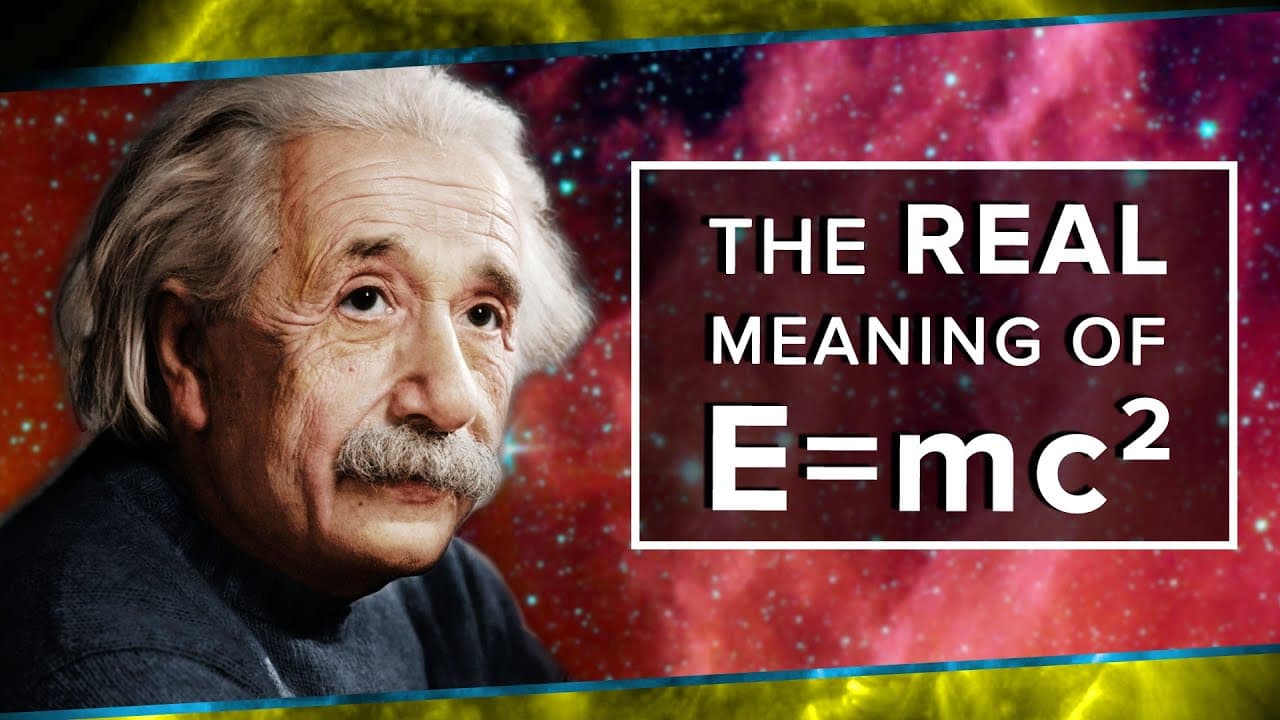
The Real Meaning of E=mc²
TL;DR
E=mc² explains mass-energy equivalence, not mass conversion.
Transcript
A hydrogen atom has less mass than the combined masses of the proton and the electron that make it up. That's right, less. How can something weigh less than the sum of its parts? Because of this. And today, we're going to clarify what the most famous equation in physics really says. [MUSIC PLAYING] E equals mc squared is probably the most famous eq... Read More
Key Insights
- Einstein's equation E=mc² is often misunderstood as mass being converted into energy, but it actually describes the equivalence of mass and energy.
- Mass is not simply the sum of an object's parts; it also depends on the arrangement and motion of those parts.
- A running watch has more mass than a stopped watch due to the kinetic and potential energy of its moving parts.
- The mass of a hydrogen atom is less than the sum of its parts due to negative potential energy.
- Light carries energy, and when it escapes an object, the object's mass decreases, as seen with the sun losing mass as it shines.
- In a closed system, like a mirrored box with a flashlight, the total mass remains constant despite internal energy changes.
- Protons and neutrons are made of quarks, and their mass largely comes from quark potential energy, not from the mass of quarks themselves.
- Mass is a property of energy, and every time we use a scale, we are measuring an object's energy content.
Install to Summarize YouTube Videos and Get Transcripts
Explore YouTube Video Summarizer or Get YouTube Transcript Extractor
Questions & Answers
Q: What does E=mc² actually mean?
E=mc² describes the equivalence of mass and energy, meaning mass is a property of energy. It does not imply that mass can be converted into energy, but rather that mass and energy are two forms of the same thing, with mass being a measure of an object's energy content.
Q: Why does a running watch have more mass than a stopped watch?
A running watch has more mass because its moving parts, such as gears and hands, possess kinetic energy. Additionally, the wound-up springs have potential energy, and friction generates thermal energy. All these energy forms contribute to the watch's mass, according to E=mc².
Q: How can a hydrogen atom weigh less than its constituent parts?
A hydrogen atom weighs less than its constituent proton and electron because of negative potential energy. When the electron and proton attract each other, their potential energy decreases, and this negative potential energy reduces the total mass of the hydrogen atom.
Q: Does the sun convert mass into energy?
The sun does not convert mass into energy. Instead, the energy in sunlight comes from the kinetic and potential energy of the sun's particles. As the sun emits light, it loses energy, and consequently, its mass decreases slightly, but this is not a conversion of mass into energy.
Q: What happens to the mass of a closed box with a flashlight inside when the flashlight is turned on?
When a flashlight inside a closed box is turned on, the flashlight loses mass due to energy emission. However, the total mass of the box remains unchanged because the light energy is confined within the box, contributing to the box's overall mass as per E=mc².
Q: How do quarks contribute to the mass of protons and neutrons?
Quarks contribute to the mass of protons and neutrons primarily through quark potential energy. The combined mass of quarks is significantly less than that of protons and neutrons, indicating that the mass largely arises from the potential energy within the particles.
Q: Is mass an indicator of the amount of matter in an object?
Mass is not an indicator of the amount of matter in an object. Instead, it reflects the total energy content of the object, including kinetic, potential, and thermal energies. Mass is a property of energy, not a direct measure of matter.
Q: What is the significance of measuring mass in physics?
Measuring mass in physics is significant because it allows us to understand the energy content of an object. Mass provides insights into the object's kinetic, potential, and thermal energies, as well as its resistance to acceleration and gravitational interactions, making it a crucial concept in understanding physical phenomena.
Summary & Key Takeaways
-
E=mc², the famous equation by Einstein, is often misunderstood as implying mass can be converted into energy. Instead, it explains the equivalence between mass and energy, showing that mass is a property of energy.
-
Mass is not just the sum of an object's parts; it also depends on the energy within the object. This includes kinetic, potential, and thermal energies, which all contribute to an object's mass.
-
The video explains that while mass seems to indicate the amount of matter, it actually reflects the total energy content of an object. This understanding helps clarify misconceptions about mass-energy conversion.
Read in Other Languages (beta)
Share This Summary 📚
Summarize YouTube Videos and Get Video Transcripts with 1-Click
Try YouTube Summary with ChatGPT & Claude or YouTube Transcript Generator
Explore More Summaries from PBS Space Time 📚
Summarize YouTube Videos and Get Video Transcripts with 1-Click
Try YouTube Summary with ChatGPT & Claude or YouTube Transcript Generator