Approximating with powers of 10 | Numbers and operations | 8th grade | Khan Academy
TL;DR
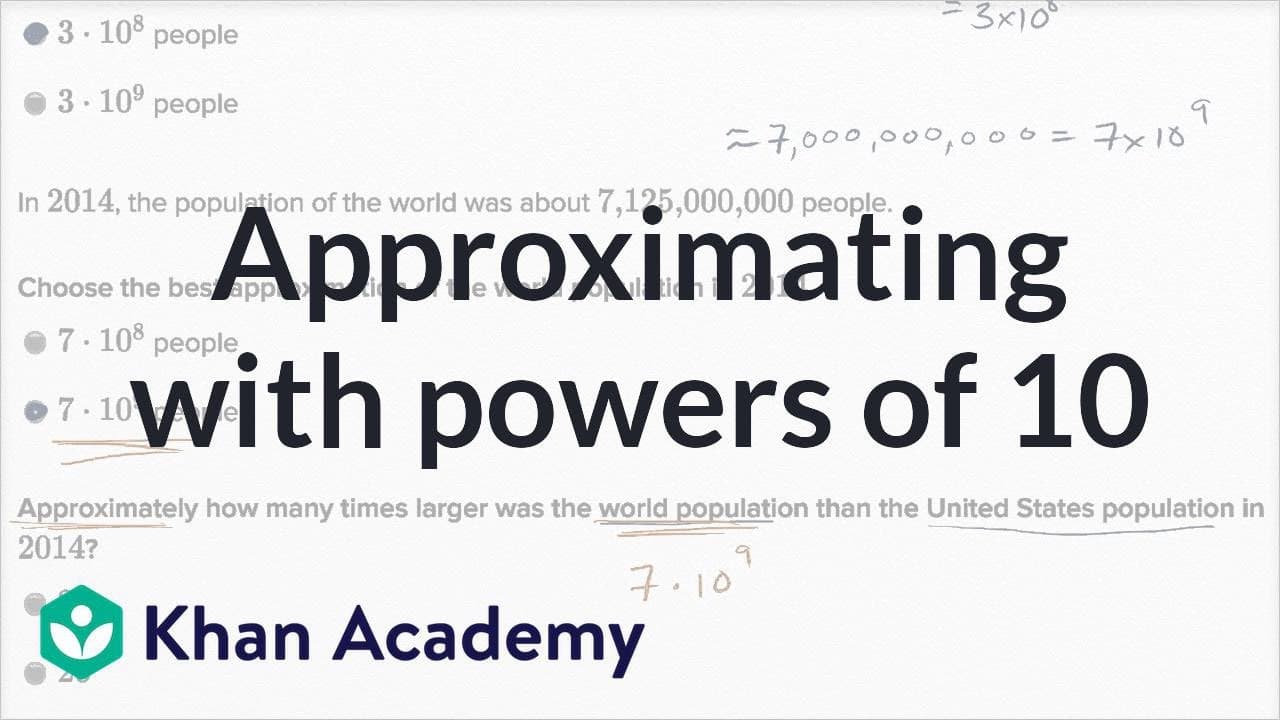
The video explains how to approximate the population of the United States and the world in 2014 using powers of ten.
Transcript
- [Voiceover] In 2014, the population of the United States was about 318,900,000 people. Choose the best approximation of the United States population in 2014. So they say three times 10 to the eighth people or three times 10 to the ninth people. This is a big difference. This is a factor of 10. This is 10 times this right over here. So which one's... Read More
Key Insights
- 🇺🇸 Rounding to the nearest hundred million, the population of the United States in 2014 was approximately three times 10 to the eighth, or 300 million.
- 🌍 Rounding to the nearest billion, the world population in 2014 was approximately seven times 10 to the ninth, or 7 billion.
- 🇺🇸 The world population in 2014 was approximately 2.33 times larger than the population of the United States.
- ✊ Approximating populations using powers of ten enables easier representation of large numbers.
- 🛝 Rounding to significant digits helps simplify population approximations while maintaining reasonable accuracy.
- 🇺🇸 The difference in approximation between the world and United States populations demonstrates the vast difference in scale between the two.
- 👻 Using powers of ten simplifies calculations and allows for quick comparisons between different population sizes.
Install to Summarize YouTube Videos and Get Transcripts
Explore YouTube Video Summarizer or Get YouTube Transcript Extractor
Questions & Answers
Q: How was the population of the United States approximated in 2014?
The population of the United States in 2014 was approximated to be three times 10 to the eighth, or 300 million, by rounding to the nearest hundred million. This is a reasonable approximation for the population.
Q: How was the world population approximated in 2014?
The world population in 2014 was approximated to be seven times 10 to the ninth, or 7 billion, by rounding to the nearest billion. This approximation provides a close estimate of the actual population.
Q: Why was the approximation of the world population significantly larger than that of the United States population?
The world population was approximately 2.33 times larger than the population of the United States in 2014. This is because the world population approximation was divided by the United States population approximation, resulting in a multiplication factor of 7/3, or 2 1/3. This ratio accounts for the difference in size between the two populations.
Q: What is the significance of using powers of ten in population approximations?
Powers of ten make it easier to express large numbers. In the case of population approximations, powers of ten are used to represent the magnitude of the populations accurately, while rounding to a reasonable number for simplicity.
Summary & Key Takeaways
-
The population of the United States in 2014 was approximately 318.9 million, rounded to the nearest hundred million, which is three times 10 to the eighth.
-
The population of the world in 2014 was approximately 7.125 billion, rounded to the nearest billion, which is seven times 10 to the ninth.
-
The world population in 2014 was approximately 2.33 times larger than the population of the United States, based on the approximations.
Read in Other Languages (beta)
Share This Summary 📚
Summarize YouTube Videos and Get Video Transcripts with 1-Click
Try YouTube Summary with ChatGPT & Claude or YouTube Transcript Generator
Explore More Summaries from Khan Academy 📚





Summarize YouTube Videos and Get Video Transcripts with 1-Click
Try YouTube Summary with ChatGPT & Claude or YouTube Transcript Generator