Chain Rule With Partial Derivatives - Multivariable Calculus
TL;DR
This content explains how to use the chain rule to find partial derivatives, with examples and step-by-step explanations.
Transcript
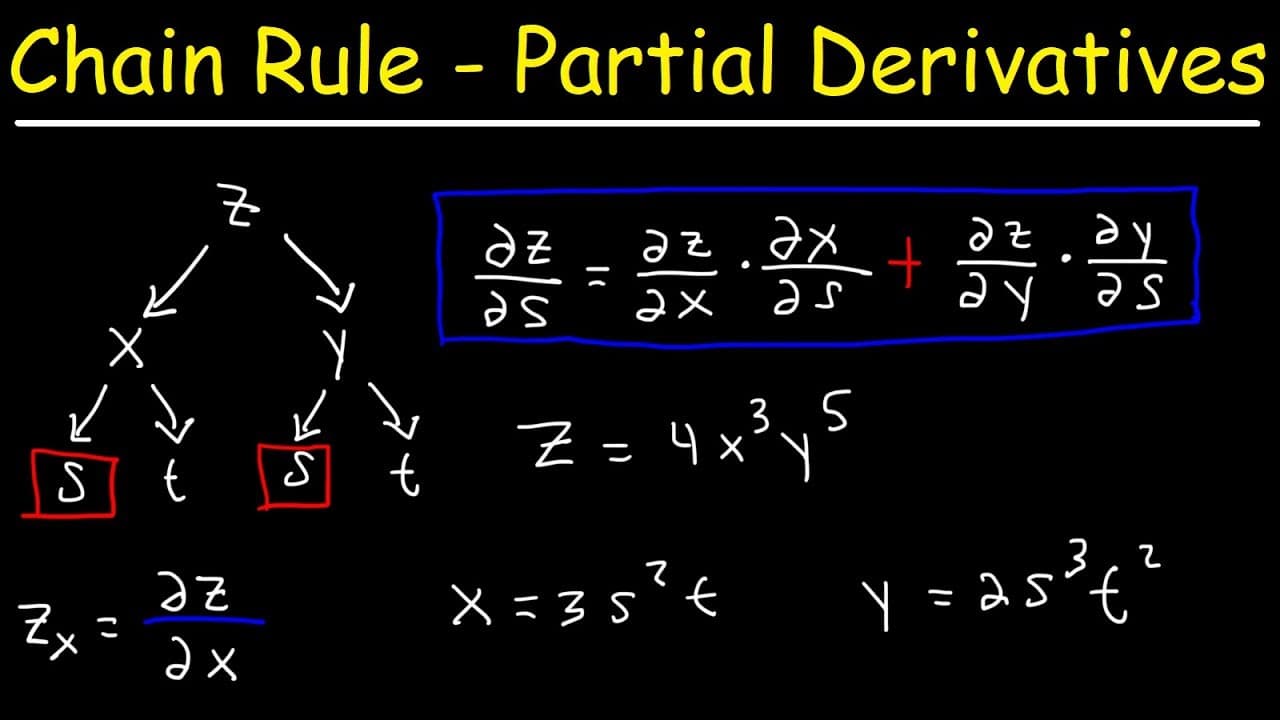
let's work on this problem use the chain rule to find dz dt how can we do this well we need to use partial derivatives so z is a function of x and y as we can see here and x is a function of t x is equal to 4 t 4 plus t squared rather and y is also a function of t so to find dz dt first we need to find the partial derivative of z with respect to x ... Read More
Key Insights
- 📏 The chain rule is necessary for finding partial derivatives when a function depends on multiple variables.
- 🫡 The process involves finding partial derivatives of the function with respect to each variable and multiplying them together.
- 🫡 The chain rule can be used for functions with different numbers of variables and allows for finding the rate of change with respect to a specific variable.
Install to Summarize YouTube Videos and Get Transcripts
Explore YouTube Video Summarizer or Get YouTube Transcript Extractor
Questions & Answers
Q: What is the purpose of using partial derivatives in the chain rule?
The chain rule allows us to find the rate of change of a function with respect to one variable when that function depends on multiple variables. In the case of partial derivatives, we focus on how one variable affects the function while treating the other variables as constants.
Q: How is the chain rule applied when finding partial derivatives?
To apply the chain rule, we take the derivative of the function with respect to one variable, while treating the other variables as constants. We then multiply this derivative by the corresponding partial derivative of the variable with respect to the desired variable. This process is repeated for each variable involved.
Q: Why do we need to use partial derivatives for finding dz/dt?
The function z has two variables, x and y, while the variable we are interested in, t, is not directly involved. To account for this, we use partial derivatives to find how z changes with respect to x and y, and then combine these changes with the corresponding changes in x and y with respect to t.
Q: Can other mathematical functions be used with the chain rule for finding partial derivatives?
Yes, the chain rule can be applied to various mathematical functions where one or more variables depend on other variables. The key is to consider the dependencies and use partial derivatives accordingly.
Summary & Key Takeaways
-
The content introduces the chain rule for finding partial derivatives by using the example of finding dz/dt, where z is a function of x and y, and x and y are functions of t.
-
The formula for finding dz/dt is derived, which involves finding partial derivatives of z with respect to x and y, and partial derivatives of x and y with respect to t.
-
Two additional examples are given, demonstrating how to find partial derivatives using the chain rule with more variables.
Read in Other Languages (beta)
Share This Summary 📚
Summarize YouTube Videos and Get Video Transcripts with 1-Click
Try YouTube Summary with ChatGPT & Claude or YouTube Transcript Generator
Explore More Summaries from The Organic Chemistry Tutor 📚
Summarize YouTube Videos and Get Video Transcripts with 1-Click
Try YouTube Summary with ChatGPT & Claude or YouTube Transcript Generator