Function Operations
TL;DR
Perform operations on functions by adding, subtracting, and multiplying them, while considering their domains.
Transcript
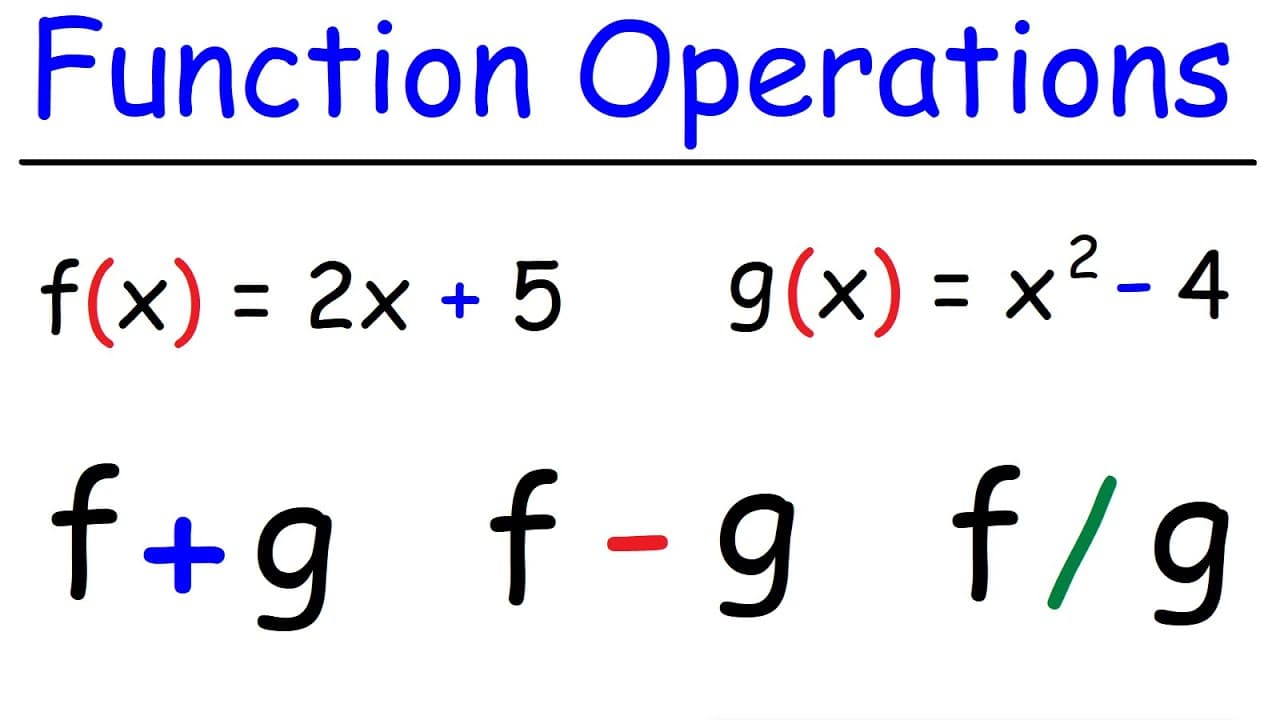
let's say that f of x is equal to two x plus five and g of x let's say g of x is x squared minus four perform the indicated operations so what is f plus g what's the sum of the two functions all you gotta do is add them 2x plus five plus x squared minus four and combine like terms so all we can combine is five and negative four which adds up to one... Read More
Key Insights
- 😑 Addition, subtraction, and multiplication of functions involve combining like terms and expanding expressions.
- 🪜 When adding or subtracting functions, the domain remains all real numbers if there are no fractions, radicals, or undefined values.
- ☺️ The domain of a function can be found by determining the values of x that make the function undefined, such as when the denominator is zero.
- 🍉 Polynomial functions are examples of functions with multiple terms.
- ✖️ The FOIL method or the distributive property can be used to multiply functions.
Install to Summarize YouTube Videos and Get Transcripts
Explore YouTube Video Summarizer or Get YouTube Transcript Extractor
Questions & Answers
Q: How do you find the sum of two functions?
To find the sum, simply add the expressions of the two functions, combining like terms if possible. The resulting function represents the sum of the two functions.
Q: What is the process for subtracting functions?
Subtracting functions involves subtracting the expressions of the two functions, again combining like terms. The resulting function represents the difference between the two functions.
Q: How do you multiply functions together?
To multiply functions, use the distributive property or the FOIL method if necessary. Multiply each term of one function by each term of the other function and then combine like terms to simplify the expression.
Q: What does the domain of a function represent?
The domain of a function represents the set of possible values that the independent variable (x) can take. It determines where the function is defined and provides restrictions on the values of x.
Q: How do you determine the domain of a function?
For functions without fractions or radicals, the domain is all real numbers since there are no restrictions on the value of x. However, if there are fractions, radicals, or any other undefined values, you need to exclude those values from the domain.
Q: What is an example of a polynomial function?
A polynomial function is a function with multiple terms, consisting of constant coefficients and various powers of the independent variable. One example is 2x^2 + 3x - 5.
Q: What happens if the denominator of a function is equal to zero?
If the denominator of a function is zero, it results in a vertical asymptote and the function becomes undefined at that point. Therefore, the value of x that makes the denominator zero is excluded from the domain.
Q: How do you represent the domain using interval notation?
In interval notation, the domain is represented by intervals separated by the union symbol. Any excluded values or intervals are stated separately. For example, if x cannot be 2 or 3, the domain would be (-∞, 2) ∪ (2, 3) ∪ (3, ∞).
Summary & Key Takeaways
-
The content explains how to add, subtract, and multiply functions by combining like terms and expanding expressions.
-
It also discusses the concept of domain and how to determine the domain of a function, depending on whether it involves fractions or radicals.
-
Examples are provided to illustrate the process of finding the sum, difference, and product of functions, as well as determining their domains.
Read in Other Languages (beta)
Share This Summary 📚
Summarize YouTube Videos and Get Video Transcripts with 1-Click
Try YouTube Summary with ChatGPT & Claude or YouTube Transcript Generator
Explore More Summaries from The Organic Chemistry Tutor 📚

Summarize YouTube Videos and Get Video Transcripts with 1-Click
Try YouTube Summary with ChatGPT & Claude or YouTube Transcript Generator