How Many Universes Are There?
TL;DR
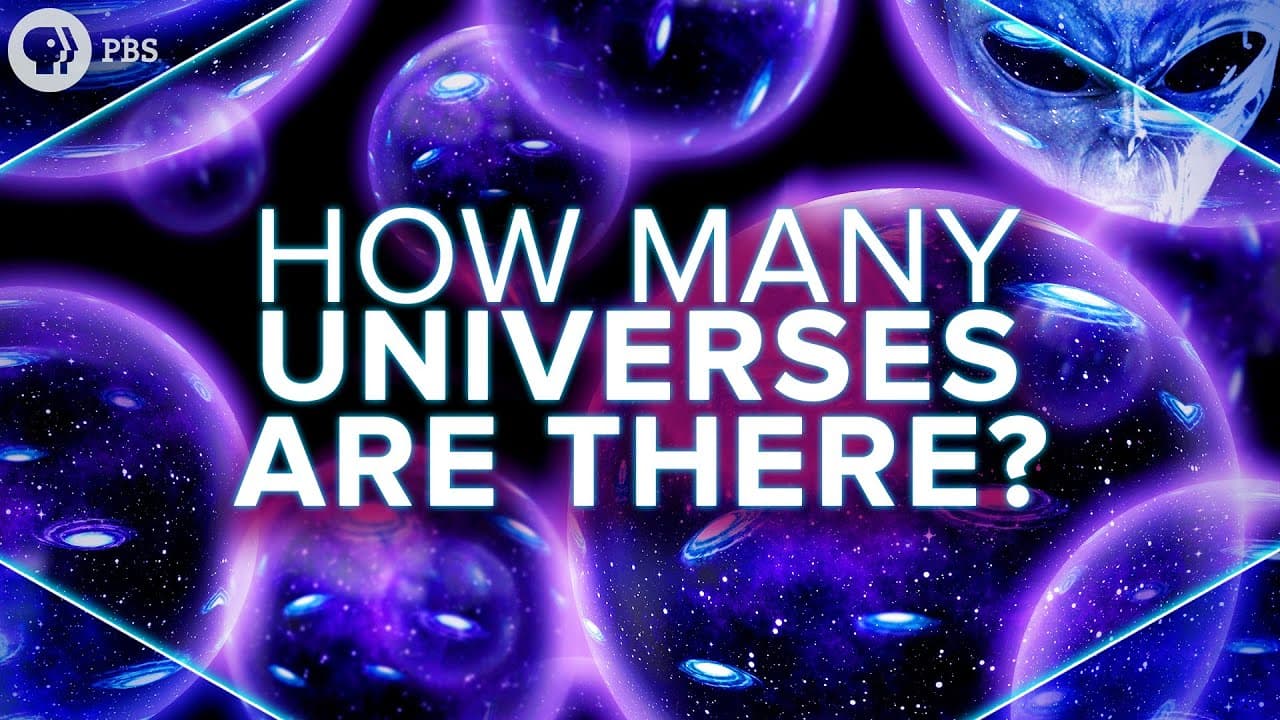
The multiverse may contain countless bubble universes with varying physics.
Transcript
Space is big, but it’s peanuts compared to the eternally inflating multiverse. But just how many bubble universes does the eternally inflating multiverse contain? What are they like? And most importantly, what can they tell us about aliens? Imagine it: the observable part of our universe is 93 billion light years across, and that’s just a small fra... Read More
Key Insights
- The observable universe is only a fraction of the potential multiverse, which may contain uncountable bubble universes.
- Eternal inflation suggests that new bubble universes continuously form and expand within a larger spacetime framework.
- The physics within each bubble universe could differ, potentially affecting dimensions and cosmological constants.
- The Anthropic Principle explains why we might exist in a universe fine-tuned for life among countless others.
- The Youngness Paradox posits that we don't see aliens because intelligent life is most common in the youngest universes.
- Bubble universes may rarely collide due to their rapid expansion, making such events unlikely in our observable universe.
- Eternal inflation remains a theoretical concept, with its implications challenging to test or prove.
- Scientific definitions, such as what constitutes a planet, can be arbitrary and may need reevaluation as understanding evolves.
Install to Summarize YouTube Videos and Get Transcripts
Explore YouTube Video Summarizer or Get YouTube Transcript Extractor
Questions & Answers
Q: What is the concept of eternal inflation?
Eternal inflation is a theoretical framework suggesting that the multiverse is continuously expanding, with new bubble universes forming within it. These bubbles emerge in a larger spacetime that expands at an accelerating rate. Each bubble represents a universe with potentially distinct physical properties and laws, contributing to the diversity of the multiverse.
Q: How does the Anthropic Principle relate to the multiverse?
The Anthropic Principle posits that we exist in a universe capable of supporting life because it must allow for our existence. In the context of the multiverse, it suggests that among countless bubble universes, we find ourselves in one fine-tuned for life. This principle helps explain why our universe has specific conditions necessary for complex chemistry and life.
Q: What is the Youngness Paradox?
The Youngness Paradox, proposed by Alan Guth, suggests that most intelligent life forms in the youngest universes due to the rapid formation of new bubble universes. As these younger universes reach the point where life can form, they outnumber older universes. This could explain the lack of contact with other civilizations, as we are likely among the first intelligent species in our universe.
Q: Why are bubble collisions considered rare?
Bubble collisions are considered rare because the rapid expansion of inflating spacetime tends to separate bubble universes before they can collide. The edges of these bubbles expand at the speed of light, and unless they form extremely close together, the intervening inflating space will push them apart faster than they can merge. As a result, collisions are unlikely within our observable universe.
Q: How does eternal inflation challenge our understanding of the universe?
Eternal inflation challenges our understanding by suggesting the existence of an infinite multiverse with diverse bubble universes. It raises questions about the nature of reality, the laws of physics, and the uniqueness of our universe. The concept is difficult to test or prove, leading to debates about its implications and the validity of using principles like the Anthropic Principle to explain cosmic phenomena.
Q: What is the significance of the inflaton field in eternal inflation?
The inflaton field is crucial in eternal inflation as it provides the energy density driving the exponential expansion of spacetime. When the inflaton field loses energy in certain regions, it leads to the formation of bubble universes with their own Big Bang events. The properties of the inflaton field influence the rate of bubble formation and the characteristics of the resulting universes.
Q: How does the debate over Pluto's status relate to scientific definitions?
The debate over Pluto's status highlights the challenges in creating scientific definitions that are clear, non-arbitrary, and scientifically useful. The International Astronomy Union's definition of a planet excluded Pluto based on its inability to clear its orbit. This decision sparked controversy, as it seemed arbitrary and failed to account for the physical nature of celestial bodies, prompting calls for reevaluation.
Q: What role does the string landscape play in the multiverse theory?
The string landscape refers to the vast array of possible minimum-energy configurations in string theory, each leading to different vacuum states and physical properties. In the multiverse theory, eternal inflation could populate the entire string landscape with bubble universes, each with distinct characteristics. This diversity might explain the specific conditions in our universe, as it is one of many possible configurations.
Summary & Key Takeaways
-
The multiverse theory suggests our universe is just one of many bubble universes, each potentially with different physical laws. Eternal inflation describes the continuous formation of these universes, expanding within a larger spacetime. The Anthropic Principle posits that we exist in a universe fine-tuned for life because it allows for our existence.
-
The Youngness Paradox offers an explanation for the Fermi Paradox, suggesting that most intelligent life forms in the youngest universes, which outnumber older ones. This could explain why we haven't encountered other civilizations. Bubble collisions are unlikely due to the rapid expansion of spacetime, making them rare in our observable universe.
-
Scientific definitions, such as the classification of planets, can be arbitrary and may not reflect the physical nature of celestial bodies. The debate over Pluto's status highlights the need for clear and scientifically useful definitions. Eternal inflation, while intriguing, remains a theoretical concept with implications that are difficult to test or prove.
Read in Other Languages (beta)
Share This Summary 📚
Summarize YouTube Videos and Get Video Transcripts with 1-Click
Try YouTube Summary with ChatGPT & Claude or YouTube Transcript Generator
Explore More Summaries from PBS Space Time 📚



Summarize YouTube Videos and Get Video Transcripts with 1-Click
Try YouTube Summary with ChatGPT & Claude or YouTube Transcript Generator