Products
Features
YouTube Video Summarizer
Summarize YouTube videos
Web & PDF Highlighter
Highlight web pages & PDFs
Chat with PDF
Ask any PDF questions with AI
Ask AI Clone
Chat with your highlights & memories
Audio Transcriber
Transcribe audio files to text
Glasp Reader
Read and highlight articles
Kindle Highlight Export
Export your Kindle highlights
Idea Hatch
Hatch ideas from your highlights
Integrations
Obsidian Plugin
Notion Integration
Pocket Integration
Instapaper Integration
Medium Integration
Readwise Integration
Snipd Integration
Hypothesis Integration
Apps & Extensions
Chrome Extension
Safari Extension
Edge Add-ons
Firefox Add-ons
iOS App
Android App
Discover
Discover
Ideas
Discover new ideas and insights
Articles
Curated articles and insights
Books
Book recommendations by great minds
Posts
Essays and notes from readers
Quotes
Inspiring quotes collection
Videos
Curated videos and summaries
Explore Glasp
Glasp Newsletter
Weekly insights and updates
Glasp Talk
Interview series with great minds
Glasp Blog
Latest news and articles
Glasp Use Cases
Learn how others use Glasp
Build & Support
Glasp API
Access Glasp's API for developers
MCP Connector
Connect Glasp to Claude & ChatGPT
Community
Glasp Reddit Community
Students
Student discount and benefits
FAQs
Frequently Asked Questions
AboutPricing
DashboardLog inSign up

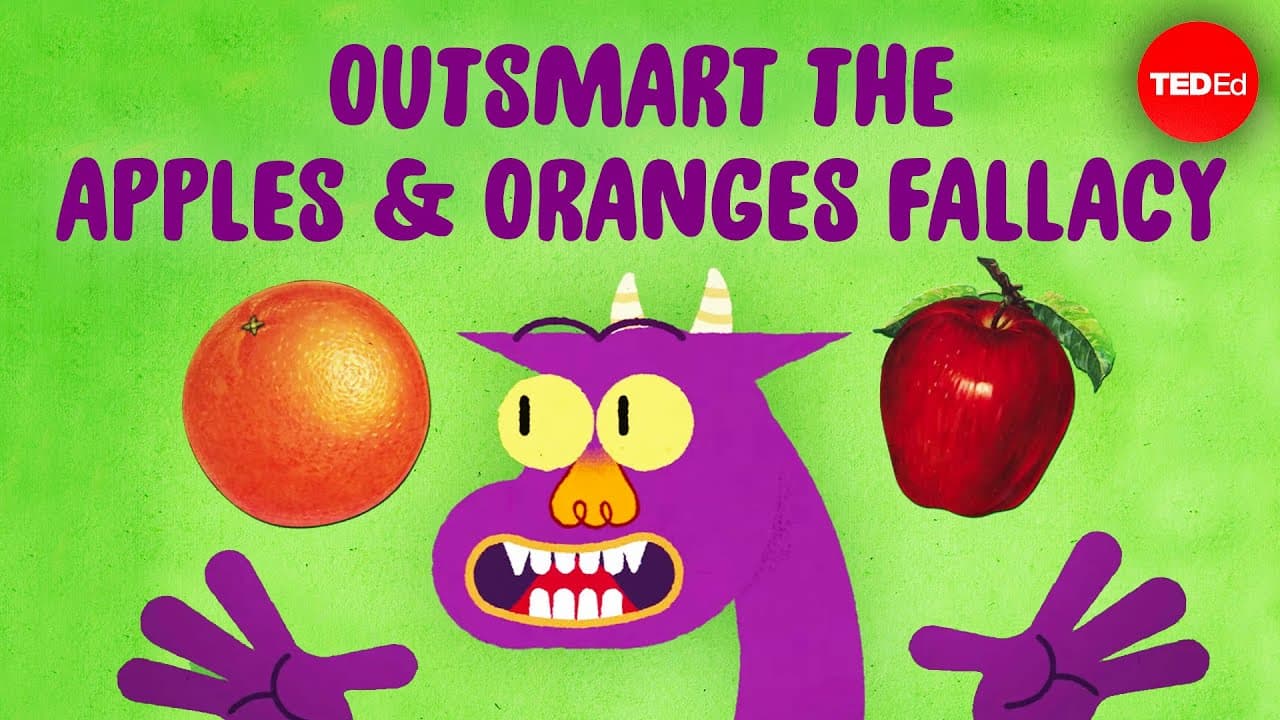
Can you outsmart the apples and oranges fallacy? - Elizabeth Cox
1.1M views
•
April 5, 2021
by
TED-Ed
YouTube video player
Can you outsmart the apples and oranges fallacy? - Elizabeth Cox

TL;DR

Debunking false analogies in the global warming debate.

Transcript

Baking apple pie? Discount orange warehouse has you covered! A fruit’s a fruit, right? It’s 1988, and scientist James Hansen has just testified to the United States Congress that global warming trends are caused by human activity, and will pose an increasing threat to humanity in the future. Well, well. That’s unusually prescient for a human. L... Read More

Key Insights

  • 🌐 Hansen's 1988 testimony warned of human-induced global warming.
  • ❓ The 1997 Senate debate highlighted natural vs. human-induced warming.
  • 💱 False analogies hinder climate change understanding.
  • ❓ Historical warming periods offer valuable insights.
  • 🌐 IPCC confirms human activity drives modern global warming.
  • 👨‍🔬 Accurate data collection is crucial in climate research.
  • ❓ Dismissing human impact on climate impedes progress.

Install to Summarize YouTube Videos and Get Transcripts

Explore YouTube Video Summarizer or Get YouTube Transcript Extractor

Questions & Answers

Q: What prompted James Hansen to testify to Congress about global warming in 1988?

James Hansen testified to Congress in 1988 after observing concerning trends indicating global warming was driven by human activities, particularly the burning of fossil fuels.

Q: How do experts in 1997 differentiate between natural warming cycles and human-induced global warming?

Experts in 1997 highlighted past natural warming periods in Earth's history while cautioning against false analogies to dismiss the current human-induced global warming trend.

Q: What key insights did the Intergovernmental Panel on Climate Change provide in 2013?

In 2013, the IPCC reported a more than 95% probability that human activities, especially fossil fuel burning, were the primary drivers of the global warming trend since the mid-20th century.

Q: How does understanding false analogies contribute to climate change research?

Recognizing and debunking false analogies in the global warming debate is crucial for ensuring accurate understanding, rigorous study, and evidence collection in climate change research.

Summary & Key Takeaways

  • Scientist James Hansen testifies in 1988 that global warming is caused by human activity.

  • In 1997, the US Senate debates global warming, with experts pointing to past natural warming cycles.

  • The debate emphasizes the importance of discerning false analogies in understanding climate change.


Read in Other Languages (beta)

English

Share This Summary 📚

Summarize YouTube Videos and Get Video Transcripts with 1-Click

Download browser extensions on:

Try YouTube Summary with ChatGPT & Claude or YouTube Transcript Generator

Explore More Summaries from TED-Ed 📚
Just How Small is an Atom? thumbnail
Just How Small is an Atom?
TED-Ed
Can you solve the bridge riddle? - Alex Gendler thumbnail
Can you solve the bridge riddle? - Alex Gendler
TED-Ed
How do cigarettes affect the body? - Krishna Sudhir thumbnail
How do cigarettes affect the body? - Krishna Sudhir
TED-Ed
Can you solve the prisoner hat riddle? - Alex Gendler thumbnail
Can you solve the prisoner hat riddle? - Alex Gendler
TED-Ed
Why elephants never forget - Alex Gendler thumbnail
Why elephants never forget - Alex Gendler
TED-Ed
What is schizophrenia? - Anees Bahji thumbnail
What is schizophrenia? - Anees Bahji
TED-Ed

Summarize YouTube Videos and Get Video Transcripts with 1-Click

Download browser extensions on:

Try YouTube Summary with ChatGPT & Claude or YouTube Transcript Generator

Apps & Extensions

  • Chrome Extension
  • Safari Extension
  • Edge Add-ons
  • Firefox Add-ons
  • iOS App
  • Android App

Key Features

  • YouTube Video Summarizer
  • Web & PDF Summarizer
  • Web & PDF Highlighter
  • Chat with PDF
  • Ask AI Clone
  • Audio Transcriber
  • Glasp Reader
  • Kindle Highlight Export
  • Idea Hatch

Integrations

  • Obsidian Plugin
  • Notion Integration
  • Pocket Integration
  • Instapaper Integration
  • Medium Integration
  • Readwise Integration
  • Snipd Integration
  • Hypothesis Integration

More Features

  • APIs
  • MCP Connector
  • Blog & Post
  • Embed Links
  • Image Highlight
  • Personality Test
  • Quote Shots

Company

  • About us
  • Blog
  • Community
  • FAQs
  • Job Board
  • Newsletter
  • Pricing
Terms

•

Privacy

•

Guidelines

© 2026 Glasp Inc. All rights reserved.