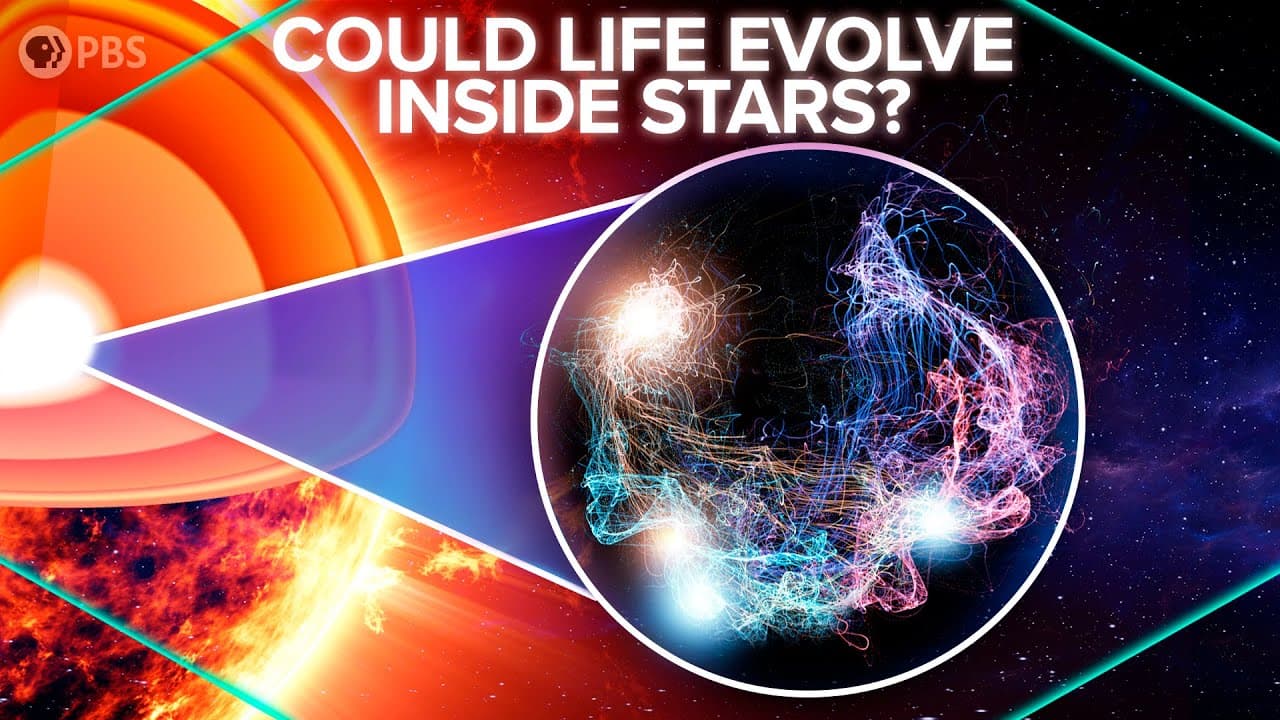
Could Life Evolve Inside Stars?
TL;DR
Exploring the possibility of life forms evolving inside stars.
Transcript
Science fiction has come up with countless ideas for weird forms of life not based on boring old DNA, or even on matter as we know it. There’s Stanislaw Lem’s sentient ocean in Solaris, or the neutron star civilization made of nuclear matter in Robert L Forward’s Dragon’s Egg. Oh, and here’s an extra crazy one - life composed of cosmic strings and ... Read More
Key Insights
- Scientists are exploring the idea that cosmic strings and magnetic monopoles might form life-like structures inside stars, challenging traditional carbon-based life concepts.
- Cosmic strings and magnetic monopoles are topological defects, which are sudden changes in the 'grain' of space that can't be easily disentangled.
- The concept of nuclear life forms involves string-monopole necklaces forming complex structures that mimic chemistry and potentially life.
- Three conditions for life are explored: the ability to encode information, replication faster than disintegration, and a source of free energy.
- Theoretical scenarios suggest that semipoles, a type of monopole, could create diverse configurations, similar to DNA's four base pairs.
- Stars might provide the turbulent environment necessary for these structures to replicate and evolve, potentially forming life-like systems.
- The study suggests that stars with unusual behavior might hint at the presence of such life forms, though verification of cosmic strings and monopoles is needed.
- The research aims to broaden the understanding of potential life forms beyond carbon chemistry, though the existence of such life remains speculative.
Install to Summarize YouTube Videos and Get Transcripts
Explore YouTube Video Summarizer or Get YouTube Transcript Extractor
Questions & Answers
Q: What are cosmic strings and magnetic monopoles?
Cosmic strings and magnetic monopoles are topological defects, which are sudden changes in the 'grain' of space that can't be easily disentangled. In magnetic materials, these defects occur when the direction of magnetic poles changes across a substance. Quantum fields may also develop such defects, potentially formed after the Big Bang during massive phase transitions.
Q: How might life evolve inside stars according to the theory?
The theory proposes that cosmic strings and magnetic monopoles could form complex structures inside stars, possibly evolving into life forms. These structures, called string-monopole necklaces, could encode information, replicate faster than they disintegrate, and harness free energy from the star's environment, akin to biological processes in carbon-based life.
Q: What are the conditions necessary for life according to the study?
The study outlines three conditions necessary for life: the ability to encode information, the ability of information carriers to replicate faster than they disintegrate, and a source of free energy. These conditions mirror those required for carbon-based life, suggesting that similar principles could apply to hypothetical nuclear life forms.
Q: How do semipoles contribute to the theory of life inside stars?
Semipoles, a type of monopole, could create diverse configurations similar to DNA's four base pairs. This diversity allows for the encoding of information, a crucial aspect of life. Unlike monopoles and anti-monopoles that annihilate upon contact, semipoles can form stable, complex structures, potentially leading to life-like chemistry and replication.
Q: What role do stars play in this theoretical life evolution?
Stars provide the turbulent environment necessary for string-monopole necklaces to replicate and evolve. The flowing plasma and magnetic fields inside stars might stretch and break these necklaces, allowing them to reconfigure and find stable, replicating states. This environment could catalyze the development of life-like systems within stars.
Q: Why is the study of cosmic strings and monopoles important?
Studying cosmic strings and monopoles is important because they offer insights into the fundamental nature of the universe and its early conditions. Understanding these topological defects could reveal new physics and broaden the concept of life beyond carbon chemistry, potentially identifying life forms in extreme environments like stars.
Q: What evidence supports the existence of life forms inside stars?
Currently, there is no direct evidence supporting the existence of life forms inside stars. The study is speculative, aiming to explore the possibility of such life forms. Some stars exhibit unusual behavior, but many other explanations exist. Verification of cosmic strings and monopoles is necessary before considering this theory as a plausible explanation.
Q: What is the broader implication of this study on the search for life?
The broader implication of this study is that life might exist in forms and environments previously considered impossible. By exploring the potential for life based on cosmic strings and monopoles, scientists can expand the search for life beyond the familiar carbon-based chemistry, potentially discovering new life forms in extreme and unexplored regions of the universe.
Summary & Key Takeaways
-
The video explores a theoretical proposal that life forms could evolve inside stars, utilizing cosmic strings and magnetic monopoles to create complex structures. This challenges the traditional carbon-based life concept by suggesting a nuclear life form that could exist in extreme environments.
-
Cosmic strings and magnetic monopoles, topological defects in quantum fields, are central to this theory. These defects could form complex structures capable of encoding information, replicating, and utilizing free energy, akin to the processes seen in carbon-based life.
-
The study, while speculative, suggests that stars might harbor life forms that influence their behavior. However, the existence of cosmic strings and monopoles needs verification, and the idea remains a theoretical exploration of life's possibilities beyond known chemistry.
Read in Other Languages (beta)
Share This Summary 📚
Summarize YouTube Videos and Get Video Transcripts with 1-Click
Try YouTube Summary with ChatGPT & Claude or YouTube Transcript Generator
Explore More Summaries from PBS Space Time 📚
Summarize YouTube Videos and Get Video Transcripts with 1-Click
Try YouTube Summary with ChatGPT & Claude or YouTube Transcript Generator