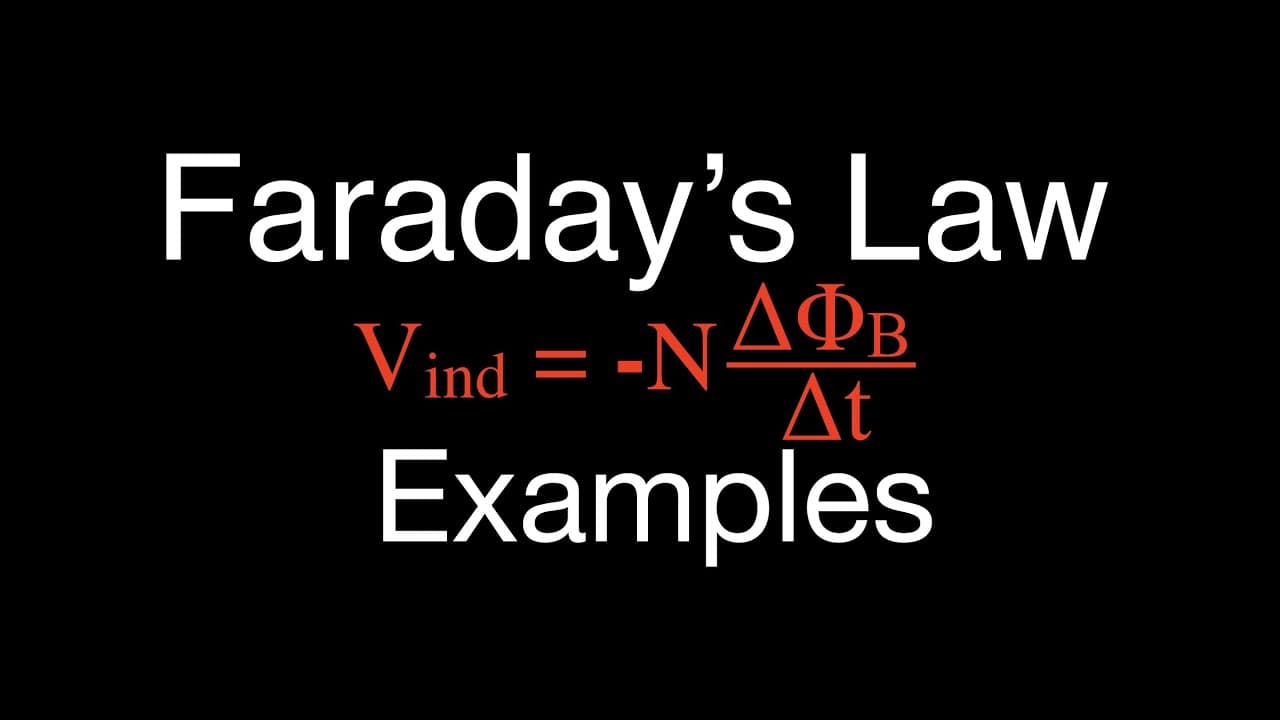
Electromagnetic Induction (6 of 15) Faraday's Law, Example Problems
TL;DR
Solving four Faraday's Law problems with step-by-step calculations and explanations.
Transcript
okay in the last video I went over an explanation of Faraday's law you can link that be in the upper right-hand corner for this video but in this video I'm gonna go over just some simple example problems using Faraday's law okay so here we go we have I have four problems revenue here I have a circular loop of wire it has a diameter of 12 centimeter... Read More
Key Insights
- 💱 Faraday's Law involves calculating induced EMF by considering the change in magnetic flux.
- 🏑 Different coil shapes and orientations impact the calculation of induced EMF in magnetic fields.
- 👮 Understanding the angle theta and orientation is crucial for accurate calculations in Faraday's Law problems.
- ⚾ Lenz's Law explains the direction of induced currents based on the change in magnetic field.
- 🤘 Negative signs in Faraday's Law calculations indicate the direction and magnitude of induced voltage changes.
- 🎓 Sharing knowledge and understanding physics concepts like Faraday's Law is essential for learning and education.
- 🆘 Practice with examples helps in mastering Faraday's Law problem-solving techniques.
Install to Summarize YouTube Videos and Get Transcripts
Explore YouTube Video Summarizer or Get YouTube Transcript Extractor
Questions & Answers
Q: How is the induced EMF calculated in Faraday's Law problems?
The induced EMF is calculated by using the change in magnetic flux, number of windings, and time, following the equation for Faraday's Law.
Q: What is the significance of the angle theta in the Faraday's Law equation?
The angle theta represents the orientation between the magnetic field and the coil, affecting the calculation of induced EMF based on the flux change.
Q: How does the direction of the induced current relate to the change in magnetic field?
The change in magnetic field direction determines the induced current direction in a coil, following Lenz's Law principles to oppose the change.
Q: Why is it important to consider the negative signs in Faraday's Law calculations?
Negative signs in Faraday's Law calculations indicate the direction and polarity of the induced EMF, reflecting the relationship between magnetic flux changes and induced currents.
Summary & Key Takeaways
-
Demonstrates solving four Faraday's Law problems using equations and calculations.
-
Includes examples of circular and rectangular loops in magnetic fields.
-
Explains the concept of induced EMF and how to calculate it step by step.
Read in Other Languages (beta)
Share This Summary 📚
Summarize YouTube Videos and Get Video Transcripts with 1-Click
Try YouTube Summary with ChatGPT & Claude or YouTube Transcript Generator
Explore More Summaries from Step by Step Science 📚

Summarize YouTube Videos and Get Video Transcripts with 1-Click
Try YouTube Summary with ChatGPT & Claude or YouTube Transcript Generator