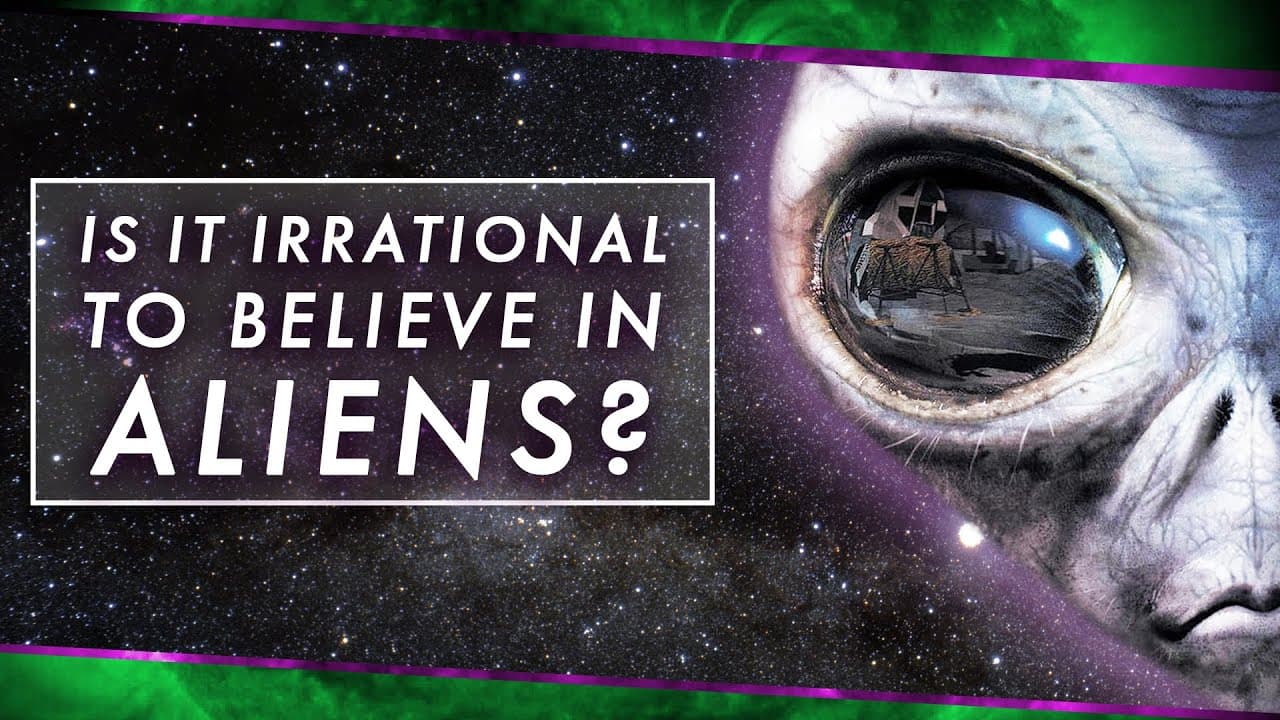
Is Believing in Aliens Irrational? Arguments Explored
TL;DR
Believing in aliens might not be irrational. The vast number of habitable planets suggests intelligent life should exist, as argued by Carl Sagan, but the Fermi paradox questions the lack of evidence for such life. Nick Bostrom's 'great filter' theory suggests that intelligent civilizations could frequently go extinct before spreading across the galaxy, complicating the debate.
Transcript
[MUSIC PLAYING] A lot of people, including many scientists, seem pretty confident that aliens have to exist somewhere in the universe. Is that just wishful thinking or can you actually calculate whether intelligent aliens exist? UFO sightings and Area 51 rumors aside, we have never seen an alien, never heard an alien, or had any kind of verifiable ... Read More
Key Insights
- The existence of aliens is a topic of debate, with arguments both supporting and opposing their existence based on scientific principles.
- The Drake equation is a method used to estimate the number of extraterrestrial civilizations, factoring in variables like the number of stars and habitable planets.
- Carl Sagan argued that with billions of habitable planets, intelligent life should exist somewhere, as the odds are in favor of their existence.
- The Fermi paradox highlights the contradiction between the high probability of extraterrestrial life and the lack of evidence for or contact with such civilizations.
- The Fermi paradox suggests that if aliens exist, they should have left evidence of their presence, yet none has been found.
- Nick Bostrom proposes the 'great filter' theory, suggesting that intelligent life may frequently go extinct before spreading across the galaxy.
- The debate on alien existence often revolves around whether it's more unlikely for intelligent life to never evolve or for it to never spread.
- The video encourages viewers to form their own opinions on the existence of aliens, considering the various scientific arguments presented.
Install to Summarize YouTube Videos and Get Transcripts
Explore YouTube Video Summarizer or Get YouTube Transcript Extractor
Questions & Answers
Q: What is the Drake equation?
The Drake equation is a formula used to estimate the number of active, communicative extraterrestrial civilizations in the Milky Way galaxy. It takes into account factors such as the rate of star formation, the fraction of those stars with planetary systems, the number of planets that could potentially support life, and other variables. Although speculative, it provides a framework for discussing the probability of alien life.
Q: What is the Fermi paradox?
The Fermi paradox highlights the contradiction between the high probability of extraterrestrial civilizations existing and the lack of evidence for or contact with such civilizations. Despite the vast number of habitable planets and the age of the galaxy, no definitive signs of intelligent life have been observed, leading to questions about why we haven't encountered aliens or their artifacts.
Q: What is Carl Sagan's argument regarding alien life?
Carl Sagan argued that the sheer number of habitable planets in the universe makes it statistically likely that intelligent life exists elsewhere. He believed that the odds of intelligent life arising, even if low on individual planets, are compensated by the vast number of opportunities across billions of planets, making the existence of extraterrestrial civilizations plausible.
Q: What is the 'great filter' theory proposed by Nick Bostrom?
Nick Bostrom's 'great filter' theory suggests that while the emergence of intelligent life might be common, there are significant obstacles that prevent such life from spreading across the galaxy. These obstacles could be natural or self-inflicted, such as catastrophic events or self-destruction, which could lead to the extinction of civilizations before they can make their presence known to others.
Q: Why is the lack of evidence for aliens problematic for some scientists?
The lack of evidence for aliens is problematic because it contradicts the expectation that, given the vast number of habitable planets and the age of the galaxy, some form of intelligent life should have emerged and left detectable traces. This absence challenges the assumption that Earth and humanity are not unique or special, a principle that underlies much of scientific thinking.
Q: How does the video suggest viewers approach the question of alien existence?
The video suggests that viewers approach the question of alien existence by considering the scientific arguments presented, such as the Drake equation, the Fermi paradox, and the 'great filter' theory. It encourages forming personal opinions based on these perspectives, acknowledging the complexity and uncertainty surrounding the topic and the limitations of current scientific evidence.
Q: What role does probability play in the discussion of alien life?
Probability plays a crucial role in the discussion of alien life, as it helps scientists estimate the likelihood of intelligent civilizations existing based on factors like the number of stars and habitable planets. However, these estimates are speculative due to the lack of concrete data, as Earth is the only known example of a planet with life, making probability calculations challenging and uncertain.
Q: What is the significance of the video's closing remarks?
The video's closing remarks emphasize the open-ended nature of the discussion about alien life, inviting viewers to share their thoughts and engage with the topic. By highlighting the lack of conclusive evidence and the variety of scientific viewpoints, it encourages critical thinking and personal exploration of the possibilities, reflecting the ongoing curiosity and debate surrounding the existence of extraterrestrial life.
Summary & Key Takeaways
-
The video discusses the possibility of intelligent alien life existing in the universe, weighing arguments for and against their existence. It explores the Drake equation, which estimates the number of extraterrestrial civilizations based on various factors. Despite the high probability of life, no evidence has been found, leading to the Fermi paradox.
-
Carl Sagan's argument suggests that the vast number of habitable planets should result in intelligent life, while the Fermi paradox questions why no evidence of such life has been discovered. Nick Bostrom's 'great filter' theory posits that intelligent life may often go extinct before spreading across the galaxy.
-
The video encourages viewers to consider the scientific arguments and form their own opinions on the existence of aliens. It acknowledges the difficulty in proving or disproving their existence due to the lack of evidence and the limitations of current scientific understanding.
Read in Other Languages (beta)
Share This Summary 📚
Summarize YouTube Videos and Get Video Transcripts with 1-Click
Try YouTube Summary with ChatGPT & Claude or YouTube Transcript Generator
Explore More Summaries from PBS Space Time 📚
Summarize YouTube Videos and Get Video Transcripts with 1-Click
Try YouTube Summary with ChatGPT & Claude or YouTube Transcript Generator