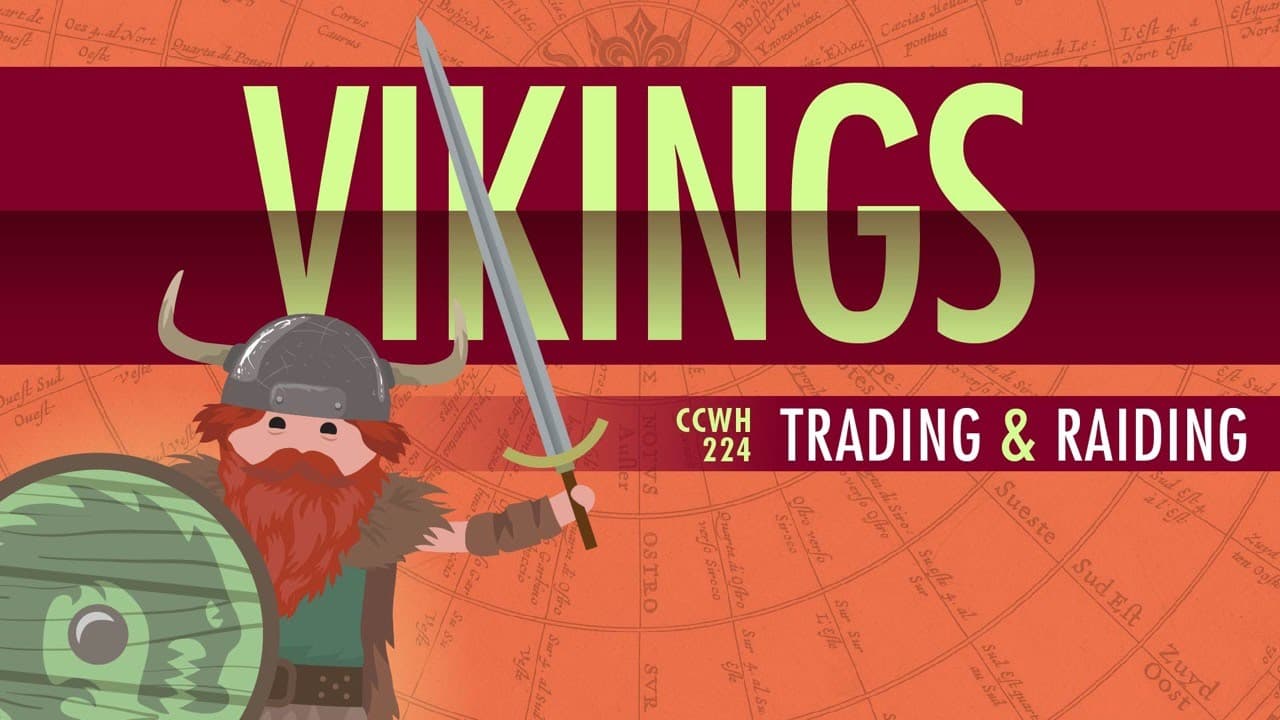
The Vikings! - Crash Course World History 224
TL;DR
Vikings were not just raiders but also traders and settlers.
Transcript
Hi I'm John Green; this is Crash Course World History, and today we're gonna talk about one of our most requested topics ever, the Vikings. Mr. Green! Mr. Green! Finally we get to talk about Thor and Mjölner. This is one of my areas of expertise! I've read all the comics! Like both Thor and The Avengers. Here's a crazy thing that happens in the nex... Read More
Key Insights
- The Vikings originated from Scandinavia and were known for their seafaring abilities, reaching as far as North America during the Viking Age (750-1100 C.E.).
- Viking expeditions involved raiding, trading, and settling, with a primary focus on gaining wealth through various means.
- Contrary to popular belief, Vikings were not solely bloodthirsty raiders; they were also skilled traders and agriculturalists.
- The historical narrative of Vikings is shaped by both archaeological evidence and written records, though the latter often comes from biased sources.
- Viking sagas, written centuries after the Viking Age, are considered pseudo-historical and provide limited accurate historical information.
- Viking settlements, such as those in Iceland and Greenland, were primarily agricultural and contributed to cultural exchanges across regions.
- Norse mythology, often romanticized, is largely understood through post-Viking Age writings and should be viewed critically.
- The Vikings' legacy includes significant contributions to trade networks, cultural exchanges, and the development of trade hubs in Europe.
Install to Summarize YouTube Videos and Get Transcripts
Explore YouTube Video Summarizer or Get YouTube Transcript Extractor
Questions & Answers
Q: What regions did the Vikings originate from?
The Vikings originated from Scandinavia, which comprises modern-day Norway, Sweden, and Denmark. They were known for their exceptional seafaring abilities, allowing them to explore, raid, and trade across the North Atlantic and Baltic regions, and even briefly reaching North America.
Q: How did the Vikings' reputation as fearsome warriors develop?
The Vikings' reputation as fearsome warriors largely stems from historical narratives written by those who suffered from their raids. These accounts often exaggerated their brutality, as they were penned by victims of Viking expeditions. In reality, Vikings were also traders and settlers, not solely bloodthirsty raiders.
Q: What were Viking expeditions primarily about?
Viking expeditions were primarily about gaining wealth through raiding, trading, and settling. While initially focused on raiding for loot, they soon realized the benefits of trade and settlement. This shift allowed them to establish trade networks and agricultural settlements, contributing to cultural exchanges.
Q: How is Viking history reconstructed?
Viking history is reconstructed through a combination of archaeological evidence and written records. Archaeology provides insights into their lifestyle, while written records, though often biased, offer additional information. However, much of what is known comes from sources written after the Viking Age, necessitating careful interpretation.
Q: What role do sagas play in understanding Viking history?
Sagas, written in the 13th century or later, are long narrative epics that purportedly describe Viking travels and adventures. However, they are considered pseudo-historical, providing limited accurate historical information. Historians view them as fictionalized accounts rather than reliable historical documents.
Q: How did Viking settlements influence the regions they settled in?
Viking settlements influenced regions differently based on their population size and cultural integration. In places like Iceland and Greenland, Scandinavian culture dominated due to significant Viking populations. In contrast, in regions like Normandy and Russia, Vikings quickly assimilated with the local culture, resulting in cultural hybridization.
Q: What is known about Norse mythology?
Norse mythology is primarily understood through writings from after the Viking Age, such as the Prose Edda. These accounts, often written by Christians, may not accurately reflect Viking religious practices. While popularized in modern culture, Norse myths should be viewed critically due to their post-Viking Age origins.
Q: What is the lasting legacy of the Vikings?
The lasting legacy of the Vikings includes their contributions to trade networks and cultural exchanges. They established trade hubs in regions like Dublin and York, facilitating economic growth. Their transition from raiding to trading exemplifies a broader historical pattern where economic interactions lead to cultural and societal development.
Summary & Key Takeaways
-
The Vikings, originating from Scandinavia, were renowned seafarers who explored, raided, and traded across Europe and beyond during the Viking Age. Their expeditions were driven by the pursuit of wealth, leading to settlements in various regions. Despite their reputation, they were also traders and agriculturalists.
-
Viking history is pieced together through archaeological findings and written records, though the latter often presents a biased view. Sagas, written after the Viking Age, are considered pseudo-historical, offering limited factual insights. Viking settlements focused on agriculture and facilitated cultural exchanges.
-
Norse mythology, largely understood through later writings, is often romanticized. The Vikings' legacy includes the establishment of trade networks and cultural exchanges, with settlements in regions like Iceland and Greenland. Their impact on history is marked by a transition from raiding to trading.
Read in Other Languages (beta)
Share This Summary 📚
Summarize YouTube Videos and Get Video Transcripts with 1-Click
Try YouTube Summary with ChatGPT & Claude or YouTube Transcript Generator
Explore More Summaries from CrashCourse 📚




Summarize YouTube Videos and Get Video Transcripts with 1-Click
Try YouTube Summary with ChatGPT & Claude or YouTube Transcript Generator