How to Simulate a Proton's Inner Universe
TL;DR
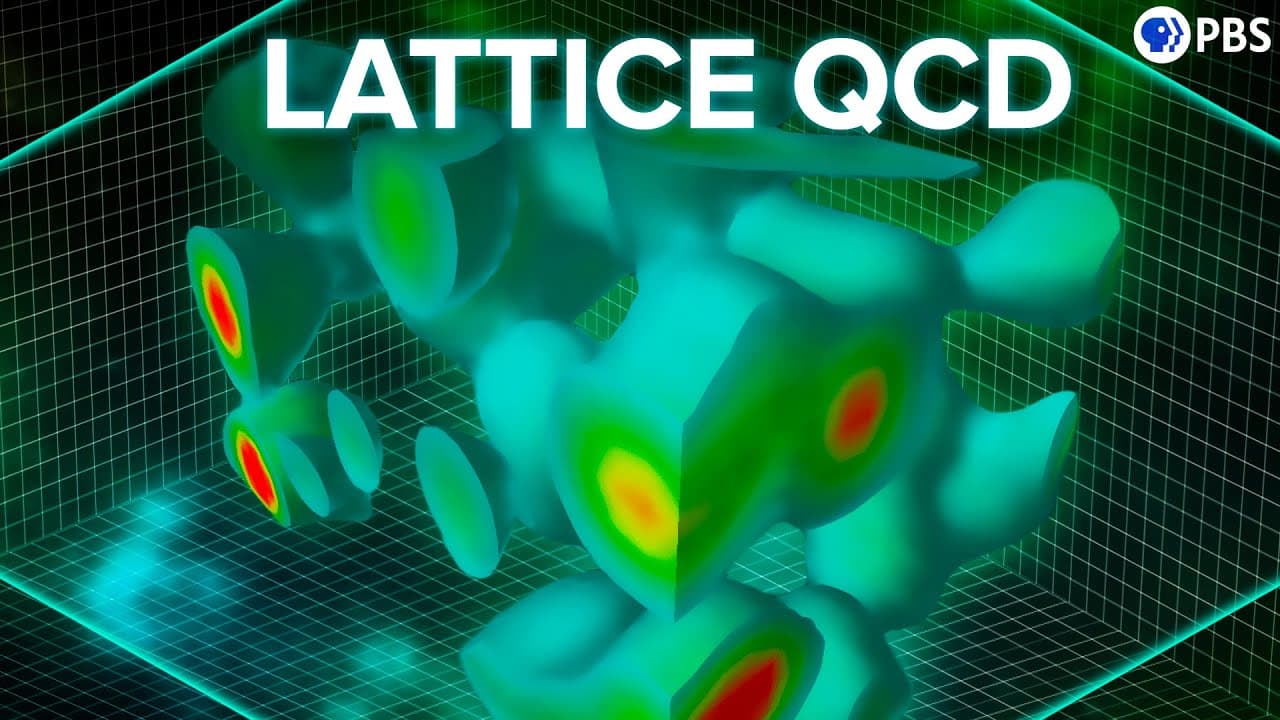
Simulating the intricate dynamics inside a proton involves lattice QCD, a method modeling quantum fields directly rather than relying on virtual particles. This approach uses Monte Carlo sampling and Wick rotation to handle complex field interactions, allowing predictions of hadron properties. Despite computational challenges, lattice QCD has successfully predicted various hadron characteristics, offering insights into quantum field behavior.
Transcript
If we ever want to simulate a universe, we should probably start by learning to simulate even a single atomic nucleus. But it’s taken some of the most incredible ingenuity of the past half-century to figure even that out. So today I get to teach you how to simulate a very very small universe. Physics has been insanely successful at finding the ... Read More
Key Insights
- Lattice QCD is a method for simulating quantum fields directly, bypassing virtual particles.
- Quantum Chromodynamics (QCD) describes quark interactions via gluons, unlike QED which involves photons.
- The strong force is mediated by gluons and is much stronger than electromagnetic interactions.
- Monte Carlo sampling is used in lattice QCD to manage the vast number of possible field configurations.
- Wick rotation transforms time into a spatial dimension, simplifying calculations by removing complex numbers.
- Lattice QCD predictions, like neutron mass, depend on lattice spacing but can be adjusted for accuracy.
- Lattice QCD has accurately predicted hadron masses, decay frequencies, and quark-gluon plasma properties.
- The success of lattice QCD underscores that virtual particles are merely calculational tools, not physical entities.
Install to Summarize YouTube Videos and Get Transcripts
Explore YouTube Video Summarizer or Get YouTube Transcript Extractor
Questions & Answers
Q: How does lattice QCD simulate quantum fields?
Lattice QCD simulates quantum fields by discretizing spacetime into a lattice, allowing for a finite number of field configurations. It uses Monte Carlo sampling to randomly select paths between initial and final field states. Wick rotation treats time as an additional spatial dimension, simplifying calculations by eliminating complex numbers. This approach enables the direct modeling of quantum fields, bypassing the need for virtual particles.
Q: What is the role of Monte Carlo sampling in lattice QCD?
Monte Carlo sampling in lattice QCD is crucial for handling the astronomical number of possible field configurations between initial and final states. By randomly selecting configurations, it estimates probabilities without needing to compute every possible path. This method allows for efficient computation of complex quantum interactions, making the simulation of strong force dynamics feasible on current computational hardware.
Q: Why is the strong force difficult to calculate?
The strong force is difficult to calculate due to its high coupling constant, which means interactions do not diminish quickly with complexity, unlike in quantum electrodynamics. This makes it impossible to ignore higher-order Feynman diagrams, requiring all possible interactions to be considered. The complexity and intensity of quark-gluon interactions necessitate advanced computational techniques like lattice QCD for accurate predictions.
Q: What is Wick rotation and its purpose in lattice QCD?
Wick rotation is a mathematical transformation used in lattice QCD to treat time as an additional spatial dimension. This operation simplifies calculations by converting complex phase shifts into real numbers, which are easier to handle computationally. By transforming the problem into a four-dimensional lattice, it allows for the application of statistical mechanics to simulate quantum field interactions effectively.
Q: How does lattice QCD predict hadron properties?
Lattice QCD predicts hadron properties by simulating the evolution of quantum fields on a discretized spacetime lattice. By adjusting the lattice spacing and using statistical mechanics, it calculates properties such as masses and decay rates. These predictions are then extrapolated to continuous spacetime, allowing for accurate determination of hadron characteristics, validated against experimental data.
Q: What insights does lattice QCD provide about virtual particles?
Lattice QCD provides insights that virtual particles are merely calculational tools rather than physical entities. By simulating quantum fields directly, it bypasses the need for virtual particles, highlighting that they represent transient disturbances in fields rather than actual particles. This understanding clarifies the nature of quantum interactions, emphasizing the fundamental role of fields over particles.
Q: Why can't the strong force be calculated using Feynman diagrams?
The strong force cannot be calculated using Feynman diagrams because its high coupling constant means that higher-order diagrams contribute significantly to interaction probabilities. Unlike in QED, where complex diagrams can be ignored, QCD requires consideration of all possible interactions, making traditional Feynman diagram approaches computationally infeasible. Lattice QCD offers an alternative by directly simulating the underlying fields.
Q: What advancements has lattice QCD achieved in particle physics?
Lattice QCD has achieved significant advancements in particle physics by accurately predicting the masses and decay frequencies of hadrons, as well as properties of quark-gluon plasma. These predictions have been crucial in validating theoretical models against experimental results, providing deeper insights into the behavior of quantum fields and the fundamental forces governing subatomic particles.
Summary & Key Takeaways
-
Lattice QCD allows for direct simulation of quantum fields, bypassing the need for virtual particles. This technique involves Monte Carlo sampling and Wick rotation to manage the complex interactions within the strong force. Despite its computational intensity, lattice QCD has accurately predicted various hadron properties, enhancing our understanding of quantum fields.
-
Quantum Chromodynamics (QCD) deals with the interactions of quarks and gluons, which are far more complex than the photon-mediated interactions in Quantum Electrodynamics (QED). The strong force, characterized by a high coupling constant, makes direct calculations challenging, necessitating advanced computational methods like lattice QCD.
-
Lattice QCD's ability to predict hadron properties, such as mass and decay rates, reveals the intricate dynamics of quantum fields. By treating time as a spatial dimension and using Monte Carlo sampling, lattice QCD effectively models the strong force interactions, providing insights into the fundamental nature of matter.
Read in Other Languages (beta)
Share This Summary 📚
Summarize YouTube Videos and Get Video Transcripts with 1-Click
Try YouTube Summary with ChatGPT & Claude or YouTube Transcript Generator
Explore More Summaries from PBS Space Time 📚






Summarize YouTube Videos and Get Video Transcripts with 1-Click
Try YouTube Summary with ChatGPT & Claude or YouTube Transcript Generator