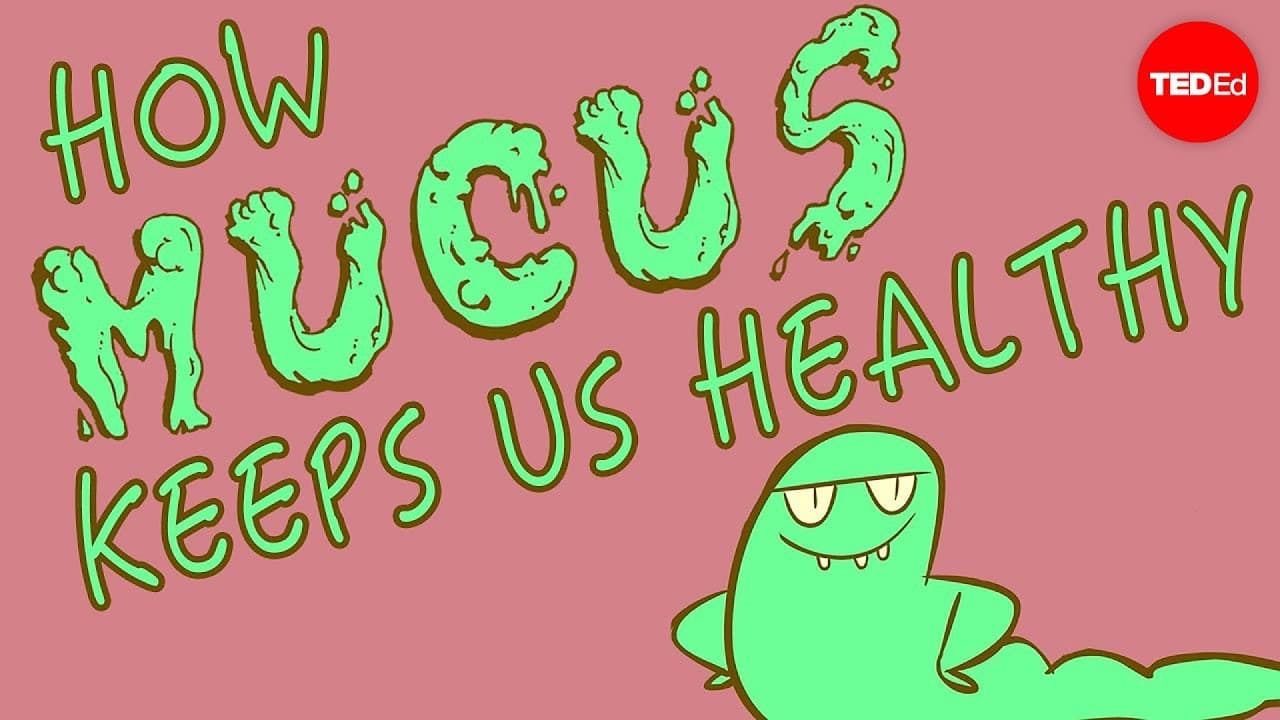
How mucus keeps us healthy - Katharina Ribbeck
TL;DR
Mucus is more than just a nuisance, playing crucial roles from protection to bacterial control.
Transcript
If you've got a cold, mucus is hard to miss. But what is it, and what does it do besides making you miserable? Your body produces more than a liter of mucus every day, and all the wet surfaces of your body that are not covered by skin, like your eyes, nose, mouth, lungs, and stomach get a liberal coating. That's why they're known as mucus membran... Read More
Key Insights
- 🛟 Mucus is produced in various wet surfaces of the body not covered by skin, serving multiple protective functions.
- ❓ Mucins are crucial proteins in mucus that create a protective barrier against pathogens.
- 🖐️ Mucus plays a vital role in maintaining a balanced bacterial population in the body.
- ❓ The body increases mucus production during infections to eliminate harmful bacteria.
- 💁 Mucus contains antimicrobial peptides, antibodies, and bacteriophages to prevent harmful biofilm formation.
- 🫥 Mucus serves as the body's first line of defense against foreign objects like bacteria and dust.
- 🖐️ The majority of the body's bacterial inhabitants are beneficial and play important roles when living in mucus.
Install to Summarize YouTube Videos and Get Transcripts
Explore YouTube Video Summarizer or Get YouTube Transcript Extractor
Questions & Answers
Q: What are the primary functions of mucus in the body?
Mucus protects tissues from drying out, lubricates eyes, neutralizes threats, houses beneficial bacteria, and acts as the body's first line of defense against pathogens.
Q: What are mucins, and how do they contribute to mucus versatility?
Mucins are proteins in mucus that interact with other molecules to create a barrier against pathogens. They have hydrophilic sugar chains that help mucus dissolve in watery fluids.
Q: How does mucus prevent harmful biofilms from forming in the body?
Mucus contains mucins, antimicrobial peptides, antibodies, and bacteriophages that work together to prevent harmful bacteria from clustering into slimy growths called biofilms.
Q: Why does mucus turn greenish during infections?
The greenish color of mucus during infections is caused by an enzyme produced by white blood cells, which are flooded into mucus by the immune system to combat harmful microbes.
Summary & Key Takeaways
-
Mucus protects delicate tissues from drying out and cracking, lubricates eyes, neutralizes threats by trapping substances, and houses beneficial bacteria.
-
Mucins, essential proteins in mucus, create a barrier against pathogens by interacting with other molecules.
-
The body ramps up mucus production to flush out offenders and floods it with white blood cells during infections.
Read in Other Languages (beta)
Share This Summary 📚
Summarize YouTube Videos and Get Video Transcripts with 1-Click
Try YouTube Summary with ChatGPT & Claude or YouTube Transcript Generator
Explore More Summaries from TED-Ed 📚





Summarize YouTube Videos and Get Video Transcripts with 1-Click
Try YouTube Summary with ChatGPT & Claude or YouTube Transcript Generator