Converting Mixed Numbers to Decimals
TL;DR
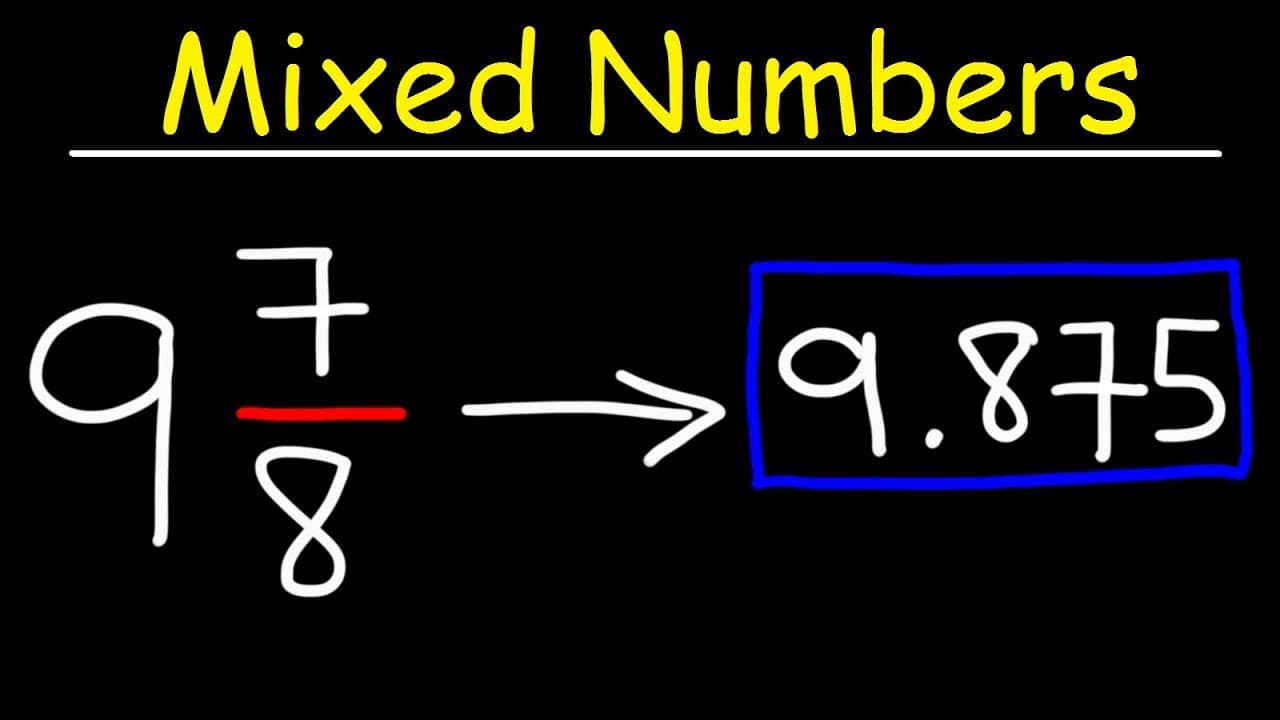
This video explains how to convert mixed numbers to decimals using long division, providing step-by-step examples.
Transcript
in this video we're gonna talk about how to convert a mixed number into a decimal so the example that I have is three and two-fifths how can we convert that into a decimal three and two-fifths is the same as three plus two over five so all we need to do is convert this portion of the mixed number into a decimal and a simple way to do that is to use... Read More
Key Insights
- ➗ Converting mixed numbers to decimals involves dividing the fraction part by its denominator using long division.
- 🪘 Each calculation in the long division process results in a decimal digit for the final conversion.
- 🧑🏭 Repeating decimals can occur when converting fractions with denominators that do not have prime factors other than 2 or 5.
- 🎭 Mixed numbers can be converted to decimals with or without using long division by performing the necessary arithmetic operations.
- 🎁 Precision in decimal conversions depends on the desired number of decimal places or whether any repeating patterns are present.
- #️⃣ The decimal representation of a mixed number provides a more precise value than the mixed number itself.
- #️⃣ Converting mixed numbers to decimals is an essential skill in various mathematical concepts, such as measurement, operations with fractions, and algebraic manipulations.
Install to Summarize YouTube Videos and Get Transcripts
Explore YouTube Video Summarizer or Get YouTube Transcript Extractor
Questions & Answers
Q: How can mixed numbers be converted to decimals using long division?
To convert a mixed number to a decimal, divide the fractional part of the number by its denominator using long division. Keep dividing until the division no longer produces a remainder.
Q: Can you provide an example of converting a mixed number to a decimal using long division?
Sure! Let's convert 6 and 3/4 to a decimal. Dividing 4 into 3 results in 0, so we add a decimal. Dividing 4 into 30 gives us 7 with a remainder of 2. Continuing the process, the final decimal equals 6.75.
Q: Is there a simple way to convert mixed numbers to decimals without using long division?
While long division is a straightforward method, you can also convert mixed numbers to decimals by manually performing the arithmetic operations. For example, you can convert 2 and 3/8 to a decimal by calculating 2 + (3/8) = 2.375.
Q: What if the fraction in the mixed number is a repeating decimal?
If the fraction is a repeating decimal, you can represent it using a bar notation above the digits that repeat. For instance, 5 and 2/3 is equivalent to 5.666... (repeating).
Summary & Key Takeaways
-
The video demonstrates the process of converting mixed numbers to decimals using long division.
-
The first example shows how to convert 3 and 2/5 to a decimal, which becomes 3.4.
-
The second example converts 5 and 1/4 to a decimal, resulting in 5.25.
-
The third example converts 9 and 7/8 to a decimal, yielding 9.875.
-
Lastly, the video converts 4 and 1/3 to a decimal, which becomes 4.3 (repeating).
Read in Other Languages (beta)
Share This Summary 📚
Summarize YouTube Videos and Get Video Transcripts with 1-Click
Try YouTube Summary with ChatGPT & Claude or YouTube Transcript Generator
Explore More Summaries from The Organic Chemistry Tutor 📚
Summarize YouTube Videos and Get Video Transcripts with 1-Click
Try YouTube Summary with ChatGPT & Claude or YouTube Transcript Generator