How To Evaluate Expressions With Variables Using Order of Operations
TL;DR
Understand the order of operations (PEMDAS) to correctly evaluate mathematical expressions with variables, fractions, and exponents.
Transcript
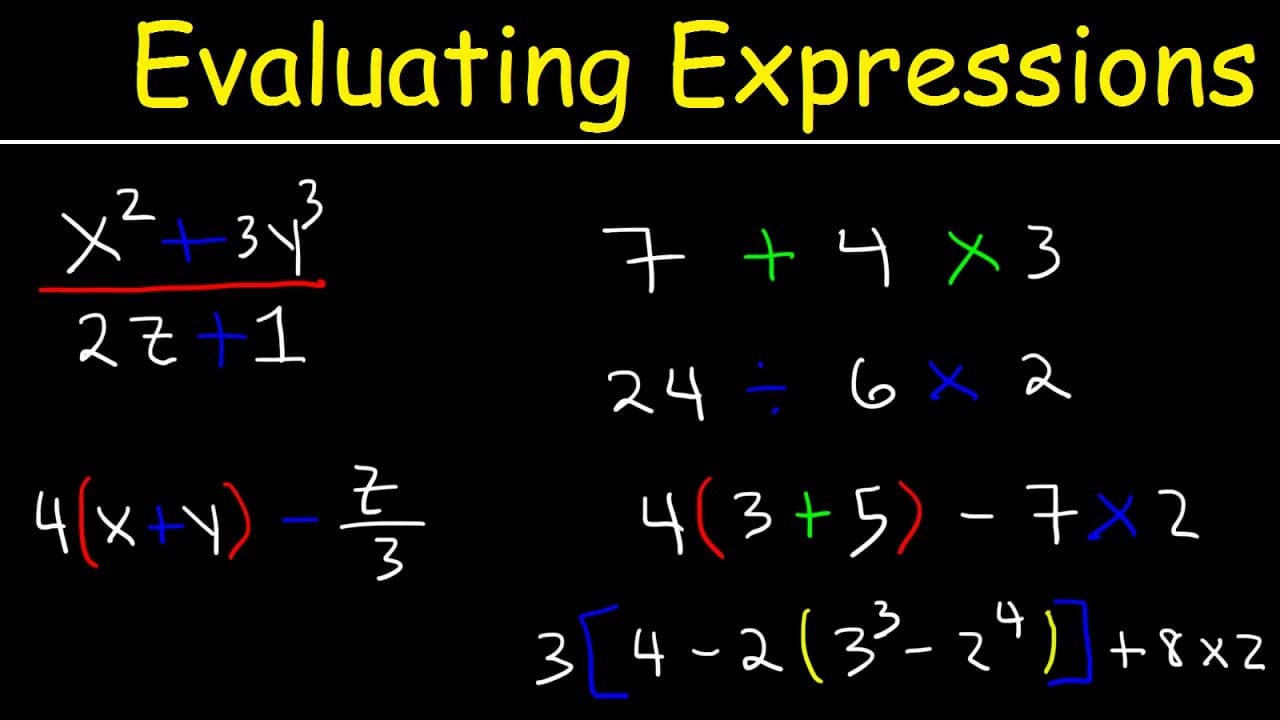
in this video we're going to focus on evaluating expressions with variables fractions and exponents but let's start with the basics first what is 7 plus 4 times 3 go ahead and evaluate that expression now there's two ways that you might be thinking of doing this should we add before we multiply or should we multiply before we add if we add first se... Read More
Key Insights
- 😑 Following the order of operations (PEMDAS) is crucial for accurately evaluating mathematical expressions.
- 🗯️ Multiplication/division and addition/subtraction have equal priority but should be performed from left to right.
- ✋ Parentheses have the highest priority, followed by exponents, multiplication/division, and addition/subtraction.
- 😑 Evaluating expressions with variables involves substituting their values before performing operations.
- 🔁 Fractions can be treated as division, and exponents as repeated multiplication.
Install to Summarize YouTube Videos and Get Transcripts
Explore YouTube Video Summarizer or Get YouTube Transcript Extractor
Questions & Answers
Q: What is the order of operations in evaluating expressions?
The order of operations is PEMDAS, which stands for Parentheses, Exponents, Multiplication/Division (from left to right), and Addition/Subtraction (from left to right). It helps prioritize which operations to perform first.
Q: What happens if you don't follow the order of operations in evaluating expressions?
Not following the order of operations can lead to incorrect answers. For example, evaluating 7 + 4 * 3 as 11 * 3 instead of 7 + 12 will result in a different answer (33 instead of 19).
Q: How do you evaluate expressions involving fractions and exponents?
When evaluating expressions with fractions and exponents, follow the order of operations while treating fractions as division and exponents as repeated multiplication. Simplify each operation before moving to the next step.
Q: Can the order of operations be different if parentheses are not present in the expression?
No, the order of operations remains the same even if parentheses are not present. You still need to follow the sequence of exponents, multiplication/division, and addition/subtraction, from left to right.
Summary & Key Takeaways
-
Order of operations (PEMDAS) dictates the sequence of mathematical operations: parentheses, exponents, multiplication/division, and addition/subtraction.
-
Following the order of operations is crucial to arrive at the correct solution when evaluating expressions.
-
Multiple examples are provided to illustrate the importance of following the order of operations.
Read in Other Languages (beta)
Share This Summary 📚
Summarize YouTube Videos and Get Video Transcripts with 1-Click
Try YouTube Summary with ChatGPT & Claude or YouTube Transcript Generator
Explore More Summaries from The Organic Chemistry Tutor 📚




Summarize YouTube Videos and Get Video Transcripts with 1-Click
Try YouTube Summary with ChatGPT & Claude or YouTube Transcript Generator