Spin Spin Splitting - N+1 Rule - Multiplicity - Proton NMR Spectroscopy
TL;DR
This video explains the concept of proton NMR multiplicity, intensity ratios, and how to determine them using Pascal's triangle.
Transcript
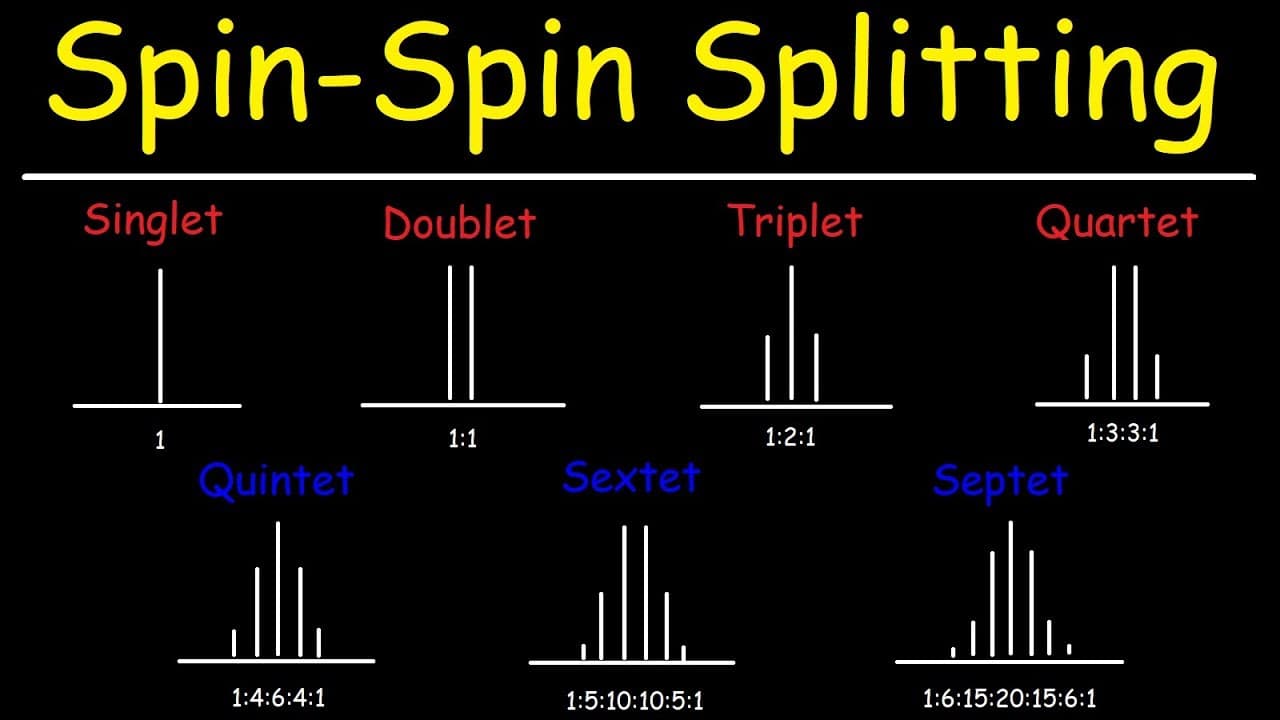
in this video we're going to go over the multiplicity of a proton nmr signal and the multiplicity is basically the number of peaks that we see in the signal so on the left here we have just one signal and there's no splitting pattern so this is just a singlet here it splits into two parts this is a doublet and below it you can see the intensity rat... Read More
Key Insights
- 🙊 Proton NMR multiplicity refers to the number of peaks in a signal and provides information about the neighboring protons.
- 🥳 Pascal's triangle can be used to determine the intensity ratios for different multiplicity types in proton NMR.
- 📐 The "n plus one" rule helps in predicting the splitting pattern and multiplicity of a proton signal based on the number of adjacent protons.
- 🥺 Complex splitting patterns can occur when adjacent protons are not equivalent, leading to a combination of multiplicity types.
- 🥳 Chemical shifts and intensity ratios are essential for matching proton NMR signals with specific protons in a molecule.
- 🥳 Magnetic interactions between adjacent protons determine the intensity ratios and the appearance of proton NMR signals.
- 🔺 Pascal's triangle, a mathematical concept, unexpectedly relates to proton NMR analysis, demonstrating interconnections between math and chemistry.
Install to Summarize YouTube Videos and Get Transcripts
Explore YouTube Video Summarizer or Get YouTube Transcript Extractor
Questions & Answers
Q: What is proton NMR multiplicity?
Proton NMR multiplicity refers to the number of peaks observed in a proton NMR signal. It provides information about the neighboring protons and their magnetic interactions.
Q: How can intensity ratios for different multiplicity types be determined?
Intensity ratios can be determined using Pascal's triangle. Each row in the triangle corresponds to a specific multiplicity type, and the numbers in the row represent the intensity ratio for that multiplicity.
Q: What is the "n plus one" rule in proton NMR analysis?
The "n plus one" rule states that the number of peaks in a proton NMR signal is determined by the number of adjacent protons (n) plus one. It helps in predicting the splitting pattern and multiplicity of a proton signal.
Q: How can proton NMR signals be matched with specific protons in a molecule?
The "n plus one" rule can be used to analyze the adjacent protons and determine their multiplicity. By comparing the multiplicity and chemical shifts, the proton NMR signals can be matched with specific protons in a molecule.
Summary & Key Takeaways
-
Proton NMR multiplicity refers to the number of peaks in a signal, with singlet, doublet, triplet, quartet, quintet, sextet, and septet being the common multiplicity types.
-
Intensity ratios for each multiplicity type can be determined using Pascal's triangle, where the numbers in each row correspond to the intensity ratio for that multiplicity.
-
The "n plus one" rule is used to determine the splitting pattern of a proton based on the number of adjacent protons. This rule helps in identifying the multiplicity of a proton signal.
-
An example problem using ethyl bromide is provided to illustrate how to draw a proton NMR spectrum, determine the signals, and calculate the intensity ratios.
Read in Other Languages (beta)
Share This Summary 📚
Summarize YouTube Videos and Get Video Transcripts with 1-Click
Try YouTube Summary with ChatGPT & Claude or YouTube Transcript Generator
Explore More Summaries from The Organic Chemistry Tutor 📚

Summarize YouTube Videos and Get Video Transcripts with 1-Click
Try YouTube Summary with ChatGPT & Claude or YouTube Transcript Generator