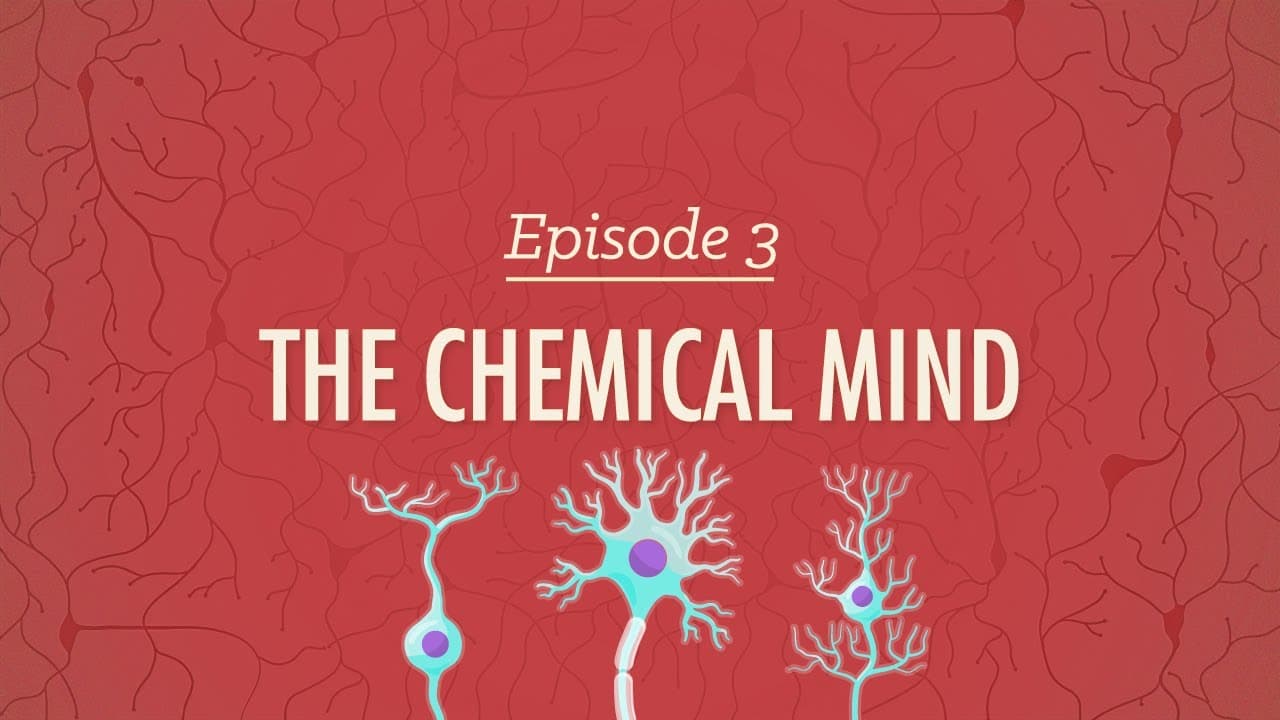
The Chemical Mind: Crash Course Psychology #3
TL;DR
Explores how brain chemicals influence thoughts and actions.
Transcript
Say it's late at night, you're home alone drifting off to sleep, just, entering that dream about Fritos, and then suddenly there's a banging at the door! Suddenly you're wide awake and it feels like your heart's gonna explode. You jump up ready to run out the back door, possibly grab a Phillips head screwdriv... Read More
Key Insights
- The brain's response to fear involves a complex chemical reaction triggered by neurotransmitters and hormones that prepare the body for action.
- Neurons are the fundamental units of the nervous system, transmitting messages through electrical impulses and chemical signals.
- Each neuron consists of three main parts: soma (cell body), dendrites (receivers), and axon (transmitter).
- Synapses are the contact points between neurons where neurotransmitters cross the synaptic gap to relay messages.
- Neurotransmitters can be excitatory, increasing neuron firing, or inhibitory, decreasing neuron activity, affecting mood, memory, and alertness.
- The endocrine system complements the nervous system by releasing hormones that regulate bodily functions over longer periods.
- The pituitary gland is the master gland, controlling other endocrine glands and influencing growth and social bonding.
- The nervous and endocrine systems work together in a feedback loop to regulate the body's response to stimuli.
Install to Summarize YouTube Videos and Get Transcripts
Explore YouTube Video Summarizer or Get YouTube Transcript Extractor
Questions & Answers
Q: What happens in the brain when we get scared?
When we get scared, the brain releases a surge of neurotransmitters and hormones, such as adrenaline, which prepares the body for a fight-or-flight response. This involves increased heart rate, heightened alertness, and energy surge, all orchestrated by the nervous and endocrine systems working together.
Q: How do neurons communicate with each other?
Neurons communicate through a process involving electrical impulses and chemical signals. When a neuron is activated, it sends an electrical charge down its axon to the synapse, where neurotransmitters are released to cross the synaptic gap and bind to receptors on the receiving neuron, transmitting the message.
Q: What roles do neurotransmitters play in the nervous system?
Neurotransmitters are chemical messengers that play crucial roles in the nervous system by transmitting signals between neurons. They can either excite or inhibit neural activity, influencing various functions such as mood, alertness, learning, and memory. Their balance is essential for proper neurological and psychological functioning.
Q: What is the function of the myelin sheath?
The myelin sheath is a protective layer of fatty tissue that surrounds the axon of some neurons. It acts as an insulator, speeding up the transmission of electrical impulses along the axon. This efficient signal transmission is crucial for quick reflexes and coordinated movements, and its degradation can lead to neurological disorders like multiple sclerosis.
Q: How do hormones differ from neurotransmitters?
Hormones differ from neurotransmitters in that they are released by endocrine glands into the bloodstream, affecting distant organs over a longer duration. While neurotransmitters act quickly and locally at synapses, hormones regulate long-term processes such as growth, metabolism, and mood, illustrating the different tempos at which these systems operate.
Q: What is the role of the pituitary gland in the endocrine system?
The pituitary gland, often referred to as the master gland, plays a central role in the endocrine system by controlling other glands. It releases hormones that regulate growth, reproduction, and social bonding. The pituitary gland's influence extends throughout the body, coordinating various physiological processes in response to stimuli.
Q: How do excitatory and inhibitory neurotransmitters affect neural activity?
Excitatory neurotransmitters increase the likelihood of a neuron firing an action potential, thereby enhancing neural activity. In contrast, inhibitory neurotransmitters decrease the likelihood of neuron firing, reducing neural activity. The balance between excitatory and inhibitory signals is crucial for maintaining proper brain function and preventing disorders.
Q: What is the significance of the feedback loop between the nervous and endocrine systems?
The feedback loop between the nervous and endocrine systems is significant because it ensures coordinated regulation of the body's responses to internal and external stimuli. The nervous system can trigger hormonal responses, which in turn influence neural activity, maintaining homeostasis and enabling adaptive behaviors in changing environments.
Summary & Key Takeaways
-
The video explains how the brain's chemical processes influence behavior, focusing on neurons and neurotransmitters. Neurons transmit electrical impulses, while neurotransmitters cross synaptic gaps to relay messages. These chemicals affect mood, alertness, and memory, demonstrating how biological processes underpin psychological phenomena.
-
Neurons consist of soma, dendrites, and axons, working together to transmit signals. Synapses are the junctions where neurotransmitters, acting as chemical messengers, cross to influence neighboring neurons. The video highlights the complexity of these interactions and their impact on emotions and actions.
-
The endocrine system, through hormones, complements the nervous system by regulating long-term bodily functions. The pituitary gland, a key player, controls other glands and influences growth and social behavior. The video illustrates the interplay between the nervous and endocrine systems in managing the body's response to stimuli.
Read in Other Languages (beta)
Share This Summary 📚
Summarize YouTube Videos and Get Video Transcripts with 1-Click
Try YouTube Summary with ChatGPT & Claude or YouTube Transcript Generator
Explore More Summaries from CrashCourse 📚





Summarize YouTube Videos and Get Video Transcripts with 1-Click
Try YouTube Summary with ChatGPT & Claude or YouTube Transcript Generator