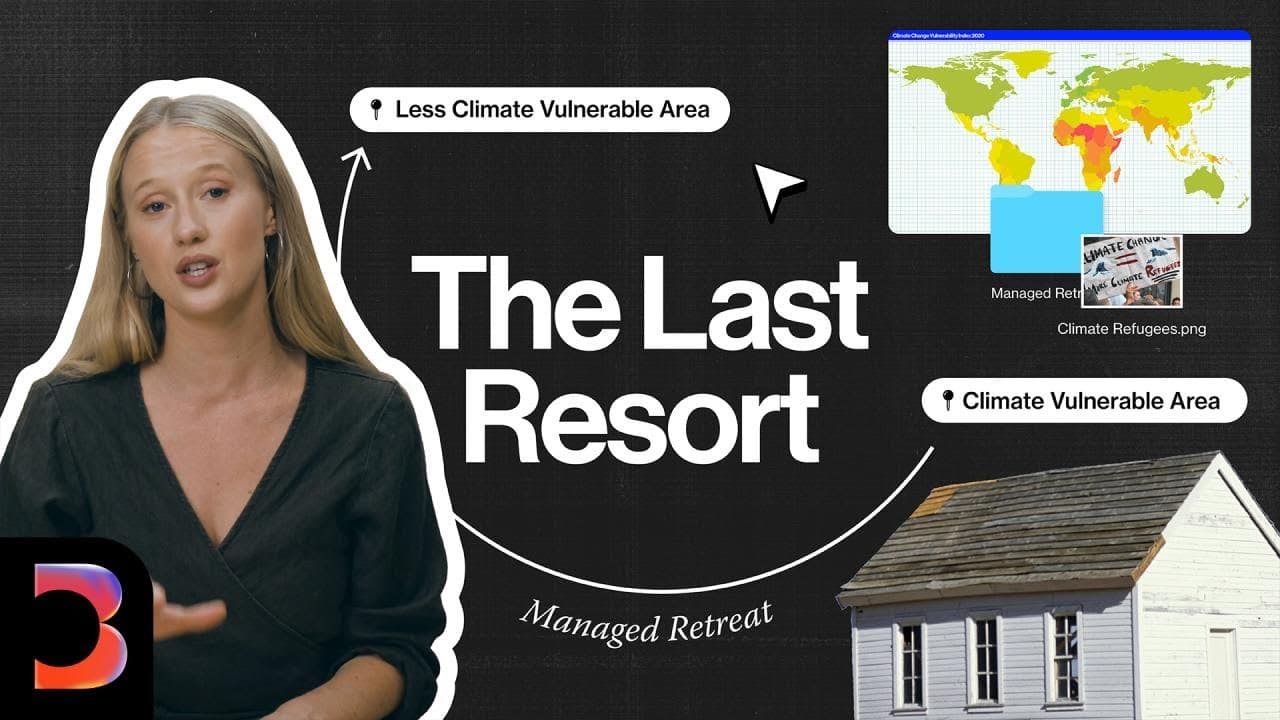
Do We Need to Plan for Managed Retreat?
TL;DR
Managed retreat is essential to address climate migration effectively.
Transcript
You've gone vegan, you recycle your plastic. You always drive electric. You've even replaced holidays with staycations. Welcome, everybody. Welcome to a very spontaneous staycation. Welcome back to another staycation vlog. I'm going on a staycation. It's 2040 and you've done your part in fighting climate change, but it's not enough. You live by the... Read More
Key Insights
- Managed retreat involves relocating communities from climate-vulnerable areas before disasters strike, ensuring safety and sustainability.
- Climate migration is inevitable, with projections of 1.5 billion environmental migrants by 2050 due to rising sea levels and extreme weather.
- Proactive measures, like those in Fiji and Bangladesh, show that managed retreat can be successful with government support and community involvement.
- Managed retreat presents challenges, including social justice issues, funding, and preserving cultural and family ties.
- The concept of managed retreat is often seen as radical, but it is becoming a necessary strategy as climate change impacts intensify.
- Inadequate funding and resources, especially in lower-income countries, hinder effective implementation of managed retreat strategies.
- Successful managed retreat requires community engagement, empowerment, and resources to improve social, ecological, and health outcomes.
- Addressing climate migration requires a global effort, as it is a crisis that affects everyone, demanding sustainable and just solutions.
Install to Summarize YouTube Videos and Get Transcripts
Explore YouTube Video Summarizer or Get YouTube Transcript Extractor
Questions & Answers
Q: What is managed retreat?
Managed retreat is the proactive relocation of communities from climate-vulnerable areas before disasters strike. It involves government support and community involvement to ensure safety and sustainability, addressing the impacts of climate change like rising sea levels and extreme weather.
Q: Why is managed retreat considered necessary?
Managed retreat is necessary due to the inevitability of climate migration, with projections of 1.5 billion environmental migrants by 2050. It provides a strategic approach to address the impacts of climate change, ensuring communities' safety and sustainability before disasters occur.
Q: What are the challenges of implementing managed retreat?
Implementing managed retreat presents challenges such as preserving cultural and family ties, addressing social justice issues, securing funding, and ensuring equitable solutions. It requires global cooperation and adequate resources, especially for lower-income countries, to support communities effectively.
Q: How has managed retreat been successfully implemented?
Successful implementation of managed retreat involves government support, community involvement, and proactive measures. Examples in Fiji and Bangladesh demonstrate that consulting communities, empowering them to make decisions, and providing necessary resources can lead to improved social, ecological, and health outcomes.
Q: What role does government support play in managed retreat?
Government support is crucial in managed retreat, providing necessary resources, funding, and policy frameworks. It helps in planning and executing relocation strategies, ensuring communities have the means to move safely and sustainably, as seen in the successful examples of Fiji and Bangladesh.
Q: What are the social justice issues related to managed retreat?
Social justice issues in managed retreat involve questions of who decides relocation, who bears the cost, and how to ensure equitable solutions. It requires careful consideration to avoid widening historic inequalities and to support vulnerable communities effectively during the relocation process.
Q: Why is global cooperation important in addressing climate migration?
Global cooperation is vital in addressing climate migration because it is a global crisis impacting everyone. Collaborative efforts ensure adequate funding, resource sharing, and support for lower-income countries, enabling them to implement effective managed retreat strategies and adapt to climate change impacts.
Q: How can managed retreat contribute to a sustainable future?
Managed retreat can contribute to a sustainable future by allowing intentional design of new communities that are resilient to climate impacts. It offers an opportunity to avoid salvaging the status quo and instead focus on creating equitable, sustainable, and just solutions for affected populations globally.
Summary & Key Takeaways
-
Managed retreat involves relocating communities from climate-vulnerable areas before disasters strike, allowing for proactive adaptation to climate change. Successful examples in Fiji and Bangladesh highlight the importance of government support and community involvement, despite the challenges posed by social justice issues and funding shortages.
-
Climate migration is a growing inevitability, with 1.5 billion environmental migrants projected by 2050. Managed retreat, although seen as radical, is becoming necessary to address the impacts of rising sea levels and extreme weather, ensuring safety and sustainability for affected communities.
-
The implementation of managed retreat requires addressing complex challenges, such as preserving cultural ties and ensuring equitable solutions. Global cooperation and adequate funding are crucial, especially for lower-income countries, to support communities in adapting to the realities of climate change.
Read in Other Languages (beta)
Share This Summary 📚
Summarize YouTube Videos and Get Video Transcripts with 1-Click
Try YouTube Summary with ChatGPT & Claude or YouTube Transcript Generator
Explore More Summaries from Bloomberg Originals 📚






Summarize YouTube Videos and Get Video Transcripts with 1-Click
Try YouTube Summary with ChatGPT & Claude or YouTube Transcript Generator