Can Warp Drives Enable Faster Than Light Travel?
TL;DR
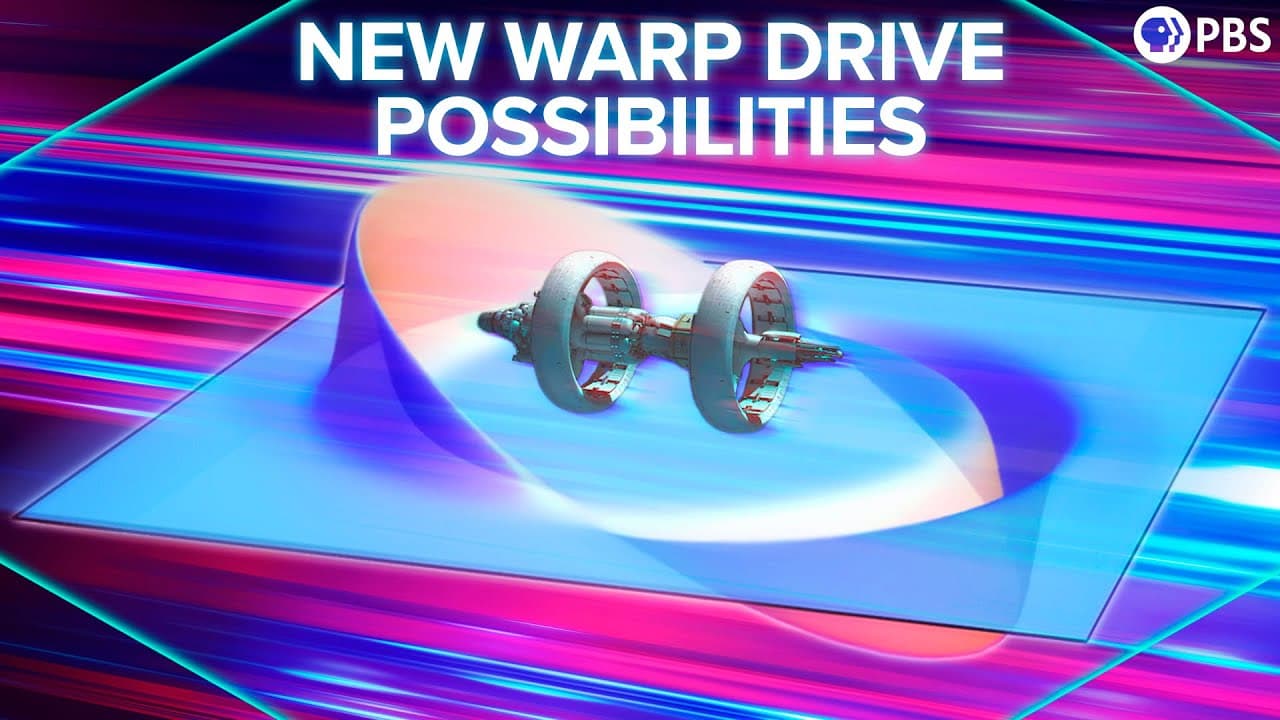
Recent studies suggest that warp drives, once considered purely science fiction, might be theoretically possible. These drives work by warping space-time, allowing a spacecraft to travel faster than light without violating Einstein's speed limit. However, challenges such as the need for exotic matter and immense energy remain unresolved.
Transcript
That Einstein guy was a real bummer for our hopes of a star-hopping, science-fiction-y future. His whole “nothing travels faster than light” rule seems to ensure that exploration of even the local part of our galaxy will be an excruciating slow. But Einstein also gave us a glimmer of hope. He showed us that space and time can be warped - and so the... Read More
Key Insights
- Einstein's theory of relativity allows space-time to be warped, hinting at faster-than-light travel.
- Warp drives work by expanding space behind and contracting space in front of a spacecraft.
- The Alcubierre warp drive is a theoretical solution that requires exotic matter with negative energy.
- Recent papers suggest potential solutions to some theoretical problems of warp drives.
- Bobrick and Martire propose a general definition for warp fields that move inertially.
- Erik Lentz's paper suggests a warp field solution without negative energy densities.
- Superluminal travel using warp drives still faces unresolved challenges like energy requirements.
- Warp drives could theoretically allow reaction-less propulsion, moving without expelling mass.
Install to Summarize YouTube Videos and Get Transcripts
Explore YouTube Video Summarizer or Get YouTube Transcript Extractor
Questions & Answers
Q: How do warp drives theoretically allow faster-than-light travel?
Warp drives theoretically allow faster-than-light travel by manipulating space-time itself. Rather than moving an object through space faster than light, they expand space behind the object and contract space in front of it. This creates a 'warp bubble' that carries the object at superluminal speeds relative to outside observers, without the object itself breaking the light speed barrier.
Q: What are the main challenges in developing a practical warp drive?
The main challenges in developing a practical warp drive include the requirement for exotic matter with negative energy density, which may not exist, and the immense amount of energy needed to create and sustain a warp bubble. Additionally, theoretical issues such as causality violations and the inability to steer or accelerate the warp bubble from subluminal to superluminal speeds remain unresolved.
Q: What is the Alcubierre drive and how does it work?
The Alcubierre drive is a theoretical concept for a warp drive proposed by physicist Miguel Alcubierre. It involves creating a warp bubble in space-time where space is expanded behind a spacecraft and contracted in front, allowing the spacecraft to move faster than light relative to outside observers. This concept requires exotic matter with negative energy to function, making it currently impractical.
Q: How do recent studies propose to overcome the challenges of warp drives?
Recent studies propose different theoretical frameworks to address warp drive challenges. Bobrick and Martire suggest a general definition for warp fields, focusing on inertially moving shells rather than specific solutions. Erik Lentz proposes a warp field solution that does not require negative energy densities by exploring a broader family of solutions to the Einstein field equations. However, these solutions still face significant challenges, such as energy requirements.
Q: What is the significance of exotic matter in warp drive theories?
Exotic matter, with negative energy density, is crucial in traditional warp drive theories because it allows the manipulation of space-time in a way that permits faster-than-light travel. It is used to create the necessary space-time geometry for a warp bubble. However, the existence of such matter is highly speculative, and its practical generation and use pose significant scientific and technological challenges.
Q: Can warp drives be used for reaction-less propulsion?
Warp drives could theoretically enable reaction-less propulsion, meaning they could move without expelling mass, unlike conventional rockets. This is because they manipulate space-time itself to move a spacecraft. However, even subluminal warp drives, which could provide this type of propulsion, would still require exotic matter and immense energy, making them currently impractical.
Q: What are the implications of faster-than-light travel on causality?
Faster-than-light travel, as proposed by warp drive theories, could violate causality, leading to paradoxes such as time travel. This is because superluminal speeds could allow information or objects to arrive before they were sent, creating contradictions. Such issues suggest that either faster-than-light travel is impossible, or our understanding of physics needs to be fundamentally revised to accommodate these phenomena.
Q: How do warp drives relate to science fiction?
Warp drives are a popular concept in science fiction, often depicted as a means for spacecraft to travel vast interstellar distances quickly. The idea captures the imagination by suggesting that humanity could explore the galaxy despite the light speed limit. While current scientific theories explore the possibility of warp drives, practical implementation remains speculative and faces significant theoretical and technological hurdles.
Summary & Key Takeaways
-
Einstein's theories suggest space-time can be warped, potentially allowing faster-than-light travel. Warp drives, like the Alcubierre drive, theoretically achieve this by expanding space behind and contracting it in front of a spacecraft. However, they require exotic matter and immense energy, making them currently impractical.
-
Recent studies propose new theoretical frameworks for warp drives. Bobrick and Martire define warp fields as inertially moving shells, while Erik Lentz suggests a solution without negative energy. These proposals address some theoretical issues but still face challenges, such as energy requirements and achieving superluminal speeds.
-
Despite theoretical advancements, practical warp drives remain elusive. Challenges include creating necessary energy densities and overcoming causality issues related to faster-than-light travel. Nonetheless, ongoing research continues to explore these possibilities, driven by both scientific curiosity and science fiction aspirations.
Read in Other Languages (beta)
Share This Summary 📚
Summarize YouTube Videos and Get Video Transcripts with 1-Click
Try YouTube Summary with ChatGPT & Claude or YouTube Transcript Generator
Explore More Summaries from PBS Space Time 📚


Summarize YouTube Videos and Get Video Transcripts with 1-Click
Try YouTube Summary with ChatGPT & Claude or YouTube Transcript Generator