What Are Carboxylic Acid Derivatives and Their Reactions?
TL;DR
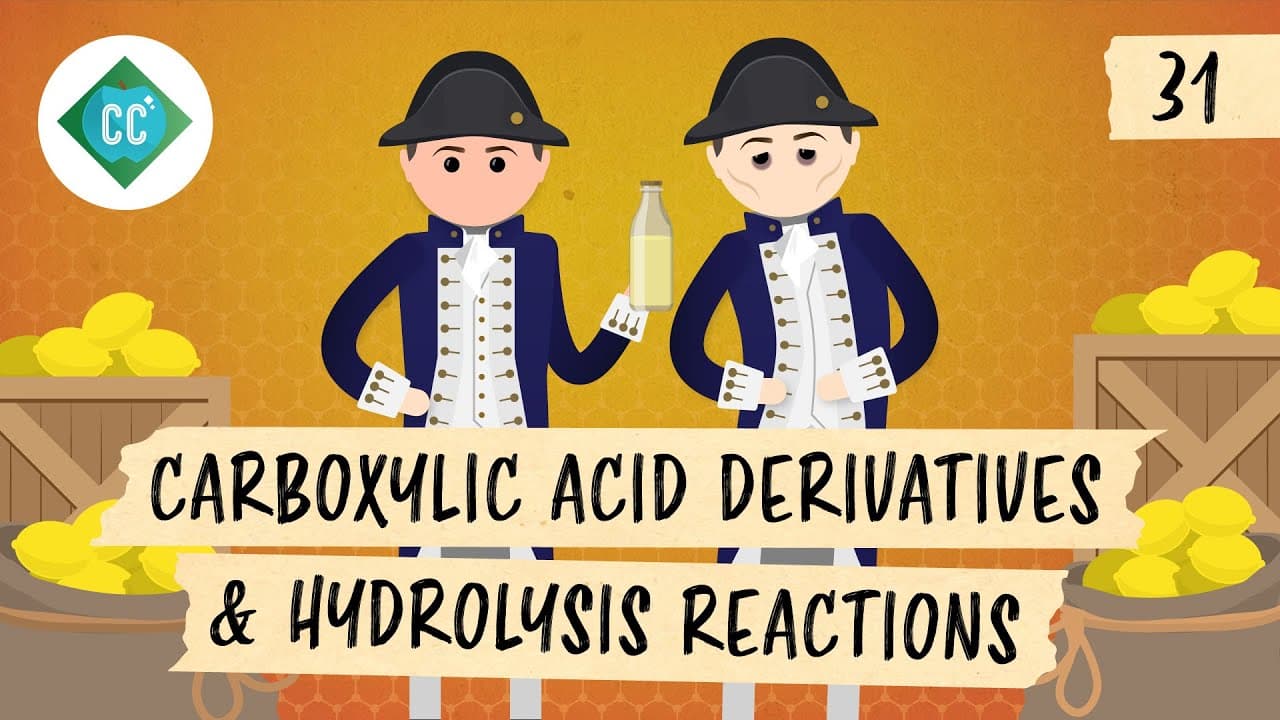
Carboxylic acid derivatives, including esters, amides, anhydrides, and acid chlorides, exhibit different reactivity due to inductive and resonance effects. Nucleophilic acyl substitution is a key reaction mechanism for these derivatives, facilitating the formation of carboxylic acids through hydrolysis, which is crucial in both biological processes and industrial applications like soap and plastic production.
Transcript
You can review content from Crash Course Organic Chemistry with the Crash Course App, available now for Android and iOS devices. Hi! I’m Deboki Chakravarti and welcome to Crash Course Organic Chemistry! Esters are found in the perfumes and colognes we wear, as well as in the fragrances of flowers and some fruits. For example, oranges contain o... Read More
Key Insights
- ⚾ Esters and amides have different reactivity levels based on inductive and resonance effects.
- ❓ Acid chlorides are the most reactive carboxylic acid derivatives.
- 🧼 Hydrolysis reactions are important in the synthesis and breakdown of biological molecules and in the production of plastics and soaps.
- 👥 Acid-catalyzed hydrolysis reactions involve protonation and elimination of a leaving group.
Install to Summarize YouTube Videos and Get Transcripts
Explore YouTube Video Summarizer or Get YouTube Transcript Extractor
Questions & Answers
Q: What are some examples of carboxylic acid derivatives and their uses?
Some examples include esters in perfumes and fragrances, amides in proteins and fats, and acid chlorides in the synthesis of plastics.
Q: How do acid-chlorides and esters differ in reactivity?
Acid chlorides are more reactive due to strong inductive effects and poor resonance effects, while esters have lower reactivity but can still undergo nucleophilic acyl substitution reactions.
Q: How are hydrolysis reactions important in our bodies?
Hydrolysis reactions of esters and amides occur in the digestion of fats and proteins, allowing them to be broken down into smaller molecules for energy or use in cell repair and growth.
Q: What is the difference between base-catalyzed and acid-catalyzed hydrolysis reactions?
Base-catalyzed hydrolysis reactions involve the attack of a hydroxide ion on the carbonyl carbon, while acid-catalyzed hydrolysis reactions involve protonation of the carbonyl oxygen and subsequent elimination of a leaving group.
Summary & Key Takeaways
-
Carboxylic acid derivatives, including esters and amides, have different reactivity levels based on their structures and resonance effects.
-
Nucleophilic acyl substitution reactions can be used to add groups to the carbonyl carbon of carboxylic acid derivatives.
-
Hydrolysis reactions, such as ester hydrolysis and amide hydrolysis, are important in the synthesis and breakdown of biological molecules and in the production of plastics and soaps.
Read in Other Languages (beta)
Share This Summary 📚
Summarize YouTube Videos and Get Video Transcripts with 1-Click
Try YouTube Summary with ChatGPT & Claude or YouTube Transcript Generator
Explore More Summaries from CrashCourse 📚





Summarize YouTube Videos and Get Video Transcripts with 1-Click
Try YouTube Summary with ChatGPT & Claude or YouTube Transcript Generator