Lecture 03
TL;DR
Discusses various investment decision rules including NPV, IRR, and payback period.
Transcript
thank you making investment decisions shareholders of a firm would like managers to invest in positive npv projects to increase the firm value thus managers can support the cause of owners by selecting positive npv projects and rejecting negative npv projects we start the discussion by reviewing our good old npb rule then we turn to some other of a... Read More
Key Insights
- The NPV rule is a fundamental investment decision criterion, emphasizing the time value of money and future cash flows to determine project viability.
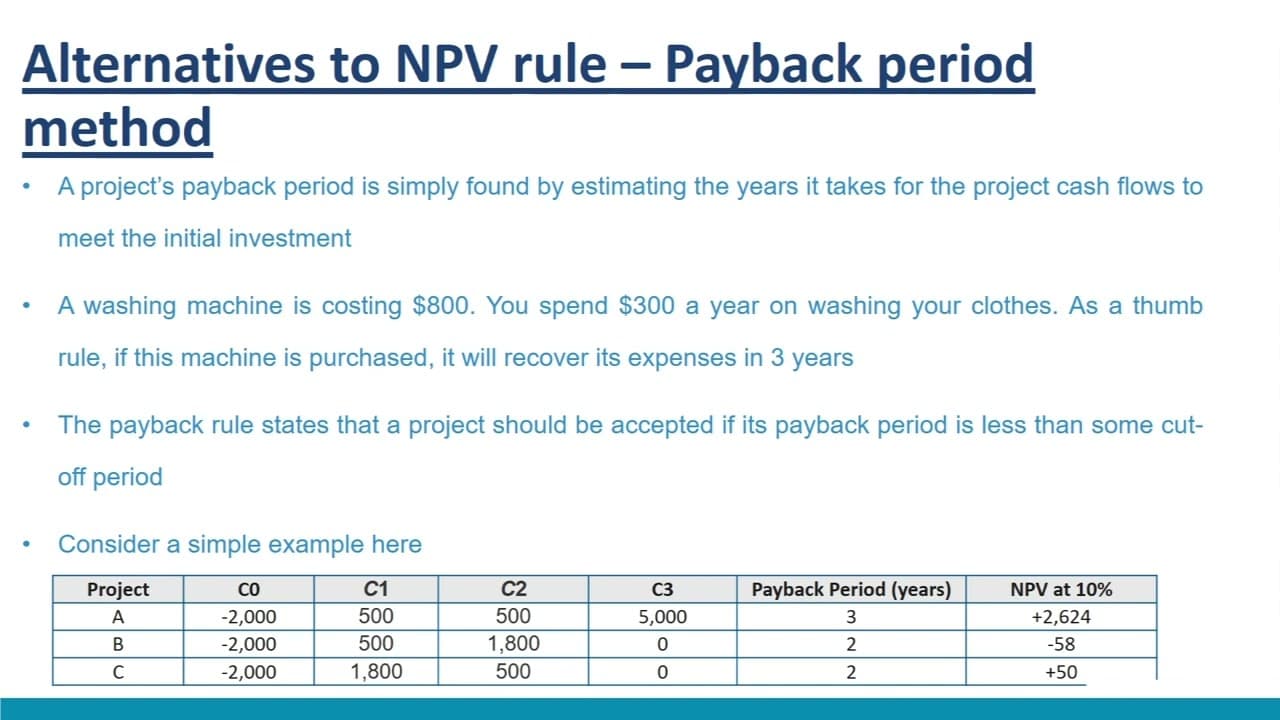
- Payback period methods are simple but often misleading as they ignore cash flows beyond the cutoff period and do not account for the time value of money.
- The internal rate of return (IRR) is a popular measure, but it can contradict NPV results, especially in cases of borrowing or multiple cash flow sign changes.
- IRR pitfalls include issues with lending versus borrowing, multiple IRRs, and mutually exclusive projects, requiring careful interpretation.
- Capital rationing necessitates prioritizing projects based on profitability index, which ranks projects by NPV per dollar invested.
- Linear programming techniques are recommended for complex capital rationing scenarios with multiple constraints and time periods.
- Book rate of return is less reliable due to its dependency on accounting classifications and depreciation rates.
- Decision rules like IRR and payback period provide quick assessments but may not fully capture the long-term value of projects compared to NPV.
Install to Summarize YouTube Videos and Get Transcripts
Explore YouTube Video Summarizer or Get YouTube Transcript Extractor
Questions & Answers
Q: What is the main advantage of the NPV rule?
The main advantage of the NPV rule is its incorporation of the time value of money, which allows it to account for the present value of future cash flows. This makes it a reliable criterion for evaluating investment projects, as it provides a clear indication of whether a project will add value to the firm.
Q: Why is the payback period method considered less reliable?
The payback period method is considered less reliable because it ignores cash flows that occur after the cutoff period and does not consider the time value of money. This can lead to misleading results, as it may favor projects that quickly recover initial investments but do not offer long-term value.
Q: What are the key pitfalls of using IRR as a decision rule?
Key pitfalls of using IRR include issues with lending versus borrowing, where IRR interpretation must be reversed, multiple IRRs due to changes in cash flow signs, and its potential to mislead in mutually exclusive projects. These limitations necessitate careful consideration when using IRR for project evaluation.
Q: How does capital rationing affect project selection?
Capital rationing affects project selection by limiting the number of projects a firm can undertake due to resource constraints. Firms must prioritize projects that offer the highest NPV per dollar invested, often using the profitability index. Complex scenarios may require linear programming to optimize project selection across multiple periods.
Q: What role does the profitability index play in capital rationing?
The profitability index plays a crucial role in capital rationing by ranking projects based on their NPV per dollar invested. This helps firms prioritize projects that provide the maximum return for limited capital resources, ensuring that the most valuable projects are selected when capital is scarce.
Q: Why might linear programming be necessary in capital rationing?
Linear programming may be necessary in capital rationing when there are multiple constraints or time periods involved. It provides a more general solution for optimizing project selection, ensuring that the firm maximizes its returns while adhering to budgetary and resource limitations across different periods.
Q: How does the book rate of return differ from other decision rules?
The book rate of return differs from other decision rules as it relies on accounting measures like book income and book value of investment, which can be influenced by accounting classifications and depreciation rates. This makes it less reliable compared to NPV or IRR, which focus on cash flows and time value of money.
Q: In what scenarios might IRR provide misleading results?
IRR might provide misleading results in scenarios involving lending versus borrowing, projects with multiple cash flow sign changes leading to multiple IRRs, and mutually exclusive projects where NPV might suggest a different ranking. These situations require careful interpretation to avoid incorrect investment decisions.
Summary & Key Takeaways
-
The video discusses the importance of the NPV rule in investment decisions, emphasizing its ability to account for the time value of money and future cash flows. It highlights the limitations of alternative methods like payback period and book rate of return.
-
IRR is explored as a popular project evaluation measure, though it can sometimes contradict NPV results. The video identifies pitfalls of IRR, such as issues with lending versus borrowing, multiple IRRs, and mutually exclusive projects.
-
Capital rationing is addressed through the profitability index, which ranks projects by NPV per dollar invested. For complex scenarios with multiple constraints, linear programming techniques are recommended for optimal project selection.
Read in Other Languages (beta)
Share This Summary 📚
Summarize YouTube Videos and Get Video Transcripts with 1-Click
Try YouTube Summary with ChatGPT & Claude or YouTube Transcript Generator
Explore More Summaries from IIT KANPUR-NPTEL 📚






Summarize YouTube Videos and Get Video Transcripts with 1-Click
Try YouTube Summary with ChatGPT & Claude or YouTube Transcript Generator