How to Estimate Company Cost of Capital
TL;DR
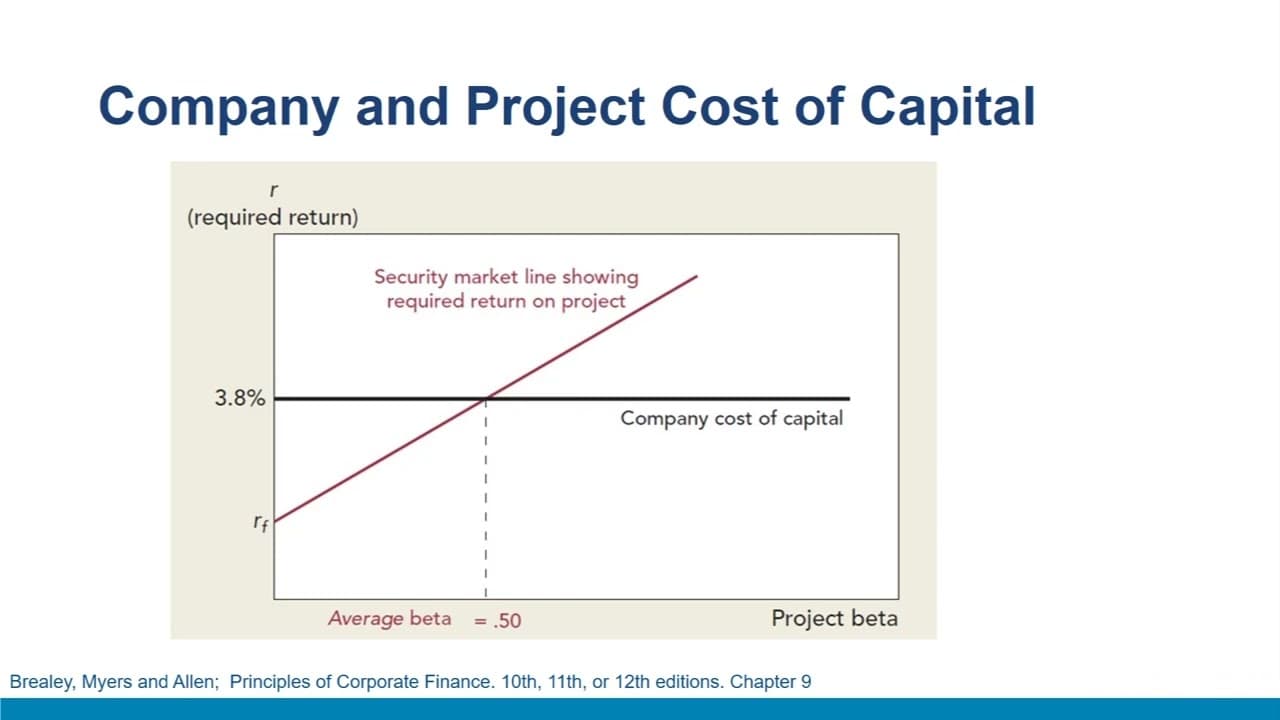
Estimating the company cost of capital involves calculating a weighted average of the cost of debt and equity, considering tax implications. This rate is used as a benchmark for average-risk projects, but adjustments are needed for projects with different risk profiles. Capital Asset Pricing Model (CAPM) is often used to estimate the cost of equity, but care must be taken to adjust for project-specific risks.
Transcript
thank you before development of the modern theories about risk and written Financial managers always knew that risky projects are less valuable than safe projects thus they demanded herits of return from Risky projects or accounting for the risk of these projects through more conservative forecasts of projected cash flows modern organizations make ... Read More
Key Insights
- The company cost of capital is a benchmark for average-risk projects, reflecting the expected return on a portfolio of the company's securities.
- Weighted average cost of capital (WACC) combines the cost of debt and equity, adjusted for tax effects, to estimate the firm's overall cost of capital.
- CAPM is used to estimate the cost of equity, incorporating the risk-free rate, beta, and market risk premium.
- Project-specific risk must be considered, as using a single company-wide cost of capital can lead to misvaluation of projects with different risk profiles.
- Asset beta reflects the average risk of a firm's business and is used to evaluate project risk, considering factors like cyclicality and operating leverage.
- Diversifiable risk should not affect the discount rate; instead, it should be incorporated into cash flow forecasts.
- Certainty equivalents offer a way to adjust for risk by converting expected cash flows into guaranteed amounts, discounted at the risk-free rate.
- Using a constant risk-adjusted discount rate assumes cumulative risk increases at a constant rate, which may not always be appropriate.
Install to Summarize YouTube Videos and Get Transcripts
Explore YouTube Video Summarizer or Get YouTube Transcript Extractor
Questions & Answers
Q: How to calculate the weighted average cost of capital (WACC)?
WACC is calculated by taking the weighted average of the cost of debt and the cost of equity, adjusted for taxes. The formula is: WACC = (E/V) * Re + (D/V) * Rd * (1-Tc), where E is the market value of equity, V is the total value of equity and debt, Re is the cost of equity, D is the market value of debt, Rd is the cost of debt, and Tc is the tax rate.
Q: What is the role of CAPM in estimating the cost of equity?
CAPM is used to estimate the cost of equity by relating expected returns to risk. The formula is: Expected Return = Risk-Free Rate + Beta * (Market Return - Risk-Free Rate). This model helps determine the appropriate return for the risk taken, using beta to measure the stock's sensitivity to market movements.
Q: Why is it important to adjust the discount rate for project-specific risks?
Adjusting the discount rate for project-specific risks is crucial because using a single company-wide cost of capital can lead to incorrect valuations. Projects with higher risk than the company's average should have a higher discount rate, while safer projects should have a lower rate, ensuring accurate assessment of potential returns and risks.
Q: How does operating leverage affect project risk?
Operating leverage affects project risk by amplifying the impact of revenue changes on operating income. High fixed costs relative to variable costs result in high operating leverage, increasing the project's beta and risk. This requires a higher discount rate to compensate for the additional risk associated with fixed costs.
Q: What is the significance of asset beta in project evaluation?
Asset beta measures the risk of a firm's business activities and helps evaluate project risk by considering factors like cyclicality and operating leverage. It provides a benchmark for comparing the project's risk to the firm's average risk, aiding in determining the appropriate discount rate for project valuation.
Q: How should diversifiable risk be accounted for in project valuation?
Diversifiable risk should be reflected in cash flow forecasts rather than the discount rate. This involves preparing unbiased forecasts that consider all possible outcomes, ensuring that the valuation accurately reflects the project's expected cash flows without inflating the discount rate for risks that can be diversified away.
Q: What are certainty equivalents and how are they used in project valuation?
Certainty equivalents convert expected cash flows into guaranteed amounts that reflect the same present value when discounted at the risk-free rate. This method separates risk and time adjustments, offering a clearer view of the risk-adjusted value of cash flows, particularly when project risk changes over time.
Q: When is it inappropriate to use a constant risk-adjusted discount rate?
Using a constant risk-adjusted discount rate is inappropriate when project risk does not increase steadily over time. In such cases, breaking the project into segments with consistent risk levels or using certainty equivalents allows for more accurate valuation by applying different discount rates that reflect changing risk profiles.
Summary & Key Takeaways
-
Company cost of capital is a key metric for evaluating investment projects, calculated as a weighted average of debt and equity costs. It's suitable for average-risk projects, but individual project risks require tailored adjustments.
-
CAPM helps estimate the cost of equity, requiring inputs like the risk-free rate, beta, and market risk premium. Accurate estimation of these components is crucial for reliable capital cost assessments.
-
Project risk evaluation involves understanding market risk, operating leverage, and cyclicality. Diversifiable risks should be reflected in cash flow forecasts, not in discount rates, to avoid misvaluation.
Read in Other Languages (beta)
Share This Summary 📚
Summarize YouTube Videos and Get Video Transcripts with 1-Click
Try YouTube Summary with ChatGPT & Claude or YouTube Transcript Generator
Explore More Summaries from IIT KANPUR-NPTEL 📚



Summarize YouTube Videos and Get Video Transcripts with 1-Click
Try YouTube Summary with ChatGPT & Claude or YouTube Transcript Generator