Vulnerabilties of OSI Model | Cryptography and Network Security
TL;DR
This content discusses the vulnerabilities and difficulties faced by the seven layers of the OSI model, and the types of attacks that can occur at each layer.
Transcript
hello let's begin with the vulnerabilities of all inside model in the previous two video lectures we have seen what the Poisson model is and what are the different layer wise functionalities of all the seven layers are phone cell model in this video lecture will you seen what are the difficulties faced faced by the seven layers of holy sign model a... Read More
Key Insights
- 🥺 The physical layer of the OSI model is susceptible to disruptions and environmental issues that can lead to denial of service attacks.
- 🌱 Vulnerabilities at the data link layer can be mitigated through hardening switches and implementing effective security on wireless LANs.
- 👊 Routing attacks and IP address spoofing are potential threats at the network layer, and can be minimized through hardened routers and packet filtering controls.
- 👊 Securing ports and implementing firewalls are crucial to avoiding attacks at the transport layer.
- 🔒 Session hijacking and SSL hijacking are security threats that can occur at the session and presentation layers, respectively.
Install to Summarize YouTube Videos and Get Transcripts
Explore YouTube Video Summarizer or Get YouTube Transcript Extractor
Questions & Answers
Q: What types of attacks can happen at the physical layer of the OSI model?
Attacks on the physical layer can include denial of service caused by physical disruptions or environmental issues like earthquakes, floods, or temperature fluctuations.
Q: How can the network layer mitigate routing attacks?
The network layer can minimize routing attacks by hardening routers, implementing packet filtering controls, and controlling routing information.
Q: What is session hijacking and how does it happen?
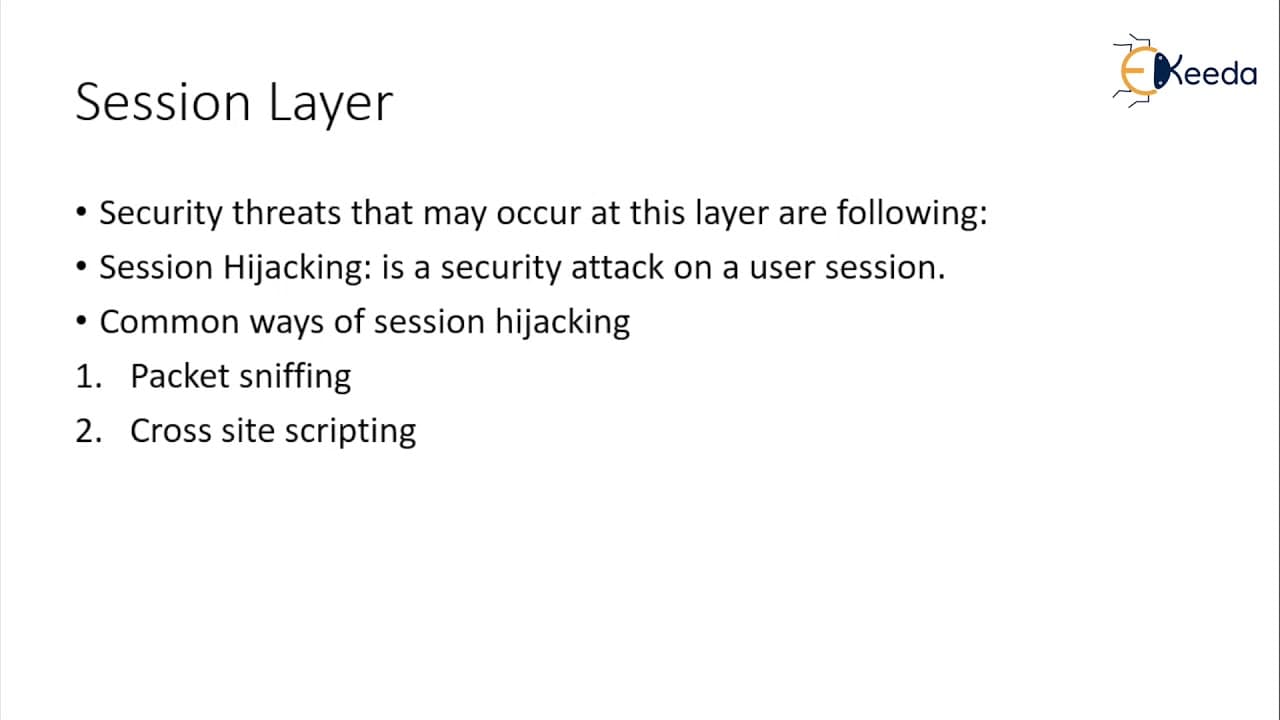
Session hijacking is when an attacker intercepts the session ID exchanged between two communicating parties. This can be done through packet sniffing or cross-site scripting.
Q: How can developers reduce the vulnerability of the presentation layer to SSL hijacking?
Developers should follow best practice development guides and adhere to ISO standards to ensure proper validation and security measures to prevent SSL hijacking.
Summary & Key Takeaways
-
The physical layer of the OSI model deals with the physical setup of the network and can face attacks such as denial of service caused by physical disruptions or environmental issues.
-
The data link layer can be vulnerable to ARP spoofing, MAC flooding, and spanning tree attacks, which can be mitigated through hardening switches and enforcing effective security on wireless LANs.
-
The network layer may experience routing attacks and IP address spoofing, which can be minimized through hardened routers and packet filtering controls.
-
The transport layer can face sync flood and smurf attacks, which can be avoided by securing ports and implementing effective firewalls.
-
The session layer is susceptible to session hijacking through packet sniffing and cross-site scripting.
-
The presentation layer can be attacked through SSL hijacking to extract encrypted data.
-
The application layer is vulnerable to virus attacks, worm attacks, phishing, and keyloggers, among others.
Read in Other Languages (beta)
Share This Summary 📚
Summarize YouTube Videos and Get Video Transcripts with 1-Click
Try YouTube Summary with ChatGPT & Claude or YouTube Transcript Generator
Explore More Summaries from Ekeeda 📚






Summarize YouTube Videos and Get Video Transcripts with 1-Click
Try YouTube Summary with ChatGPT & Claude or YouTube Transcript Generator